|

|
|
Building bridges through
'Inner
Architecture'
- September 2002
A personal reporting by Peter
Anderschitz on the International Forum of Young Architects (IFYA) with
focus on Auroville's International Zone. This annual international design forum
took place in Auroville under the label of 'Inner Architecture' from Sept. 15th
until 29th 2002.
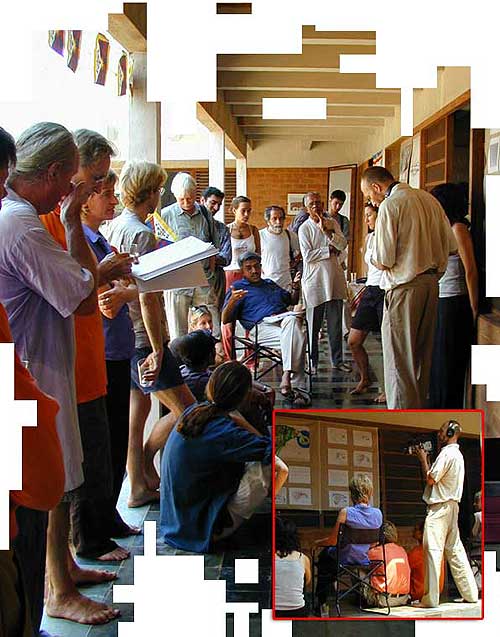
Why they came..?
Why they all came together - with a lot of effort from
both the participants and the organisers - and for a rather unknown adventure?
Those young professional architects from far away: from Vietnam, Germany, USA;
as well as those young architecture students from India and Europe who by
joining unexpectedly added even more spice to the learning exercise..?
They came to learn from each other and from this richly
inspiring environment called Auroville, which is a City with a Vision, yes, but
also a place and a people just beginning to learn how to become citizens - of a
new world.. They came to learn, and it turned out that everybody, participants
and organisers, became student during these two weeks.
An other dimension to architecture
Naturally, the intention and the topic of the forum 'Inner
Architecture', was the signal and call to look for another dimension to
architecture, and urban and environmental design, with another intention,
another way of action. Focusing the work on Auroville's International Zone,
which only recently got another push by the AVI
Centres expressing the need for a more dynamic communication and interaction
of Auroville in the world at large, the forum provided the collective flesh to
the topic: how to leave room, or create space, for the soul-aspect of
nation-cultures to be expressed, to become an essential part of the City's inner
platform for the realisation of human unity in diversity?
Lively Auroville scenario
Having said all that, the IFYA event then became indeed a
living example of an ideal Auroville scenario: a creative exchange and
interaction between all participants with most diverse backgrounds in an
atmosphere of non-competitiveness and sharing.
And of course, the two-week seminar could take advantage
from the best that Auroville has to offer: the Pavilion of Tibetan Culture
providing the workplace, excursions touching Auroville's ground realities and
life experiences, informal lectures and exercises as introduction to the topic,
interviews and presentations by 'core' Aurovilians pertaining to the issue, a
workshop experiencing the 'Architecture of the Body', and very positive response
and support by those Auroville working groups and individuals which are
particularly involved with the development of the International Zone.
Let's have a look at what happened
These two weeks, enhanced by Auroville's pulsating energy
field, provided a time-slot with an intense mixture of parallel and exiting use
of astonishingly different working tools and media of expression, from hi-tech
to ground-stuff; interwoven with Tibetan chants, the heat, the power cuts -or
ego cuts- into the flow of energy; at times the pressing need for inspiring
guidance; an opening up inner and outer spaces so as to concentrate, share,
meditate...
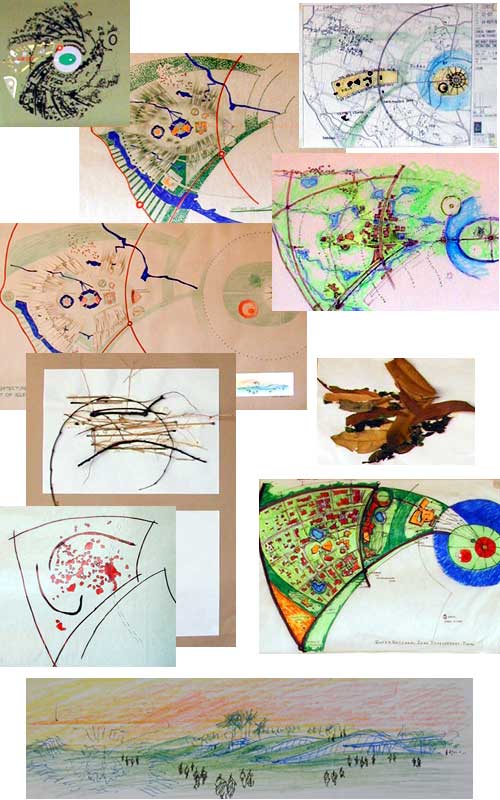
Working results
Surprisingly, six of the seven individual design proposals
eventually developed a common 'attitude', coming very close to merging into one
single concept including the following features:
-
Respect for the land and for the original vision of
Auroville's Galaxy town plan as a potentially powerful formation.
-
Adopting the concept of a free positioning of
national-cultural pavilions, supported by an understanding of Sri
Aurobindo's 'ideal of the free grouping of mankind' as a guiding principle -
where deeper affinities can emerge to get then formulated in the process of
positioning. For this to happen, interesting variations were proposed in
regard to integrating the various 'pavilions': One option saw a
transportation loop connecting all pavilions in an open landscaped park, and
the other worked through a flow of spaces covered by landscaped roofs under
which each 'pavilion' can find its proper place, while all together comprise
a peaceful valley, open towards the Matrimandir.
Other approaches concentrated rather on intuitive methods
for planning, on development processes and growth-patterns: suggesting
concentrated development in a unifying way along the educational 'focal-points',
in order for the pavilions to reach out from there.
Résumé
'Inner Architecture' means first of all an attitude to
build from within, from an inner source. From that space, a good spirit of
working together emerged, producing fresh insights into the challenging work of
developing the International Zone. Vice versa, the participants carried some of
that spirit back to their home countries.
However, and sadly enough, from Auroville's many
architects only a few expressed interest. Were they too busy with 'reality', is
'envisioning the City of the Future' nowadays neither reasonable nor affordable?
And couldn't an exercise like this be seen as one of
many more to come, a living part of an international school of architecture to
come? Not only about producing, but also about inducing results?
Contact: peter auroville.org.in auroville.org.in
|
|
|