|
Nishtha
The strange disappearance of Margaret Woodrow Wilson
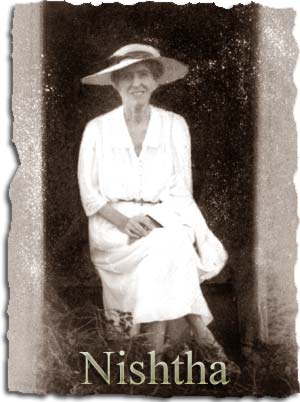 Nishtha is the story of Margaret Woodrow Wilson, daughter of the 28th
President of the United States of America, Woodrow Wilson, (1913-1921)
whose vision and commitment to world unity eventually lead to the
formation of the 'League of Nations'. Nishtha is the story of Margaret Woodrow Wilson, daughter of the 28th
President of the United States of America, Woodrow Wilson, (1913-1921)
whose vision and commitment to world unity eventually lead to the
formation of the 'League of Nations'.
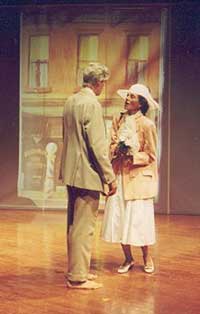
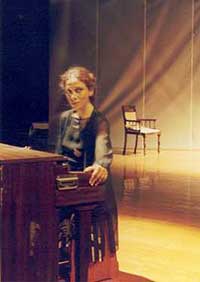
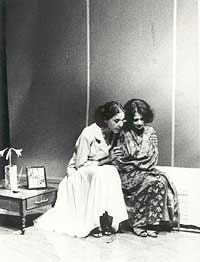
The play was written by Aurovilian Seyril Schochen, American playwright
and actress, and has been performed on various occasions, most recently
by the Auroville Theatre Group in Auroville, directed by Jill Navarre,
American Aurovilian who has worked in theatre since 1977.
Margaret Woodrow Wilson
Margaret was an intelligent, capable, fiery woman of her times, a
suffragette, and a famous concert singer. During the First World War she
toured around America singing to raise funds for the Red Cross, and went
to sing at the frontiers of war-torn France as a way of giving her
support and making a contribution to the cause.
Connection with Sri Aurobindo and the Mother
 She was first introduced to eastern mysticism by her friend Eliot, an
English army officer and follower of Sri Ramakrishna.
She was first introduced to eastern mysticism by her friend Eliot, an
English army officer and follower of Sri Ramakrishna.
In 1936 she discovered Sri Aurobindo's 'Essays on the Gita' at the New
York City Public Library and was so taken by it that the guards had to
more or less throw her out at closing time. She returned eagerly the
next day and continued to do so until she had read through the book. To
her great joy, she realised that at long last she had found her path and
her guru.
She took up correspondence with the Mother and Sri Aurobindo and was
anxious to be near them in order to receive their help and guidance for
her inner progress. They advised her to "remain in America due to
(her) ill health but to establish an inner contact". Sri Aurobindo
also wrote to her that "The silent answer and help can always go to
you immediately - for there distance doesn't count".
Arrival in Pondicherry in 1938
Two years later, aged 52, Margaret was finally granted permission by Sri
Aurobindo and Mother to come to the Sri Aurobindo Ashram in Pondicherry.
She arrived in Pondicherry in October 1938 against the advice of her
doctors, who warned her of the ill effects of the tropical climate on
her acute arthritic condition.
 Soon after her arrival, she was renamed 'Nishtha' by Sri Aurobindo, who
wrote to her on 5.11.1938: "The word means one-pointed, fixed and
steady concentration, devotion and faith in the single aim, the Divine
and the Divine Realisation."
Soon after her arrival, she was renamed 'Nishtha' by Sri Aurobindo, who
wrote to her on 5.11.1938: "The word means one-pointed, fixed and
steady concentration, devotion and faith in the single aim, the Divine
and the Divine Realisation."
Refusal to return home
In 1940, after the United States joined the war, President Franklin D.
Roosevelt sent instructions to evacuate all Americans from India on
reports of Japan's threatened invasion of India. But she resisted all
pressure from family, friends and the United States government to return
to America, and stayed on in the Ashram to fulfill her dream. (It is
mainly this period which has been used for the script of the play 'Nishtha'.)
The last six years of her life Nishtha spent in Pondicherry, often ill,
but content to be in such close proximity to her beloved gurus.
"Their way is my way…"
 On 21.1.1943 she told The New York Times correspondent Herbert L.
Matthews - "I don't want to return to the United State. I am not
homesick. In fact I never felt more at home anywhere any time in my
life."
On 21.1.1943 she told The New York Times correspondent Herbert L.
Matthews - "I don't want to return to the United State. I am not
homesick. In fact I never felt more at home anywhere any time in my
life."
To her friend Lois, she wrote in 1939: "Since seeing Sri Aurobindo
and the Mother together, I have been surer than ever that their way is
my way - that my soul brought me here where it belongs."
Inner experience
The Ashramites remember her as an imperious, fastidious lady of
remarkable mind and character. True to her new name, she seems to have
had only one intense aspiration, that of realising the Divine.
In her letter to her dear friend Lois, it appears that she was indeed
progressing towards her goal, for she writes:
"I think I can say that some kind of 'experience' has begun for me,
for I strike a quiet nearly every day."
Letter from Sri Aurobindo to
Nishtha, September
1936 (Download .zip file)
Nishtha's
observations (Download .zip file)
|