|
THE
FERTILE FOREST VANDI THEATRE
A tea shop drama
  Aurovilians
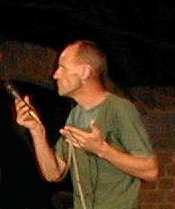
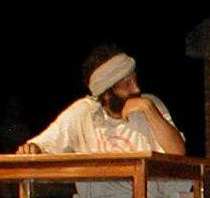
Paul (British) and Wazo (French) have always felt a calling to perform
comic theatre in the village. This ancient yearning (Paul was already
playing with a toy vandi at the age of three) drove them to create the
Fertile Forest Vandi Theatre, a traveling tour de force now presenting
'A tea shop drama', in villages near us. The performance is in Tamil and
simple English, easily accessible to the local audiences it's intended
for. Aurovilians
Paul (British) and Wazo (French) have always felt a calling to perform
comic theatre in the village. This ancient yearning (Paul was already
playing with a toy vandi at the age of three) drove them to create the
Fertile Forest Vandi Theatre, a traveling tour de force now presenting
'A tea shop drama', in villages near us. The performance is in Tamil and
simple English, easily accessible to the local audiences it's intended
for.
Muthu and Bapoune
Two viewings of the Vandi Theatre's production left me stunned and
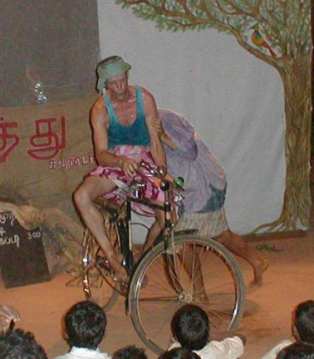
amazed. Ninety minutes of Tamilian Muthu (played by Paul) and French Bapoune
(played by Wazo) moving rapidly over a smooth
dirt ground-level stage before a laughing throng of Tamil children and
their older relatives had me experiencing inner states. Sympathy, as I
learned the plight of Bapoune, a Frenchman just arrived in India and
struggling to stay afloat after temple monkeys relieved him of his most
valued possessions, passport and money. Hilarity, as Muthu, a local
farmer, adopts Bapoune with typical Tamil hospitality, and gives him
work helping to build a tea shop. Whirlwind action, song and dance,
sheer slapstick, and a number of costume changes flood the senses and
transport the audience.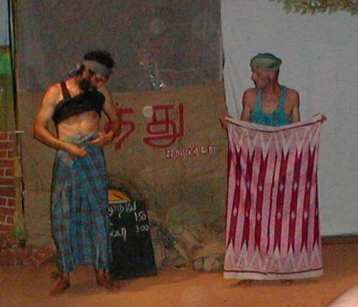
The story
Two gods converse, one tells the other the tale of Muthu and Bapoune.
Bapoune, despondent over loss of his security, curls up in a sack and
goes to sleep. Unexpectedly finding him there, Muthu listens as he's
told about the monkeys and in a typically Tamil spontaneous gesture of
friendship and goodwill offers Bapoune tea, food, and a place to stay,
"Casu illa, passport illa? Paravailla." (No money, no
passport? Doesn't matter.)
Bapoune, claiming experience in all manner of work and dance, offers his
services. In a dream Muthu is shown how to make good tea, and they begin
to construct a teashop to raise money for Muthu's sister's wedding. When
Muthu tries to marry his sister to Bapoune, he is thwarted by his
father's vehement dislike for vellakarans ('vellakaran' is the Tamil
word for 'foreigner', meaning anyone from outside the Tamil region).
Ultimately however, Bapoune is reunited with his lost possessions, and
Muthu, having found an alternative husband for his sister, reconciles
with his father and joins in the wedding festivities.
Traditional Tamil
shadow-puppeteer
While the entire drama is carried out with only three actors, Muthu,
Bapoune, and Muthu's sister, ingenious use is made of a shadow puppet
screen placed as backdrop to the stage. The shadow puppets are
manipulated by Rajappa, a traditional Tamil shadow-puppeteer.
Incorporating his work into the performance allows plot development and
the visual exploration of scenes difficult to stage, such as the dream,
speech between the gods, the incorporation of universal characters (i.e.
'the fool'), or the image of an airplane crossing the sea to deposit
Bapoune in this strange foreign land.
A dying breed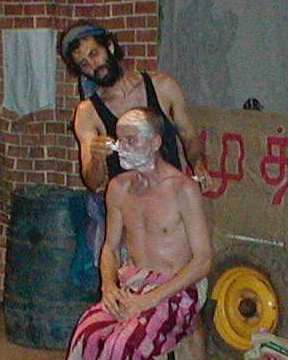
Rajappa remains of a dying breed. Local theatre, a venerable tradition
in the south of India, has been largely supplanted by the growing access
to television and cinema. The Vandi Theatre imports Rajappa for their
weekly show from his village some 30 kms away. No longer in his youth,
Rajappa has been doing puppet theatre all his life, but hardly finds
work these days, and lives with his wife in a tiny keet hut on a small
borrowed piece of temple land. He makes all his puppets himself, and
each has a name, recognisable by a Tamil audience. Adept at manipulating
several characters simultaneously, he changes his voice to suit the
role, now growling in deep, gravelly tones, now screeching in falsetto
as different puppets dance across the backlit screen. Unorganised in a
western sense, he improvises as the need arises, digging through a pile
of puppets heaped beside him to find the perfect one for the moment.
Arriving at one performance without his puppets, he explained that the
leather characters had been eaten by a dog. Paravailla.
Wazo on Bapoune
Although the performance is not biographical, Wazo underwent a similar
ordeal on his first arrival in India. Monkeys vanished with his passport
and money, but fortunately returned them some hours later. With a
background in French street theatre, activist and humorist, he first
embodied Bapoune in the early '80s in a local Tamil performance. He
explains Bapoune as a universal character known to audiences worldwide;
the fool, or joker, the one who tries to do things and falls down, tries
to get the sweets, makes people laugh. Performing for a purely local
audience, the French Bapoune has very little language at his disposal,
and must rely mainly on effective physical gestures.
Bullock cart theatre..?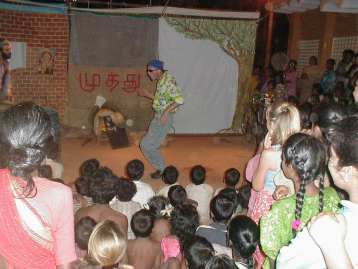
But what is a "Vandi Theatre"? Vandi, of course, is the local
name for a bullock cart. Paul built a small, single bullock vandi, and
then, with some friends and a US $1000 (approx RS 47.000) grant from the
USA-based Foundation of World Education (FEW), he constructed a mobile set for the performance that fits entirely in the
cart. Setting up and breaking down takes only 20 - 30 minutes. The
12-volt stage lighting is powered by batteries.
Why arrive for the show in a vandi? Why not a truck or a van? As Wazo
explains, "the effect is totally different. From the moment we
arrive in a village the kids are there, they look, they see us. I dance,
and we sing a song. They are the first to come and see what's up, then
they tell the others. Later the whole crowd comes. When we arrive by
vandi, that's already something they can understand. If we arrived in a
Spitfire, with cool sunglasses, two vellakarans, already we create a
gap." Accessories are limited to those that are readily found and
understood in the local Tamil culture. Muthu and Bapoune build a
teashop, with mumptis (local digging tools) and bricks, not a space rocket made of high-tech
materials. Wazo points out that he conscientiously avoids using any
props that carry foreign connotations, such as a guitar, in order to
render the performance as locally accessible as possible.
 Absolutely
non-political Absolutely
non-political
'Issues' (such as for instance the spraying of pesticides by village
farmers, an ongoing bone of contention between Auroville and Village)
are not addressed in the performance. On the contrary, they are
meticulously avoided, even though Paul says he's often asked by
Aurovilians why they don't preach a message within the play.
"We, two vellakarans, can't go into the village and start to say,
'don't put pesticides on your cashews'. Until everything we grow and
consume in Auroville is completely organic, we have no right to tell
others around us what to do." Wazo has had previous experience in
social activist theatre, and agrees that preaching on issues is not
their aim.
Abundant response
So far what kind of contact have they had with the audiences, what kind
of reactions? Judging from the two performances I saw, the audience is
well pleased, and a bit wonderstruck, to see two foreigners arriving in
a vandi, performing a drama in local dialect with a good dose of the
Tamil film idiom. Paul points out that they instantly react to the
humor, 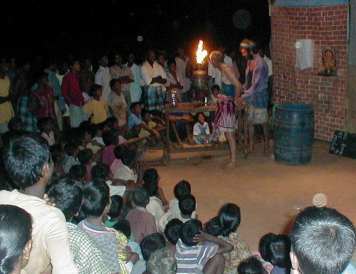 the
slapstick especially, so it's easy to monitor what is effective and what
isn't. The only time he says they momentarily lose contact with the
viewers is during their dances. They can't hear laughter over the loud
music that's playing, so the feedback they receive has to come later,
from audience like myself. I assured them that the dance scenes are as
integral a part of the show as they are in any popular Indian film. Wazo
relates touching feedback from the Tamil audience; after their first
performance one older man came up and kissed him on the forehead in
thanks. the
slapstick especially, so it's easy to monitor what is effective and what
isn't. The only time he says they momentarily lose contact with the
viewers is during their dances. They can't hear laughter over the loud
music that's playing, so the feedback they receive has to come later,
from audience like myself. I assured them that the dance scenes are as
integral a part of the show as they are in any popular Indian film. Wazo
relates touching feedback from the Tamil audience; after their first
performance one older man came up and kissed him on the forehead in
thanks.
Direct communication
based on feeling
"Fundamentally, the Vandi show and the Akademic Genius Brothers,
and anything that we do, the Christmas Fair or anything, is all based on
a fundamental feeling, no?", explains Paul. "That for me is
what's interesting, trying to get that feeling across, communicate it to
the village and see if there's a response. And from the responses I've
had from the individuals in the village at the end of the show, I see
that they come out of it with exactly the same feeling. It's a direct
communication. I have a sense of this feeling, and Wazo has a sense of
this feeling, and being individuals in this whole thing we're all trying
to work out if we have the same feeling. By doing the Akademic Genius
Brothers we have this feeling and are communicating it, and with the
Vandi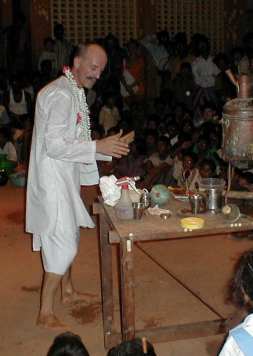 show, for me, it's the same thing. And the characters in the village
that come up to me at the end, they're communicating to me as if they
have exactly the same feeling. They know what you're talking about. Why
do you do anything anyway? For me it's basically about trying to communicate
this one feeling."
show, for me, it's the same thing. And the characters in the village
that come up to me at the end, they're communicating to me as if they
have exactly the same feeling. They know what you're talking about. Why
do you do anything anyway? For me it's basically about trying to communicate
this one feeling."
Recognition
"I think they want to see vellakarans more closely. For example, I have a
carpenter in my house. After the show in Kuilapalayam he came up to me
and said that one of the things he remembers from the show is when
Bapoune is given a task by Muthu, waits for his 'boss' to exit, and then
sits down to enjoy some free time. He says this is such a common thing,
it's easy to relate to."
By playing on certain
stereotypes, connection is made with an audience worlds removed from the
western psyche. "Our purpose is to touch universal stereotypes from
local situations. It's what we try to do. Again, it's not about social
problems, it's more about the feeling."
|