 |
|
|
|
Home > Education > Schools in Auroville for Village children > Isai Ambalam school |
|
|
||||
Isai Ambalam school |
||||
|
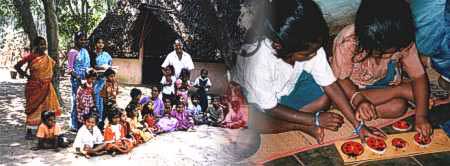
Isai Ambalam School is located on the northern periphery of Auroville. Its name means 'Place of Harmony' and it draws an increasing amount of students from five major local villages surrounding Auroville. Aurovilian Subash (55) from Madhurai, India, who
has been fluctuating between Ashram and Auroville from 1973 onward and
who joined Auroville in '93 for good, is presently the school's main
driving force. During the last four years he has been painstakingly
instrumental in introducing and implementing newer and livelier methods
of education than the traditional system prevalent in the area, with
success! Since 1982Started off in 1982, Isai Ambalam School initially was catering to the learning needs of Young Adults in the age group of 8 to 15 years, who were considered drop-outs from other learning establishments, and who came from villages in the immediate Auroville area. In the course of time it has evolved to the present stage where it has pre-school, primary and young adult sections, and these sections are divided into 7 groups. It has 115 students and 12 teachers, and is providing for the students to receive education up to 8th and 10th standard levels. Innovative educational methodsFor the last 4 years the school has been specialising in conducting experiments in education by adopting innovative and comprehensive educational methods which make learning easier, faster, more joyous and context-oriented. Many of these methods have been effectively and successfully used elsewhere in and outside India. Glenn Domain methodCreative and play-way activities are daily given to the pre-school children. Apart from these activities, the teachers apply the 'Glenn Doman method' for imparting reading skills in Tamil and English and general knowledge to the children, and found that they joyously respond to this method of learning. Since the inception of this method in 1996, three batches of 12 children each have learnt to read using this method. One of the three batches learnt the reading skill completely, thanks to the continuance of the learning practice for the full-specified period of 2 years. Last year the staff's effort to involve some parents in using this method for the children at home became fruitful, giving a hope for shortening the learning time Rishi Valley methodFOR the Young Adults the school is aiming to
impart all the skills needed for their self-directed learning. As one of
its steps, it has transcribed in Tamil the educational method discovered
and successfully used by the Rishi Valley Rural Schools in Andhra
Pradesh. This method consists of a number of study cards in Tamil,
mathematics and environmental science which are arranged in a graded
manner and can be used by the primary level students to learn most of
the subject matter by themselves. Creative and play-way activities are
in-built in the study cards. A regular primary section was opened in
June 1999 Education by Design methodFor older Young Adults who wish to continue their studies, the Education By Design (E.B.D.) method is used, and an appropriate classroom environment has been created for them for this purpose. In this method, as a part of their learning process, the Young Adults are given challenges or problems to tackle which involve the study of their subject matter. The teachers create the challenges or problems from the subject matter to be learnt, such as staging a play, enacting the important events in the Indian Independence Movement, or preparing a chart with appropriate illustrations to teach simple prepositions in English. The Young Adults divide themselves into groups of appropriate size and do project works to tackle such problems and challenges. The teachers help them when needed. This method of learning is somewhat similar to the Free Progress System used in the Sri Aurobindo Ashram school. Need-based English learningEnglish is learnt by all the students and teachers
using a need-based approach. That is, all those who wish to learn to
speak English are taught the spoken skills, and all those who wish to
read and write and pursue higher studies are taught to list out the
details of this learning, and then to learn them using Learning by doing and self-learningAll the methods experimented in and implemented by the school conform very well to the 3 cardinal principles of education enunciated by Sri Aurobindo, all of them being based on joy, freedom, learning by doing and self-learning. Out of the 8 methods now used, 4 have yielded good results. The experiments with the other methods have not yet been completed, but so far they have been giving a positive outcome. Three of the successful methods have become ongoing ones, and the fourth one will be institutionalised within a few months. List of the methods and their potential1 and 2. Glenn Doman method for learning to read well in Tamil and English; 3. The Phonic Sounds Method used by the student to learn to read any English word on his/her own; 4. Rishi Valley Method used by the primary level students to learn all their primary level subjects in a complete manner. After a certain point this method enables a student to learn most of his/her subject matter on his/her own; 5. Audio Tape Method combined with Language Games enables the student to learn English comprehensively. This method can be used for any student to enable him/her to learn any language other than his/her mother tongue; 6. Basic Sentence Structure Method enables students or teachers who are familiar with English to a certain extent to write in good English on their own, and that too without mistakes, within 6 months; 7. CIEFL Method, developed by Central Institute for English as Foreign Language, Hyderabad, enables the students at the secondary or higher secondary level to acquire a very good proficiency in English in 400 hours. This method uses 50 language lesson units and 500 reading cards prepared in a gradually increasing complexity. (This method is currently used by the teachers in the school for improving their English language skills.); 8. Education By Design Method. Resourceful and intelligent use of this method, apart from enabling the students to learn their subject matter comprehensively, can also bring out the innate talents and faculties in them and lead them to access the deeper or higher regions of consciousness. Acceptance of the methodsThe school is slowly developing the capacity to train people in these methods which are generally new and unknown to the traditional system of learning in the area, which is mainly based on the more formal (repeating) methods of teaching. Educational institutions outside of Auroville have also started seeking assistance from the school in applying non-formal, joyous, play-way learning activities. Particularly the AVAG Primary Education Programme, which sends supplementary teachers to 21 village schools around Auroville, has picked up the Rishi Valley Method from the school. A team of village school headmasters has visited Rishi Valley and are now taking preparatory steps to apply the method in their schools. Resource baseIsai Ambalam school is also gradually becoming a
resource base with reference to the removal of the difficulties in
learning encountered by the first generation school-going children, in
particular the removal of the difficulties that stand in the way of
acquiring language and maths skills and of pursuing higher studies. Consciousness trainingFurther to the above, an effort is being made to create conditions in the school under which the students can become aware of a higher energy level in their lives, the Grace, and can invoke it. For instance, when difficulties or hurdles arise in the context of their studies, they are taught to keep their mind silent and to concentrate so as to find a way for their removal. Alternatively, they may pray for their removal. Grace also operates automatically when a certain maximum possible perfection is achieved in any aspect of their study, or a certain maximum effort is put forth by them. The students are taught and encouraged to do these two things. As a result they are acquiring the capacity to feel the silence that results from such endeavours, and to cherish it. They are also able to feel the intensification of silence when they collectively concentrate. The school hopes that soon aspiring students will learn to 'draw upon' the Grace for their individual progress in learning. ConclusionThe learning of the students occurs not only at
the mental level but also at the vital, physical and psychic levels. The
students learn art-related skills in drawing, music and classical dance,
and also vocational skills like tailoring and typewriting. Towards the
end of the school day physical exercises and sports activities take
place. Thus learning occurs in a balanced manner involving all the parts
of the being. Contact: avag@auroville.org.in |
|||
|
Education > Schools in Auroville for Village children > Isaiambalam School |
| Auroville Universal Township | webmaster@auroville.org.in |   |