
Progress report
- update December 2001
The Garden's main focus will
be the conservation of indigenous species. As the native Tropical Dry
Evergreen Forest of the Coromandel Coast has almost totally disappeared
and as there is no other Botanical Garden existing along the entire east
coast between Kolkota and Kanyakumari, the value of this project is only
too obvious.
With this urgent need to
document and preserve the local flora, the work at the Garden has
started off with whatever support and means possible. So far most of the
funds have come from within the community and voluntary help from
individuals. Over the last months a detailed 5 year project proposal was
written which will be sent out for overseas funding. Till then the work
will continue slowly as the finances allow.
Work progress from January to October 2001
-
In the beginning of 2001
a generous donation helped purchase a very needed windmill which
enabled the new caretaker family to move to the site, giving the
place the important 24 hour presence. With plenty of water, also the
freshly planted, young TDEF species survived the long hot summer
months. The monsoon last year had been a total failure so without
the additional watering only a few plants would have made it.
-
The caretakers of the
Garden are also part of the seed-savers network 'Annadanna' which is
now being established on the site. In association with Kokopelli,
this organisation is involved in preserving traditional vegetable
and flower seeds from all over the world. This is their first base
in India and research has already started to see which varieties are
best suited to this region.
-
In May the B.G. team
made their first official visit to the Tropical Botanical Garden
Research Institute in Kerala. This research institute covers a
sprawling area with a wild indigenous forest and natural river. As
our time was limited only the most important features were looked
into and discussed with the Gardens Staff. A lot of ideas and
inspiration were generated for the future detailed planning of the
Auroville B.G.
-
July saw the first dry
pond dug with the help of a JCB. It took 3 days to dig and shape the
hole and mound, creating some relief in the flat landscape. This is
one of the many to come, adding character to the land and catching
precious rainwater.
-
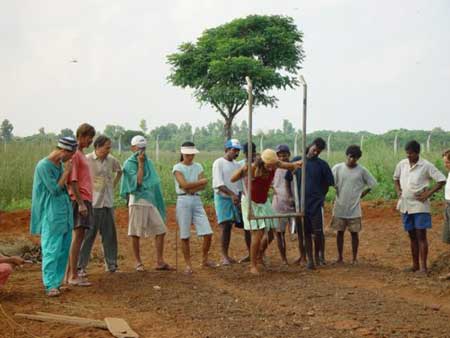
September and October
were spent preparing for the arboretum planting. Large pits of 1 X 1
mtr were dug and filled with an ideal compost and soil mix to
welcome the patiently waiting seedlings who have been waiting for
months in their tightly crammed plastic bags. A lot of manual help
was received from volunteers and visiting students who sweated in
the heat making it a joint, fun work-out session.
-
November will be time
for planting and hopefully again individuals, students and groups
will participate in this nice collaborative work of planting trees
together.
-
A small fundraising
scheme 'Sponsor a Tree'
was started to help finance the arboretum planting.
Overview and numbers
As indicated on our intro
page, the development of the fifty acre site was begun in the autumn of
2000, with the planting of an indigenous forest area on 10 acres. This
will eventually double in size when the next area for the Gardens are
purchased. The first planting consisted only of climax species for the
Tropical Dry Evergreen forest type of which there are approximately 35
woody species, all of which are evergreen and have similar ecological
traits such as berry bearing and small, white, perfumed flowers. When
the area is developed further, other secondary and colaniser species
will be included, which will raise the number of represented woody
species to approximately 135.
In the autumn of 2001 the
arboretum was begun with the planting of 167 species of tree and 35
species of shrub. The arboretum surrounds the future area of the formal
gardens with an inner ring of ornamental flowering trees. The first
phase included most of the indigenous and native India trees that are
common in and around Auroville. The trees are at wide spacing, 10 -15
meters, and will be grown as specimen trees.
Dioecious species have two
representatives, one of each sex. The plantings have been arranged as
per genus as far as is possible, and most families have been planted.
However, certain larger, more diverse and interesting families such as
Euphorbiaceae and Ficus will be planted out in specialised areas of the
Gardens in the future, and so their representation in the arboretum
planting this year has been minimal.
So far an area of 10 acres
has been covered and this will be expanded in subsequent years as and
when species become available.
Botanical Gardens
Auroville
605 101, TN
India
|