|
Once upon a time a young man and his family
walked across a
land where there was nothing to see except a big building.
The land was dusty and barren, cut through by a few gullies,
and the building was really not much more than a ruin. But
somehow the family, just arrived from Belgium, liked the place and
decided to develop it.
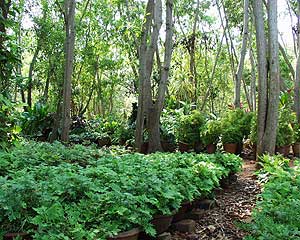
Development of Shakti Nursery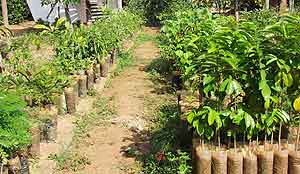
The year was 1983, and that was the beginning of
the Shakti Community and its nursery. There was no water, no electricity
and no fence, and things were not too easy. Right from the start we were
involved with nursery work. The first couple of years we cultivated
mostly ornamental plants and trees for the many gardens in Auroville,
but later we got more concerned about Auroville's indigenous forest.
When we managed to get a 7-year funding for the conservation and
propagation of the forest - the Tropical Dry Evergreen Forest (TDEF)- we
switched almost exclusively to raising the specific TDEF species. The
aim of the TDEF project is to entirely re-create the indigenous forest
in the Green Belt area of Auroville.
In 1999 the Shakti nursery raised over 50,000
seedlings.
Index Seminum
In I981, when still living in Aspiration, we
published the first
issue of the 'Auroville Index Seminum', listing all the seeds in
Auroville available for exchange. The booklet was sent to the few
Botanical Gardens we knew at that time: just over fifty. Also, our list
was still rather short and mentioned only 160 species.
To date, we have a mailing list of over 650 Botanical Gardens,
Universities and interested groups all over the world (including a large
Garden in Novosibirsk, Siberia, measuring 1.060 ha.), and can offer
almost 500 different species for exchange.
Study of remnants of Tropical Forest
The next activity was the study of remnants of the
TDEF,
together with 2 other Aurovilians, and the setting up of the Auroville
Herbarium. A herbarium is a collection of preserved plants. It is a tool
for the taxonomist to use and give answers to the many questions more
and more asked about plants: medicinal or other useful properties,
habitat, identification, correct name, etc.
Criteria for the usefulness of the herbarium will be the
completeness of its collection, the quality of the preserved material,
and the labels, with comprehensive notes and correct names.
Special Herbarium
One of our aims is to build up a so-called
'Special Herbarium', a herbarium with a limited scope, the main purpose
being to represent the TDEF project with collections from the remaining
pockets of that type of forest over its entire geographical distribution
area, as well as a representation of the invading flora in the
disturbed, degraded and denuded areas. Collections are also required
representing the various plant associations on the different soils
encountered in the area of the TDEF, such as the beach, new and
consolidated dunes, salt marshes, black cotton soils and others.
Interesting note
The very first collection for the Herbarium (AURO
5001) was made on the 5th of April 1994. Interestingly, as we discovered
much later, this involved collection of a plant listed in the botanical
literature as "very rare, probably extinct". It is a liana
belonging to the Fabaceae family, Derris ovalifolia (Wight et
Arn Benth.), found mainly in and around the Auroville plateau.
Botanical survey on Andaman Islands
We then got requested by an NGO, the Andaman &
Nicobar Ecological Team (ANET), to carry out a botanical survey on some
lesser known islands of the group. We did that for four consecutive
years (1995 - 1998) and came home with a sizeable collection from those
islands.
Further expansion
In the meantime we began accepting private
collections from
students, mostly Indian, but a few also from Europe. Presently, the
outcome is that the AURO Herbarium has a much wider variety of species
in its collection, and is growing much faster than anticipated, with its
more than 7,000 accessions to date. (Accession: if one has in the
herbarium a collection of, say, 10 times the same plant, it counts in
your collection as 1 species but 10 accessions.)
Botanical Garden
Last but not least, in the year 2000 Auroville
acquired 50 acres of
land, with the promise of 50 more adjoining acres to come. The newly
obtained land was earmarked to set up a botanical
garden and so, at long last, a 20 year old dream to set up an
Auroville Botanical Garden finally is coming true.
In 2000 itself, about 5,000 specimens of evergreen
trees and shrubs of the TDEF were planted in a stretch along the eastern
side of the future garden. This year, at the next planting season, we
will develop that part of the area where the arboretum has to come. For
that purpose we already have 190 different tropical species ready in the
Shakti nursery.
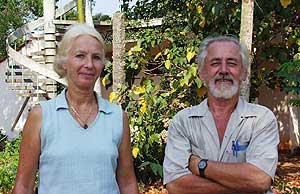
Walter and Tina
|