|
FERTILE
MEMORIES
 Jan
Allen, one of Auroville's 'old-timer' residents, looks back at those
very first years, and smiles... She tells us here about life in 'Fertile', a large settlement in the north-eastern part of Auroville's
Greenbelt. Jan
Allen, one of Auroville's 'old-timer' residents, looks back at those
very first years, and smiles... She tells us here about life in 'Fertile', a large settlement in the north-eastern part of Auroville's
Greenbelt.
Moving from beach to
inland, '73
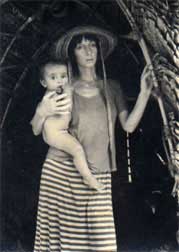
I remember so well: it was 1st April 1973 when my little daughter
Aurojina and I finally arrived in 'Fertile' - to stay. Having sent our
belongings ahead by bullock cart, we made the journey from Pondicherry
by cycle. It was a cool morning for April, and as I was fuelled by a
sense of new beginnings, the journey was memorable. Jina travelled in a
wicker seat on the front of the cycle, and we brought with us a little
black kitten that rode calmly in its basket at the rear.
This inland living was to be a leap from our beach house in Quiet, where
I had spent the first years in Auroville viewing the experiment from the
edge. Aurojina was four and a half months old. Shortly after Jina's
birth, the November cyclone of '72 had driven us into Pondicherry to
take shelter in a solid brick house near the Arumugan temple.
I had no doubts about this next venture. We were to be part of a
community of eight which would include Johnny, our son Jonas now six
years old, Christianne and Denis, and Rose and Boris. We were
representing America, France and Australia, and I felt a loving
appreciation of all these individuals who had mysteriously come together
to this odd outpost on this desert plateau in close proximity to the
'Seven Banyan Trees' settlement.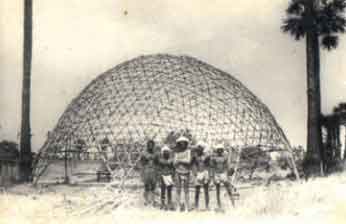
Fertile
In those days there was the wide peripheral sweep of the horizons: the
sun rose, shone down relentlessly and set, and the moon was most obvious
in all its phases, for we were without the protection and camouflage of
tree cover. Boris had come from Gerard's Orchard where he had been under
the influence of Mercier, a fervent exponent of organic gardening from
New Caledonia, and had already acquired the knowledge and skills to
create what would become an impressive vegetable garden, and begin the
first orchard in the area. Denis was the interface and fundraiser; he
knew how to negotiate with the world at large, writing proposals and
fine articles about Auroville. Johnny looked after the practical
details, eventually installing the pump maintaining the Kirloskar
engine, involving himself in agriculture, and interacting well with the
local villagers. The women's work was all encompassing, as it tends to
be. It was my maternal year of surrender - so my energy mainly went to
Aurojina, who grew into a fine specimen fueled later by the ragi
porridge which came from our first ragi crops.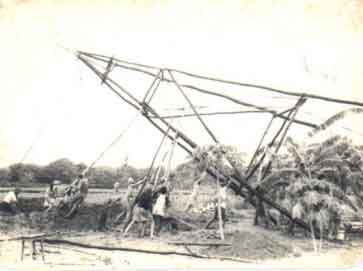
Halcyon days
In these first months our water was delivered each day by bullock cart
from a tank in Aspiration. It was poured into two great barrels and had
to be judiciously used. We developed a series of rituals and unspoken
rules about this scanty water supply. Our meals were regular and
unvarying - ragi and curd for breakfast, rice and dahl for lunch, bread
and left-overs for dinner. All meals interspersed with man-size mugs of
steaming tea, but chicory in the evenings. Later there were the seasonal
fruits from the young orchard.
We took it in turns to cycle the 15 kms into Pondicherry and buy the
basics, transporting them on cycle saddlebags. In those days we were
still entitled to 'prosperity', which would be distributed at the Banyan
tree at the Centre each month by some dignified Ashramites. Through this
arrangement were available bed linen, towels, soap, (always black)
umbrellas, and an almirah (small steel cupboard) on a sort of a ration
basis. We managed so frugally, and yet the days were full and our
spirits high. There were the occasional care parcels from home… Johnny
referred to them as 'the cargo cult'. How we would delight in their
luxurious contents and send waves of gratitude and love to the senders,
usually our dear parents. It was the Mother's last year. We were living
out her dream cradled in her care, and we trusted in the moment; halcyon
days.
Memorable moments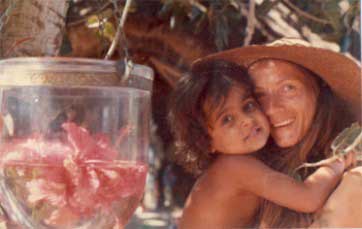
Then there were the key periods. One of them was initiated the day the
diesel engine began to pump water from the bore well; it flowed through
the elaborate system of pvc pipes and into the waiting tanks and on to
the thirsty earth. This was something to celebrate indeed. Then there
was the first lactation of the milk cow after the thrilling arrival of
the baby calf. And the successful harvesting of a peanut crop and the
first bounty from Boris's vegetable garden.
There also were the hardships: the thieves from the village, the endless
ever-so-hot days, the bad spacing of the monsoon for the dry crops and
hence their failure, and the occasional inevitable disputes with our
neighbouring Aurovilians. There were the interminable run-ins with the
villagers over marauding goats and orchard raiders. 'Our' water also had
to be shared with an ever-increasing parade of people, especially during
the cashew seasons and in the height of summer. So despite this outlying
existence in the then wilderness, it was sometimes difficult to find
some peace.
Fertile community
expanding
'Fertile' began to expand after a time. Boris and Rose moved out to the
east and started their own place (the present 'Nilatangam' settlement),
and Denis and Christianne moved a little further away to the west (now
'Dana'). Vijay was a colourful addition to the group, and he and began
his 'Fertile Windmill' community with a plantation of Mango trees. Every
day we continued to use the central Fertile for a communal lunch.
Further down the road towards Aspiration, there were Jean and Colleen
with Asha, George and Gabby, and later Patrick and Heidi at Fertile
East. Aurogreen was to come later.
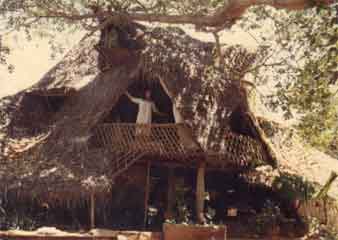 Rambling
castle of bamboo Rambling
castle of bamboo
Johnny had begun his work with roof-maker Ramu and his men. Together
they built the first bamboo dome, and we moved into it as a family. At
last our home was a dome, but despite having paid tribute to all
Buckminster Fuller's ideas and utterances for many years, we found it
ever so difficult to live in. There were no cozy corners, no private
nooks. Jina, taking her first steps, would hover precariously at the
edge of a sunken storage area in the centre. Trying to get settled, we
moved our bedding around the perimeter week by week and then finally out
OF the door again and into what we called the Big House near the
kitchen, that Denis and Christianne had vacated.
And this became our true home for the next ten years. It was a great
rambling castle of bamboo, casurina, pakamaram and keet, which was
constantly added to and subtracted from according to our needs. The dome
became a meeting place and PLACE where music was performed and where the
Auroville children gathered for their games.
Fertile Forest
expanding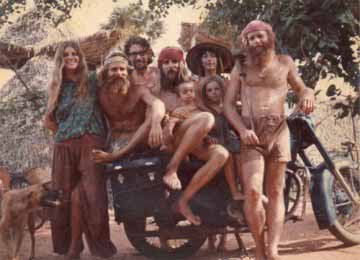
In the meantime the project I had drawn up for our besieged forest came
true, and money filtered in from the Tamil Fund which enabled the
acquiring of a fine bullock cart, a water tank, money for growing
seedlings and fencing. Fertile's Forest was now able to expand. In a way
it was a learning experience and a testing ground. Now I can see the
forest that might have been. Far too many exotics were planted; advice
was given from all quarters. Too much use of the seedlings from the
nursery. A huge exotic forest was projected, like a great extension of
the nursery itself. But it wasn't practical or possible. The 'Avenue of
Passion' (Spathoda Campanulata, named 'Passion' by the Mother) was the
first to suffer. Too many journeys of the vandi/bullock cart with the
water tank were required to keep them erect - one by one they withered.
The interspersing of Work trees (Acacia Auriculiformis, named 'Work' by
the Mother) saved the day: the indigenous trees could gain roothold in
their shade.
Help from Indian
Forestry Department
A year or so later, with advice from inspired Forest Officers, we began
to make forays into local scrub jungles, as in nearby Marakannam and
then further afield, to gather seeds. And in a year the seedlings were
ready to plant out in the next monsoon. Joss from Pitchandikulam was the
overriding inspiration for these adventures. This interface with the
Indian Forestry Department found us in all sorts of remote regions with
uniformed men in jeeps. Some wonderful friendships were formed, and
important seeds were collected and the forests benefited.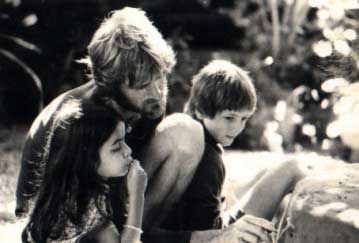
Lively education
Auroville was growing apace. There were now older children hungry for
information, who often ended up around the circular table at the Fertile
kitchen listening to Johnny's marvellous stories. Johnny's patience with
children and his inventiveness beguiled enough disciples that a regular
school evolved. It began, of course, with our immediate family, which
now often included Jesse and Luke, Johnny's sons, visiting regularly
from Australia, who brought with them the sophistication from their city
life and their burgeoning dramatic skills. It was to stimulate these
abilities that the first plays were written and performed in Fertile.
'The school' soon expanded, and graduated from the old round table to a
regular classroom by popular demand. Our old chicken house was
converted, a grand colourful skylight installed, and the children set
about making their own desks from available timber. A blackboard was
constructed on request, and over the months there were visiting
notables, including Eleanor, who was able to present a living history of
the Second World War from her experience on Life Magazine. Prem Malik
would occasionally appear for a rallying on the spiritual level with
some of Sri Aurobindo's philosophy for junior consumption, and even a
torrid account of the Vietnam War from a sensitive veteran. Kalya came
regularly for mathematics and introductory information about computers,
and then, for light relief, Judith the Puppeteer would wend her way
weekly from the Far Beach. Together with her, from accessible materials
incredible characters would be created, and soon the travelling Puppet
Theatre evolved. There was also the rather unorthodox examination of
magic, and there were soon several amateur magicians.
Friends and family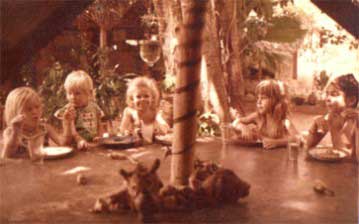
Some parents left India and their children stayed with us for a time.
Notable and more permanent among them were our beloved Nell and Isaac.
Nell had such an avid appetite for mathematics that Johnny would have to
hone up his skills to stay a jump ahead of her, and we had to find more
books for her insatiable reading lust. Isaac and Jonas inspired the
younger ones with their acquired knowledge of constructing traps and
their familiarity with the ravines; they also kept diaries that they
illustrated, and they filled up many drawing books.
Stefanie, a nine year old German girl, came one day for afternoon tea,
nestled into our hearts, and stayed on for six years or so. Occasionally
Llewellyn (Nell and Isaac's father) would arrive with marvellous tales
to recount of his adventures on the Seas. He was also an authority on
the Arthurian legends, and so there were spellbound nights in the big
house with the children in their various beds falling asleep to the
stories of the knights and their ladies, their trysts and their battles.
I think Llewellyn may have invented more characters as these stories
continued, thrilling and interminable.
Time of innocence and
sweetness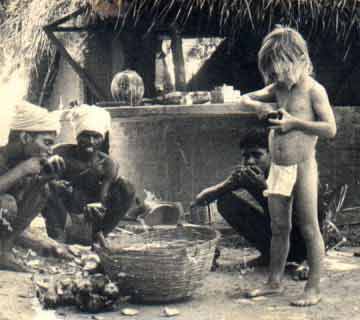
The children at this time were stimulated by simple things and satisfied
with their interaction with nature. Perhaps it helped that there were
only one or two motorcycles in the whole of Auroville, and there was no
television or videos, only the occasional film at Aspiration. This must
have given some pertinence to the immediate, for it was innocent fun.
Make believe, with wolf games, hiding treasure and making maps, creating
bows and arrows, lots of drawing and painting, dressing up, riding and
maintaining their horses, which were more often ridden without bridles
or saddles. We could spend an hour or so watching the major tragedies of
a Mynah bird couple. The invading snake, the inquisitive monkey, the
mongoose's journey up the Palmyra for an attempt on their eggs, their
ultimate survival. It was always such a delight seeing Stefanie emerging
through the Banyans with her long golden hair streaming in the sunlight,
and at the helm of a little one-bullock vandi/cart which she plied from
Fertile to Discipline and back.
Aliamma, unsung heroine
of early days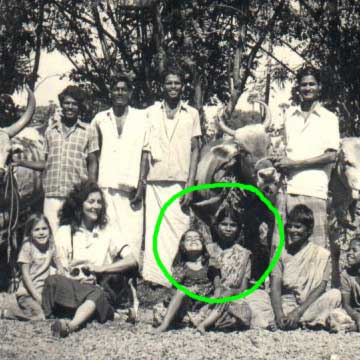
I must say it would have been impossible to cope with so many without
dear Aliamma from Pillaichavadi village, who would arrive punctually at
8 each morning, a little high on betel nut, and throw herself
wholeheartedly into sweeping and cleaning. Her face would light up with
the more the merrier for lunch, so it was in those days that the open
house policy evolved. In low times, with Aliamma's help, we could find
all sorts of edible wild spinaches in the garden, and with a magical
concoction of spices prepare delicious meals which became renowned in
Auroville. It was Amma who perfected the dosai with varagu, a sort of
hybrid vadai, and her famous version of appalam; she was always ready to
experiment. She was an inspiration and a delight, a woman of limitless
energy and the unsung heroine of those early days. Then there were our
Tamilian mainstays, Kadival from Bommaiyapalalam, Govindraj and Manjini
from Pettai, a series of bullock cart drivers. And dear Moonaswami from
Kalapet, with his smooth brown legs and his staff, who for so many years
despite his age was a constant vigil in the forest. He also had the
uncanny ability to determine the existence within - and sometimes gender
of - a chicken egg: he did this by holding it to his eye and twisting it
while holding it to the sun.
So it was a time of
innocence and sweetness. Drugs were an impossible evil, and that
generation of children even discouraged beedie smoking. Motor traffic
was a distant curse. Fertile was a smoke-free zone, a home away from
home, a paradise of endless delights and a haven of peace. I am
delighted to have been a part of it all.
|