 |
|
|
|
Home > Environment & Bioregion > Land and Nature |
Land and Nature
|
|||
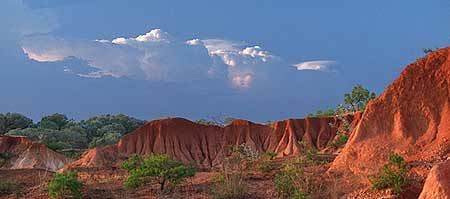
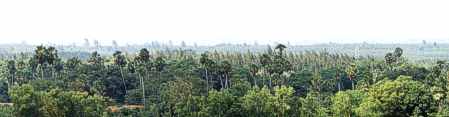
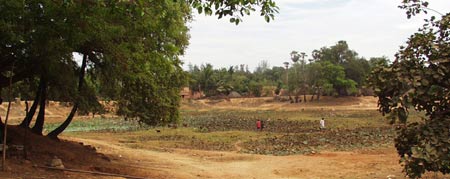
Ever-present red laterite earth..Auroville is located on a plateau some 50 mts above sea level. Ignoring the gentle slope up from the sea all the way to the Matrimandir, and a number of erosion features, the land is essentially flat in the sense that it is without any hills or escarpments. Rainwater running in streams across the ground betrays otherwise unnoticeable subtle grades. Over time these streams have cut deep grooves into the earth on their journey to the Bay of Bengal. Carrying topsoil away, they have left several canyons within Auroville. Multihued in whites, reds and browns, comprised of sand, pebbles and the ever-present red laterite earth, home to many birds and small animals, reptiles and insects, these heavily eroded areas are slowly being reclaimed by the forests; many trees can now be found growing in Forecomers and Utility canyons. Auroville woodsFrom the insistent and repetitive cry of the 'brainfever'
bird (common hawk cuckoo, Cucilus varius Vahl, which you hear in the
background of this page) to the milder chirping of
varied small songbirds, forests across Auroville resound with clear
melody. Occasional thickets of mature green and yellow bamboo reach
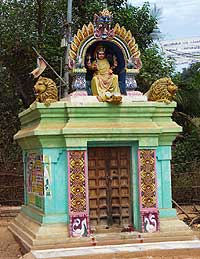
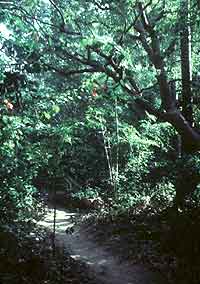
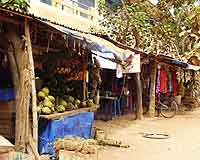
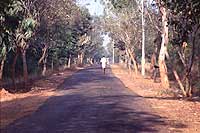
toward the sky and sway in the ocean breeze. Giant banyan trees, found in tropical climes, form vast, arching tents; aerial roots descend from upper branches seeking earth. Thick, twisting limbs support sturdy green leaves. Stippling their vermilion canopies, red cherry-like seeds grow, and attract flocks of crows, parrots and mynahs by day, followed by huge flying fox fruit bats at night. Fences of thorn branches and a local cactus resembling ferocious aloe vera work to ward off encroaching goats, cows and firewood gatherers from nearby villages. Thriving villagesKottakarai, Edayanchavadi and Kuilapalayam are the main villages which thrive within the perimeter of Auroville. Kuilapalayam, situated on the main road heading toward the beach and Pondy, has become quite affluent through daily trade with Aurovilians. It boasts a row of prospering shops lining the road, and several newly built or renovated little temples, colourful with brightly painted icons of Kali, Ganesh and Durga. With the lifting of restrictions on foreign trade, western goods are found in increasing abundance in India, including in Kuilapalayam. Although rumour has it that Chennai taxi drivers speak of Kuilapalayam the way we speak of 'Timbuktoo', it is not truly such an outpost of civilisation. Leatherman multi-tools, blank CDs, Marlboro cigarettes and cell phones can be had not far from a local idli/vadai restaurant and fruit vendors are displaying colourful piles of coconuts, pineapples, papayas, bananas and varied vegetables. Roads and trafficThe local roads have either improved or deteriorated, depending on how you see it. Change seems inevitable. While they used to consist of dusty dirt tracks, today a prominent tar road winds through a major section of Auroville. Flanked by cashew topes, cyclists on this road are subjected to the hazards of increasing motorised traffic, especially of the four-wheeled variety. Although the roads of urban India are incomparably worse in terms of danger and population density, in Auroville a growing number of lorries, buses, taxis and vans, as well as private cars, bear down on smaller traffic. Horns blaring, exhaust and dust combining in mini-storms, often they race by, local labourers staring from the backs of trucks, film music pumping forth from car interiors. The omnipresent motorcyclists, inhabitants of Auroville, sun-glassed and mostly well-dressed, edge impatiently around these larger vehicles and vanish, leaving only the echoing scream of engine sound, and perhaps the memory of an acknowledging nod or smile. One may also notice bullock carts and tractors on these roads, some trailing noxious loads. Compounding the health threat posed by dust and exhaust, the habit of yearly pesticide spraying of the cashew trees by the local villagers leaves many an Aurovilian and Tamil villager sick with cough, running nose, sore throat or burning eyes. Other roads have retained their rustic qualities, dirt tracks still, wending through shady forested areas replete with crystalline birdsong. Life at the beachAuroville lies on the 'Coromandel Coast'. Here the Bay of Bengal hosts regular swimmers, avid surfers, and weekly sunbathers. Coconut palms are separated at Repos, a beach community, from the water's edge by a large expanse of sand, too hot to walk on in the midday sun. Auroville beach access points lie between local fishing villages. Fishermen rise well before dawn, and can be seen offshore standing on their palm tree canoes. In the distance against the sunrise they appear to walk on the water. Dawn at the seaside also witnesses the morning ablutions of these fishing communities, which conveniently get washed into the sea. Lakes and kolams
|
|||
|
|||
|
|||
|
Environment
& Bioregion > Land and Nature > |
| Auroville Universal Township | webmaster@auroville.org.in |   |