Kites
Pariah Kite
'Milrus migrans govinda'
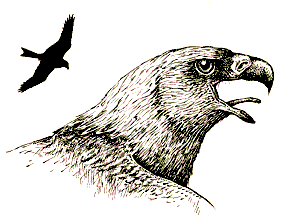
Dark crosses gliding endlessly on tireless wings
and shrill "ewe-wir-wir-wir" whistles are familiar to most
urbanites throughout India. Indian cities literally swarm with these
scavengers - New Delhi alone is said to harbour more than 2,400
breeding pairs of pariah kites. Naturally, this species is believed to
be the world's most abundant bird of prey, being found throughout most
of Europe and Asia and some parts of Africa and Australia. (Now it is
said to be extending its range).
In the Auroville bioregion it has supplanted
the locally extinct Pondicherry vulture (another term for the Indian
black vulture 'Sarcogyps calvus).
Lightning swoops..
This large, brown kite is easily distinguished
by its forked tail, a feature particularly noticeable in flight. It's
adept at avoiding pedestrians, motor traffic and overhead wires, its
lightning swoops to carry off a bit of offal from even crowded bazaars
can never fail to amaze the observer.
Both physically and psychologically well adapted
to live in the vicinity of man, it depends on the latter's
artificially created conditions for nesting. Coconut trees are the
favoured site for its 'platform' nest and often many pairs occupy the
same grove; it has also been observed to nest on overhead water tanks.
Three greyish white, brown speckled eggs are the usual clutch. The
parents vigorously defend them and their young against the
ever-present house crows and the aerial skirmishes between the two
species are a treat to watch..!
Brahminy Kite
'Haliastur indus'
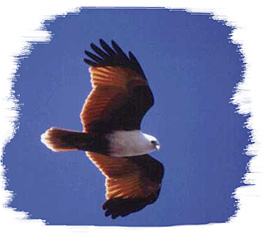 Myth
discerns it to be the 'Garuda' bird, and people living in the
Auroville bioregion call it 'Krishnar paraandu' - both in association
to it being the 'vahana' (vehicle) of Lord Vishnu, one of the 3
principle deities of the Hindu pantheon. (Krishna too is believed to
be one of the Avatars of Lord Vishnu). Myth
discerns it to be the 'Garuda' bird, and people living in the
Auroville bioregion call it 'Krishnar paraandu' - both in association
to it being the 'vahana' (vehicle) of Lord Vishnu, one of the 3
principle deities of the Hindu pantheon. (Krishna too is believed to
be one of the Avatars of Lord Vishnu).
In an eye-catching shade of russet, the adult
with a prominent white head, neck and breast, is a striking creature.
This impression is somewhat marred by its food habits.. Though it may
hunt the occasional fish or frog, it subsists largely on carrion (dead
fish floating on the water's surface are its special favourite) and is
also said to clumsily 'hawk' winged termites in the air.
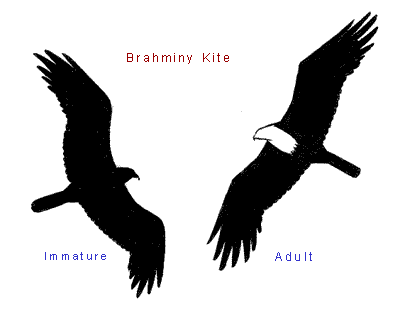
In danger..
Unfortunately its divine status does not
guarantee safety in India at large. Eroding cultural and religious
values have had repercussions on wildlife. These birds, especially the
juveniles which lack the white marking of the adults, are often
stoned, their nests destroyed and water polluted.. (This state of
affairs is not confined to this species alone, the cobra - though
revered and worshipped, is ruthlessly battered to death whenever any
opportunity presents itself..)
Public awareness being the key to the long
term survival and peaceful co-existence of both animal and man,
environment education programmes (that could ideally combine cultural
sentiments with scientific knowledge) are imperative for the general
understanding of ecological precepts and cerebral evolution among
human societies. Such a far-sighted programme, that has obvious
benefits for Auroville and its Greenbelt, could be given much more
attention.
|