        |
|
|
|
Home > Environment & Bioregion > The web of life > Starred Tortoise |
|
|
|
|||
|
A few months ago there appeared on Auroville's Intranet and AVNews the following interesting reportage by Aurovilian Renu informing the community about the miraculous appearance in Auroville of the Starred Tortoise, a beautiful creature with an intricate network of bright, interlinked stars on its shell..
Saved from being exported
Landlubbers
How they came hereMeanwhile, Joss and Anita of Pichandikulam who were out of station at the time, have responded to Renu:
Keep them free!We are happy if they are finding their ways across Auroville, and hope that they will find safe homes in its forests and gardens. It would be great if someone can co-ordinate a record of where they are turning up. However, we want to stress that we did not let them all go to be caught again! People shouldn't catch them and keep them, please.. This is a test in a way, to see whether we can be an appropriate
place for the release of other confiscated wild animals, but it comes
with a responsibility and guarantee to the T.N. Forest Department that
they really are free.
|
Facts according to: 'The Book of Indian Reptiles' by the Bombay Natural History Society:Local names- Hindi: Kachuva All land tortoises are grouped under a
single family, the Testudinidae. The shell is heavy and covered
with horny shields. The head and neck are completely retractile.
The hind limbs are columnar and club shaped. Habitat, distribution and statusFairly common in sandy tracts such as the
coastal scrublands of the amanathapuram District in Tamil Nadu
and the semi arid and desert tracts of peninsular India. It is
said to be very common in Chitoor district, A.P. and the
adjacent Kolar district, Karnataka. Its status in wetter areas
is not clear. Occurs in the peninsular area of India westward to
Sind in Pakistan. Precise information is required on the status
of the Starred Tortoise within this range. Not an uncommon
species. (It is now considered an endangered species due to over
poaching for the pet market.) FoodOmnivorous but inclined to be vegetarian. Feeds on succulent like cissus quadrangularis, fallen fruits, grass and similar vegetation. Captive specimens thrive on all types of soft vegetables. They are also known to feed on snails, and animal and bird excreta, and in captivity are reported to have fed on carrion. BreedingMates during the rainy season when the animals are most active. The concave plastron of the male facilitates mounting. Instances are recorded of the males shoving and trying to overturn each other. The eggs, in clutches varying in number from 3 to 7, are laid in a pit dug by the female with her hind feet, the soil being moistened with her urine. When completed and tamped down, the egg hole becomes undistinguishable from the surrounding soil. Clutches have been laid in March, April, June, October and November. A female may lay more than one clutch in a season. The hard-shelled eggs are ellipsoidal, white, matt-surfaced, and range in size from 40 X 35 to 51 X 37 mm. Incubation may take from 47 days to 147 days for eggs of the same clutch. It takes about twenty-four hours for the young to surface after hatching. The yolk sac is external at birth but is usually absorbed in forty-eight hours. The hatchling is provided with an egg tooth for breaking the shell. (An egg tooth is a temporary point on the upper mandible.) Within a week of birth the young start eating greedily and on the same food as the adult. Maturity is attained in about two years. Three more species of land tortoise in India.
|
Contact: renu@auroville.org.in
|
Environment & Bioregion > The web of life > Starred Tortoise |
| Auroville Universal Township | webmaster@auroville.org.in |   |
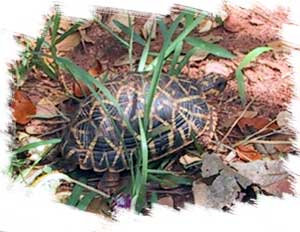 The
'Starred Tortoise' (Geochelone elegans) is the one that has been
gracing the Auroville landscape lately. Rumour has it that
Pitchandikulam Joss released a quantity of these gentle animals that
had been seized before they were slated for export as pets. Sadly they
are now considered an endangered species. Once we receive the actual
facts (see below) of how many and where exactly they were
released, it will be interesting to mark their journey throughout
Auroville.
The
'Starred Tortoise' (Geochelone elegans) is the one that has been
gracing the Auroville landscape lately. Rumour has it that
Pitchandikulam Joss released a quantity of these gentle animals that
had been seized before they were slated for export as pets. Sadly they
are now considered an endangered species. Once we receive the actual
facts (see below) of how many and where exactly they were
released, it will be interesting to mark their journey throughout
Auroville. Meanwhile
all Aurovilians can be an important part of this research by emailing
us where you find a turtle, and its sex. (Not surprisingly, the males
have a longer tail than the females). If you decide to keep one around
for a while, make a large enclosure with granite pillars or a similar
short wall and make a hiding place under a slab of stone. I have had
good luck feeding them tomato, salad leaves, orange and papaya skins.
Meanwhile
all Aurovilians can be an important part of this research by emailing
us where you find a turtle, and its sex. (Not surprisingly, the males
have a longer tail than the females). If you decide to keep one around
for a while, make a large enclosure with granite pillars or a similar
short wall and make a hiding place under a slab of stone. I have had
good luck feeding them tomato, salad leaves, orange and papaya skins. Yes,
we did release 200 tortoises in Pitchandikulam, just after the peak of
the summer. They were brought to us by the Tamil Nadu Forest
Department after they had been confiscated at the Chennai Airport as
it is illegal to export them (they were on their way to Singapore to
be sold as pets or for medicine..). If you ask in any pet shop in
Pondicherry about food for tortoises, you will be told that it's
illegal to keep them. The ones that were confiscated had been
collected in Tamil Nadu from the wild, and it was necessary that they
be released into a safe place.
Yes,
we did release 200 tortoises in Pitchandikulam, just after the peak of
the summer. They were brought to us by the Tamil Nadu Forest
Department after they had been confiscated at the Chennai Airport as
it is illegal to export them (they were on their way to Singapore to
be sold as pets or for medicine..). If you ask in any pet shop in
Pondicherry about food for tortoises, you will be told that it's
illegal to keep them. The ones that were confiscated had been
collected in Tamil Nadu from the wild, and it was necessary that they
be released into a safe place.