        |
|
|
|
Home > Environment & Bioregion > The web of life > Timtopix > Termites |
|
"I am afraid it will mean |
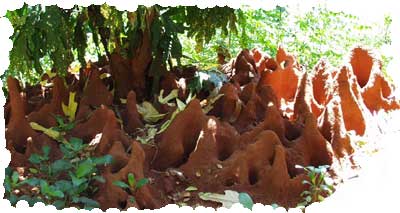
Auroville wouldn't be Auroville without its teeming world of termites, manifesting in exquisitely sculpted termite mounds all over the place, termite eaten cupboards, books or clothing, termite perforated doors and window frames... and the endless rows of transparent, 'naked', slivering little creatures (termites) marching in columns through your garden, or probing their way via earth-encrusted tunnels into your hutment or house. Termites are part of the diet of many animals, birds, reptiles and other creatures - even humans (see below). They also break down dead wood and keep the environment 'tidy' thereby, open up the earth to aeration.
Ever seen a chicken eat termites, one by one as they march by her? A very rapid peck, peck, peck and the column gets briefly disrupted, with gaps in its continuity, but in the end they just keep coming and coming… and coming, as they have done for countless millions of years, and are likely to continue doing so for eons to come. As termites are an incredibly successful collective life form, Aurovilians may have some things learn from them..! They may even deserve our grudging admiration.. Termites aren't antsThe 'white ants' tag for termites is very misleading since termites are more closely related to cockroaches and grasshoppers. Their mouth parts in particular are very like the cockroach's, with tough biting jaws: and they have thick waists, generally soft bodies and straight feelers, also quite unlike ants, who have thin waists, hard bodies and bent feelers. And, of course, they are entirely vegetarian, taking their sustenance mostly from dead wood; though a few of the approximately 2,000 species worldwide also eat fungi, and plants such as grass, as Aurovilians may have noticed, columns regularly invading and denuding patches of grass. Queen can be up to 10 cms long!
Highly organised earth-made dwellingsTermites have achieved one of she most perfect
of all 'animal' societies. Found throughout the tropics and as far
north as Europe (2 species), they usually live in highly organised
earth-made dwellings, either excavated below ground level only, or in
the form of a mound above ground level. In some species these mounds,
which may be iron hard and contain up to a million or more occupants,
can be as tall as 8 metres (26 feet). And, of course, species are also
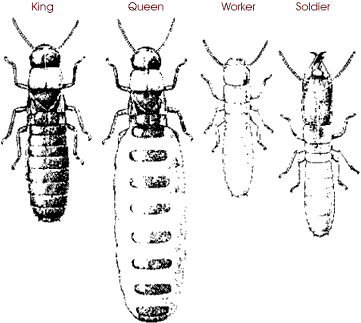
found living in galleries hollowed out of dead wood. Nearly all colonies consist of:
Soldiers and workers probably live for up to 4 years. Superb ways of defenceThe most constant and widespread enemy of
termites is ants, though termite soldiers can put up a formidable
defence using their jaws or chemical weaponry. One species has
developed specially shaped jaws which enable them also to 'flick'
invading ants into the air, away from the colony entrance. Flying termitesThe big event of the year is of course the
mating flight of reproductives, which seems to happen simultaneously
for all members of a species in an area. Immediately the flight is
over, they break off their wings and then proceed in bonded pairs to
dig out their first subterranean home. It is at this time that we here
in Auroville sometimes awake in the morning to a gossamer carpet of
fairy-like discarded wings under outdoor lamps, and the sight of the
last few couples nose-to-tailing off in search of an excavatable spot
for their nest. Rice with termites anyone?The usually followed recipe is: first kill off the crawling mass by heating in water. Next, dry them in the sun, and then heat them on a metal dish over fire. This separates the bodies, so wings and legs etc can be discarded. Finally, add spices, chili, dal or rice to taste, and cook them over a slow fire. Personally I've only tried them once, and have no great desire to do so again, having eaten so many I had a stomach ache next day (people say they taste a bit like fried groundnut or mutton!). Perhaps we could persuade the Solar Kitchen to serve them in season? On the other hand, perhaps everyone would prefer to stick to rice and veggies!) Contact: timwrey@auroville.org.in
|
|
|
Environment & Bioregion > The web of life > Timtopix > Termites |
| Auroville Universal Township | webmaster@auroville.org.in |   |

 There
are many other differences, but perhaps one of the most significant is
that whereas every ant you see is female (except briefly, for a few
hours each year at mating flight time) all termite castes are divided
into approximately equal numbers of males and females at all times.
Even their royalty is balanced, with a king ever present alongside the
queen in a special inner chamber called the 'copularium'. The royal
couple may live up to 50 years in some species, frequently re-mating
to maintain the queen's prodigious output of up to 1,000 eggs a day.
In appearance the king is normal, but the queen is absolutely
something else! Once she starts the colony, her body swells up with
eggs until she becomes a monstrous white caterpillar-like creature,
sometimes up to 10 cms long, totally helpless, and existing only like
some awful machine to endlessly pump out eggs for the colony.
There
are many other differences, but perhaps one of the most significant is
that whereas every ant you see is female (except briefly, for a few
hours each year at mating flight time) all termite castes are divided
into approximately equal numbers of males and females at all times.
Even their royalty is balanced, with a king ever present alongside the
queen in a special inner chamber called the 'copularium'. The royal
couple may live up to 50 years in some species, frequently re-mating
to maintain the queen's prodigious output of up to 1,000 eggs a day.
In appearance the king is normal, but the queen is absolutely
something else! Once she starts the colony, her body swells up with
eggs until she becomes a monstrous white caterpillar-like creature,
sometimes up to 10 cms long, totally helpless, and existing only like
some awful machine to endlessly pump out eggs for the colony.