|
March '03
Enhancing soil fertility with bioelectric eggs
- by Priya Sundaravalli
How to harness living energies for Auroville Farms.
What strikes one about Rolf Brokmeier is his unusually luminous
face, bright and intense eyes and a matching smile; perhaps a
natural spill over from the energies that he deals with - cosmic
cylinders with the charged quartz sunk into still water or the
tall power-tower where one can get a cosmic ray shower… This morning
I am at his home in Petite Ferme to cover his latest foray, this
time it's into eggs - 'bioelectric' eggs to be precise. It is
an exciting reporting assignment, and I immediately perceive that
Rolf is a man of the future.
"It all began four
years ago when I got introduced to the work of the late Viktor
Schauberger who spent his entire life experimenting with living
energies," begins Rolf. He explains how Schauberger (1885-1958)
studied natural shapes and forms and the generation of energy
fields around them, in the process gleaning profound insights
into energetic natural processes still unknown to science. "I
am now in contact with Josef Just, a German researcher who worked
with Schauberger's methods and who confirmed the improvement of
soil fertility. Now Schauberger's entire life works are held at
the Pythagoras Kepler School in his original home in Austria."
Rolf patiently explains
how Schauberger viewed certain opposing forces, such as heat and
cold, expansion and contraction, electricity and magnetism, centrifugal
and centripetal forces, gravitation and levitation etc. as manifestations
of similar energies, but separated by an octave scale. These opposites
are believed to be endowed with specific vibrational powers which
are considered to be 'self-organizing intermediate vibratory matrices
of immaterial energies', that bridge gaps between the will-to-create
and creation, spirit and matter, and an idea and its manifestation.
This is the basis on which one can supposedly generate bio energies
that can increase the soil fertility for several kilometres radius,
using large egg-shaped containers buried in earth.
Whew! It seems to make sense yet is mind-blowing. How will AV
Today readers react to all this…? The moment of doubt subsides
as intuition kicks in asking me to shut-up and open myself. I
feel a new respect for Rolf, and I am all ears to listen.
Rolf says that according
to Schauberger, the deep red ferruginous (iron-rich) earth that
is found in the Auroville bioregion is 'relaxing' in nature and
thus growth-retarding. This may explain the poor fertility of
the region. In such an environment, the use of energy-generating
sources such as these egg-shaped pots can improve soil fertility
and have a significant impact on yield and productivity of these
farms.
With a small seed grant
Rolf has begun testing in two fields at Siddhartha and Windarra
farms. Both Herbert and Fredericke, who run these farms, have
been open and encouraging. While Schauberger used metal eggs,
Rolf patronizes indigenous technology using low-fired terracotta
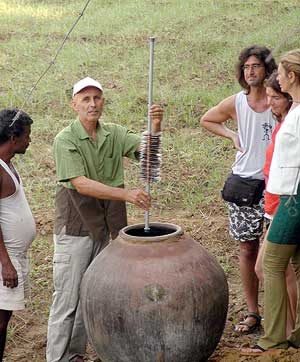
pots which are available in the bioregion. These large pots, traditionally
used for grain-storage, are egg-shaped and 90 cm in length. The
pots are buried in the ground partially or wholly and arranged
in a triangular pattern, with the tips located 11 metres apart.
The pots are filled with water into which is inserted a vertical
array of 24 beaten copper and zinc sheets arranged alternately
along a cylindrical stem. The sheets of copper represent the female
elements while the zinc is the male counterpart, and together
they generate the bio energies that affect soil fertility.
Rolf, like any true
researcher, is well aware of averse factors - in this case the
amount of rainfall, composting, local differences in the micro
environment etc. - which can affect growth or yield. This has
led him to maintain a meticulously detailed data log for each
trial plot. He also believes that the human testers whose fields
these pots are in should have an open attitude towards the experiment.
Since there is no dearth of this in Auroville, one Sunday morning
in early February a trial plot at Siddhartha Farm, which already
contained 5 cm tall peanut plants, was seeded with three giant
terracotta eggs. Observation and the recording of data is being
carried out at regular intervals. The yardsticks of success or
failure of this project will be the growth rate of the plants
and the final peanut yield. Rolf's optimism and hope shines through
and, as I leave, I cross my fingers sending up a prayer for a
demonstrable success of this new experiment. For now, the giant
eggs lie incubating in those two fields working their magic in
Auroville's soil.
|