|
March '03
One family
-
by Alan
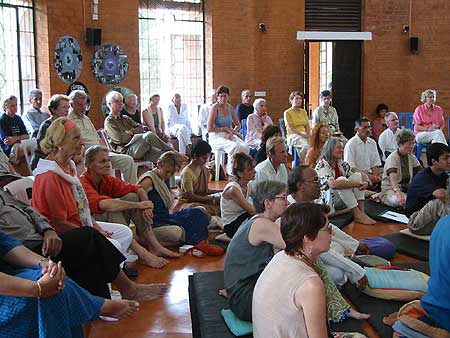
This February,
for only the second time ever, an Auroville International meeting
was held in Auroville. A perspective.
Often it's all a matter of timing. The first time many Aurovilians
heard about Auroville International (AVI) was at the fag end of
a hot, fraught Pour Tous meeting in August, 1983. As people got
up to leave, somebody announced that Aurovilians had to decide,
at that moment, on the wording of the statutes of a new organization
to be based in Holland. "Sounds like another takeover,"
someone sourly remarked. In 1988, when the AVI groups decided
to hold their first meeting in Auroville, their timing was again
spot on, for they managed to arrive at a moment of maximum tension
in the debate over Aurelec and the community's relationship to
the Government of India. The result? Many AVI members felt overwhelmed,
their concerns ignored in the larger imbroglio. "I never
want to meet here again", grumbled one of AVI stalwarts as
she prepared to return home.
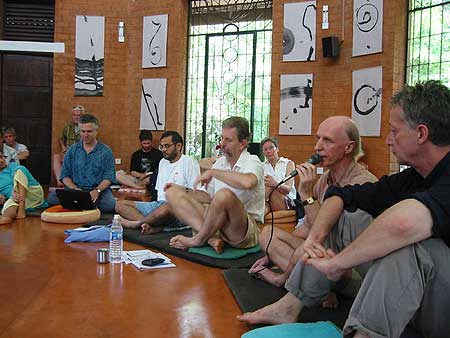
But this year AVI returned,
and this time it was different. For one thing the meetings were
held in Vérité, far from the madding crowd, so that
one of the complaints was that too few rather than too many Aurovilians
turned up for the sessions. This was not just a matter of geography:
there continues to be widespread ignorance among Aurovilians concerning
the purpose and work of the Auroville International Centres and
their relationship to Auroville. One of the main purposes of holding
the meeting here was to remedy this, which is why, on the first
morning, the AVI members spoke about what made them take up this
work. It was a profoundly moving session - as they talked of their
'love affair' with Auroville and of the challenges they faced
in communicating its spirit in places like Russia, Kazakhstan
and South Africa, the depth and quality of their contact was evident.
Afterwards, one senior Aurovilian, who was attending such a meeting
for the first time, said it had completely transformed her view
of AVI: she understood now that we are really one.
During the afternoon
session another relationship was explored - that of Auroville
to the United Nations and its affiliated organizations. In recent
years, concerns about securing the land and thus the integrity
of Auroville's development have led to a number of initiatives
aimed at increasing funding and gaining protection from adverse
development. Interestingly, at least three of these initiatives
involve the U.N. or its agencies.
Discussion of possible
links with the U.N. led onto the second main topic of this year's
AVI meeting - the development of the International Zone. Dr. Ananda
Reddy began with a remarkable presentation on how to find one's
nation soul. We were then reminded that Mother had wanted governments
to be directly involved in the construction of the pavilions.
In this context, there was a proposal that an appeal be made to
UNESCO, through the Government of India, that governments of member
countries follow up on UNESCO resolutions supporting Auroville
by actively participating in the development of the International
Zone as an international university campus devoted to human unity
and global understanding. The AVI General Assembly presented this
proposal to the Governing Board for their consideration, with
the further suggestion that each government might send a few outstanding
young people to Auroville for some months in order to understand
the purpose of the International Zone. On their return, they would
report to their government how it might best participate and be
represented in the Zone.
It's easy to get high
on ideas. Which is why, after the various pavilion groups had
presented their plans, it was important that Gilles Boulicot and
Angad weighed in with reality checks. Gilles pointed out there
is little water in the International Zone, and that rainwater
harvesting can be an expensive proposition even for generously-funded
pavilion projects. Angad mentioned that some of the inhabitants
of neighbouring Kottakarai village are very frustrated. In the
early years much of their land was sold to Auroville but some
of the villagers now find themselves with no money, no resources,
and no jobs. Recently an extension of Kottakarai, Bharatipuram,
has come up. These villages are situated partly in the International
Zone, but Angad suggests that they could become living exhibitions
of vibrant local culture rather than their being housed elsewhere
in model colonies: "To develop the International Zone at
the expense of the villages is absurd."
The last full day was
taken up with guided visits to the International Zone and the
Information Centre, and a tour of the endangered lands of Auroville.
In the afternoon people broke up into smaller groups to discuss
in more detail topics like fund-raising, the presentation of Auroville
in the mass media, and linkages with the U.N. and governments.
Was this meeting a success?
In many ways, yes. Veteran AVI meeting goers talked of experiencing
a different community this time - quieter, more relaxed, but also
more professional in its practical approach to the challenges
of living here - and many were touched by how readily Aurovilians
welcomed them as co-partners. To take but one example: at last
summer's AVI meeting in the USA a proposal was made to include
members of the Centres as full partners in the International Zone
group based in Auroville. When the topic came up for discussion
this time there was clearly trepidation among AVI members that
the Aurovilians on the International Zone group would express
reservations. In fact there was no opposition, and most of the
discussion focused upon keeping the organization as fluid and
open as possible.
There were still complaints
from the Centres that they were sometimes left out of the loop,
notably over the provision of information material like new brochures
and videos, but these came across as niggles rather than indications
of major fault lines. Nevertheless such concerns touched once
again upon the larger question of the raison d'etre of the Centres
and their relationship to Auroville. Over the course of the meeting
various interpretations of this were offered: the AVI members
should be 'watchdogs', ensuring that Auroville moves swiftly towards
the ideal of a money less economy, the AVIs are there to raise
funds and disseminate information, the AVIs can keep Auroville
in touch with a larger world, the AVIs can promote research into
areas essential to Auroville's development etc. etc. There is
some truth in all of these. However, they all imply an instrumental
relationship - the AVIs are there merely to serve Auroville -
whereas the profounder truth may be that members of AVI are carrying
the ideals of Auroville out into a wider world, attempting to
embody, practice and anchor them amongst lifestyles and in cultures
which are frequently not sympathetic or supportive. This is truly
the yoga of the market-place, one of the hardest of all, and it's
high time Aurovilians treat AVI members with the respect and appreciation
due rather than viewing them as Aurovilians manqué or mere
support troops.
In fact, from an occult
point of view it's likely that all those connected to Sri Aurobindo
and Mother have already been together many times through the ages.
Thus any attempt to make distinctions between Aurovilians and
members of AVI is ridiculous. We're family, one family, inspired
and inextricably linked by a common ideal.
If this year's meeting
has in any way illuminated this truth - and the evidence from
some of the attendees is that it has - then it has more than fulfilled
its purpose.
|