|
November 02
The disappearing beach dilemma
-
by Aurofilio
Auroville beaches are under imminent threat
of being eroded
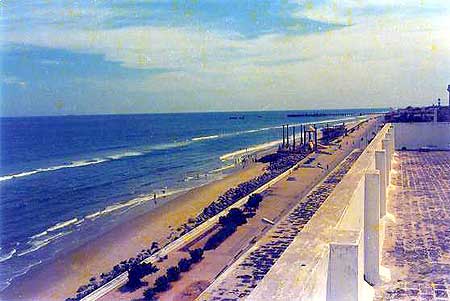
Unsustainable development
practices in Pondicherry are endangering Auroville's beach communities.
They face the prospect of being either washed away or needing
protection by massive seawalls to prevent an erosion disaster.
It has already happened
in the coastal village of Kottakuppam between Auroville and Pondicherry.
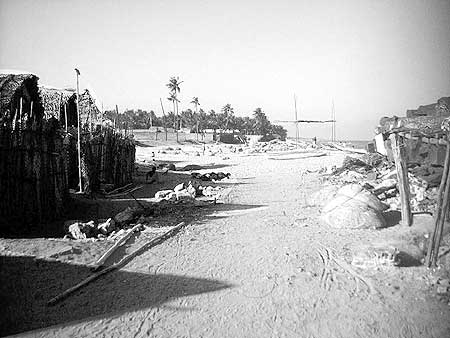
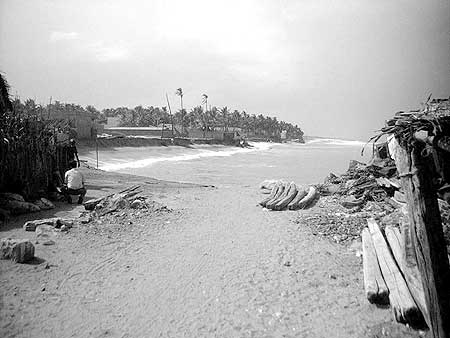
During the recent South-West monsoon the sea eroded a huge part
of the beach and several hundred fishermen lost their homes. To
prevent further erosion and loss of property, the Tamil Nadu District
Collector is now considering dumping rocks along the affected
coastline. Though this measure would bring relief to Kottakuppam,
it would transfer the erosion to the beaches further up north,
including those of Auroville.
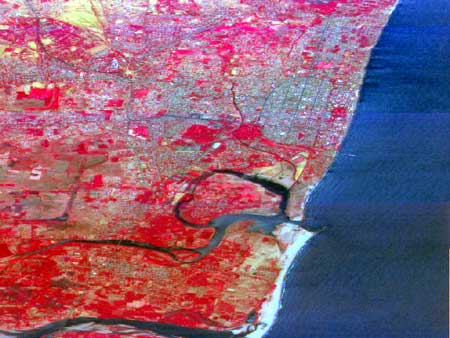
The problem of coastal
erosion originated in 1986, when the Government of Pondicherry
gave the green light to develop a new harbour at the mouth of
the Ariankuppam Estuary, south of Pondicherry. As part of the
New Harbour, two long breakwaters - rocky wall-like structures
that protrude from the shore into the sea - were built. These
breakwaters interfere with the coastal currents and processes.
As a result, a very significant process of coastal erosion was
triggered off. It started south of Pondicherry, from the mouth
of the New Harbour, and grew gradually towards the north. Every
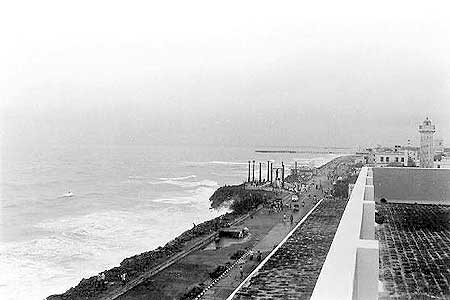
year another large chunk of beach was lost to the sea. In little
more than a decade, all six kilometres of the beach of Pondicherry
town disappeared. Today a rocky seawall extends all the way from
Aryankuppam from the south of Pondicherry to Kottakuppam at the
North. The Kottakuppam beach is next in turn to be washed away.
Beaches are like rivers
of sand, part of a dynamic and complex coastal ecosystem. If one
follows a grain of sand on a beach one will find that it moves
in small leaps and bounds. From February to October sand grains
move from South to North; from November to January they move from
North to South.
Nature, left to itself,
has established a state of dynamic equilibrium in which that which
has naturally gone is replaced naturally. The two breakwaters
at the mouth of the New Harbour interfered with this dynamic equilibrium.
These structures, acting like a dam, interrupted the flow of sand
from South to North. As a result the beaches south of the New
Harbour have grown immensely at the cost of the beaches to the
north, which are now being starved of sand and are therefore perishing.
Auroville's beach erosion
has already started. In the last decade the Auroville beaches
have changed considerably. There used to be a sandbar, a so-called
"underwater island," about 15-30 meters away from the
shore. It no longer exists. The beach itself has become more and
more steep. The beach sand is now coarse as the finer grains were
gradually washed away while the heavier larger ones have been
left behind. These are the first symptoms of beach erosion. The
next thing to happen is that the beach will start receding. And
this will go from bad to worse as long as the problem caused by
the New Harbour breakwaters is not rectified or mitigated.
But instead of tackling
the problem where it originates, the Government of Pondicherry
is planning to protect its coast and restore the beaches along
the town by constructing about 30 "groynes" - rocky
structures similar to breakwaters that stick out like fingers
into the sea perpendicular to the shore. The groynes will be 50-150
m long and placed at regular intervals starting from the New Harbour
all the way to Muthialpet, where Pondicherry state ends and Tamil
Nadu territory starts.
While the proposed groynes will offer at best only some temporary
protection and reduce to some extent erosion along the town of
Pondicherry, they will even more transfer the problem of erosion
to the beaches of Tamil Nadu north of Pondicherry. What the breakwaters
did at the mouth of the New Harbour, the groynes will repeat at
Muthialpet. Just as Pondicherry lost all its beaches, so Tamil
Nadu will lose theirs north of Pondicherry State.
A concerned group of
citizens of Pondicherry has meanwhile obtained independent technical
opinions from the Danish Hydraulics Institute, the Delft Hydraulics
Institute of the Delft Technical University in The Netherlands,
the Canadian Hydraulics Centre as well as from several individual
experts. Their common opinion is that the planned groynes will
not solve the problem of erosion and would transfer and aggravate
the problem of erosion at other locations. Unfortunately the Government
of Pondicherry has not yet changed its plans, which is amazing
as the proposed groynes project is estimated to cost about Rs.
40 crores, an enormous sum compared to the construction cost of
the New Harbour (about Rs. 20 crores in 1986). Moreover, Pondicherry
port is classified as a minor port. Since New Harbour was completed
in 1989 not a single commercial ship docked there until the month
of September 2002 when one ship anchored and New Harbour was used
for the first time ever. During the last two years only 16 ships
came to Pondicherry, but they used the "New" pier opposite
the Ashram Park Guesthouse instead of New Harbour.
The problem is not one
of Auroville alone, but one of the Tamil Nadu State. Should Tamil
Nadu lose part of its coastal environment and its villages because
of the poor coastal management practices of the Government of
Pondicherry? Should Tamil Nadu citizens be bereft of fresh underground
water because the sea gradually creeps inland and the water turns
saline? Should Tamil Nadu lose part of its natural defences against
storms and cyclones? For when the beaches are gone, the land will
be open to the sea's fury. And lastly, should Tamil Nadu lose
the recreational and environmental values of part of its coast?
|