|
November 02
Paper Fascination
-
by Anu
The Auroville Press inspired an unusual
exhibition. A review.
Paper is a magical thing.
In the hills above Manali a shepherd boy stitches together the
fine bark of a Himalayan tree to make school notebooks. In China
and Japan paper is precious, treated with respect. Paper has a
mystique that combines infinite utility with a throw away lightness
and refinement. This rich experience of paper was on display at
the Bharat Nivas gallery in Auroville, August through September:
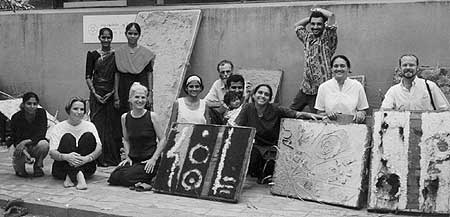
at an exceptional exhibition called Paper Folly, the result of
an artist's workshop, organised by Auroville Press, the creators
of a unique line of hand-made paper and imaginative products.
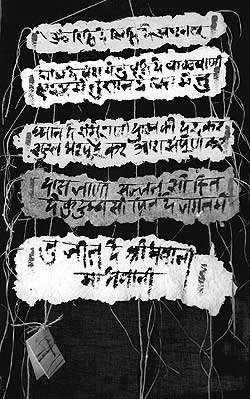 The
exhibition covered two levels. On the ground floor, one encountered
large, elegant sheets made from a variety of fibres: cotton, banana,
casuarina needles and rosella. Big objects made from paper offered
viewers a concentrated impact of the material: a hefty granite
coloured pillow lying on the floor was, in fact, made from 'banana
paper'. An over-size white bowl moulded on a dish antenna was
another startling piece. On the next floor one was surprised by
the outburst of multiple energies, the work of different artists
and designers invited to participate in the paper workshop organised
by Auroville Press. The
exhibition covered two levels. On the ground floor, one encountered
large, elegant sheets made from a variety of fibres: cotton, banana,
casuarina needles and rosella. Big objects made from paper offered
viewers a concentrated impact of the material: a hefty granite
coloured pillow lying on the floor was, in fact, made from 'banana
paper'. An over-size white bowl moulded on a dish antenna was
another startling piece. On the next floor one was surprised by
the outburst of multiple energies, the work of different artists
and designers invited to participate in the paper workshop organised
by Auroville Press.
What led to such splendid
folly?
In 1995, Auroville Press
was going through a financially-trying time. Paper was essential
for the ideas they wanted to develop: was there a solution? One
day Serge reflected, "We have to make paper," an idea
which appealed to Alain instantly. Eventually, Hervé, Luisa
and Olivier took over the production and design side of the new
hand-made paper section.
"In the beginning
we knew nothing," Hervé says simply, "so much
nothing," he laughs, "that we didn't know what questions
to ask. Then Alain went to Chennai and brought back photocopies
of two books on paper and, one Sunday, we tried out our first
paper sample with an idli mixer at Pour Tous." Luisa is more
pragmatic. "In the beginning we had this ambition to produce
handmade paper that would look like stuff that is generally made.
Then," her eyes light up, "we began to experiment, and
in a short time we had done so much that we were ourselves surprised
and we began to get beautiful results."
Rakhee participated
in this phase and even today, when she is busy with her own pottery,
she maintains a close contact. "The basic thing we kept in
mind was the principle of paper itself, taking care it doesn't
become heavy, is easy to handle, keeps its natural quality. Then
it got so much fun that even stuff we thought was very wild could
actually be used for products."
Their enthusiasm proved
so infectious that even the workers were inspired to bring material
from the village and join the initial round of experimentation.
"We never say this is possible or not possible, we say, 'We
Try': that is our motto." More importantly for Luisa, the
paper was finally crafted, made from things of life all around
them, "I felt this paper belonged to Auroville, not only
because of the materials but because of the spirit that went with
it."
Both Herve and Luisa stress the help and kindness they have received
from the Sri Aurobindo Ashram Handmade Paper Factory, in Pondicherry.
"What they know they share and whenever we make a new paper
we show it to them," says Hervé, "they have come
here a few times and are most encouraging."
A walk through the storeroom
reveals enchanting results. Paper of different grain and texture:
fine to caress, embedded with leaves, engraved like stone; paper
blonde as wheat, soft at felt, some like sheets of granite; some
austere, some serene, some like a riot at a fair. All these translate
into products.
"We do everything
from posters to cards, letter-paper sets, portfolios, bags, artists'
paper." Luisa pulls out a lovely folder in white. A natural
fibre sweeps through it like a calligrapher's brush-stroke. "And
we want to do everything else that will evolve." Since two
years they have been exporting to Switzerland, Italy, England,
Ireland and the U.S. Again, the difference is in the imaginative
and elegant styling of their products. "For example,"
says Rakhee, "for the paper-bags for a client in the U.K.
we decided to put leaves only at the bottom of the paper."
This meant no extra cutting and the possibility of keeping at
least one natural edge apparent. Their experiments have led to
a paper that contains all design elements within itself, eliminating
the elaborate cut, paste and print processes normally used which
can make paper rigid or loose its charm.
"It was Rakhee's
idea to do a workshop and the exhibition," said Luisa. "I
was hesitant: Oh my god, how? Where's the time? But Rakhee pushed!
Hervé said yes immediately so I followed!" Hervé
adds: "People always ask what we are doing. No one knew we
were making paper, so this seemed the best way to share. There's
a lot of beautiful stuff going on in Auroville you know, I hope
other units will also show their work."
Organising the workshop
cum exhibition was a huge amount of work. Rakhee's idea was not
only to show the paper but combine ideas with other artists, designers
and crafts people as well. "It was exhausting but it turned
out very well." Hervé says. "People were really
happy with the experience. They discovered the material. Someone
like Adil, being a potter, was immediately at ease with the material.
It was really worth it."
Any unusual experiments?
I ask Hervé.
"I once tried elephant
dung. They use it in Sri Lanka."
"You did? And?"
"We got a sheet
of paper that doesn't smell so bad. But Luisa keeps it far away."
|