|
November 02
When water turns salty
-
by Emmanuelle
Seawater intrusion
in the aquifer threatens Auroville beach communities
 The
beach communities of Auroville are under threat. In mid-July,
the dozen residents of the Repos community were greatly alarmed
to find seawater had infiltrated their bore-well. The situation
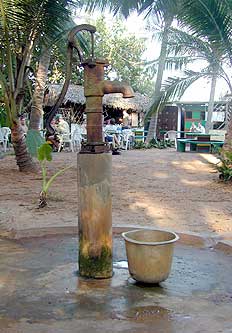
rapidly worsened. Soon, even the water from the hand pumps had
turned salty. Other Auroville beach communities like Gokulam and
Quiet and the beach villages Chinnamodeliarchavady, Perrya-modeliarchavady
and Bommarpalayam too have witnessed seawater intrusion in some
of their wells and hand pumps. It appeared that the entire coast
from Pondicherry to Chennai is suffering from the same problem,
a problem which has also affected parts of Kerala on the western
coast. The
beach communities of Auroville are under threat. In mid-July,
the dozen residents of the Repos community were greatly alarmed
to find seawater had infiltrated their bore-well. The situation
rapidly worsened. Soon, even the water from the hand pumps had
turned salty. Other Auroville beach communities like Gokulam and
Quiet and the beach villages Chinnamodeliarchavady, Perrya-modeliarchavady
and Bommarpalayam too have witnessed seawater intrusion in some
of their wells and hand pumps. It appeared that the entire coast
from Pondicherry to Chennai is suffering from the same problem,
a problem which has also affected parts of Kerala on the western
coast.
Saline intrusion happens
when the underground water level is lower than the sea level.
This creates a vacuum and allows seawater to come in. Manfred,
who has done a lot of research on the subject, explains, "When
the water level of a well is below sea level, then the pressure
of the sea water opens small channels, through which the sea water
enters. Once the connection has been made, the channels will never
close again. The situation is irreversible; the well can not be
used anymore."
The
problem is the extremely low level of the underground water table.
This is only in small part due to the near failure of the summer
monsoon this year. The root cause is prolonged over exploitation
of ground water, mainly because of free electricity for farming.
Farmers, however, are not the only ones guilty of overexploiting
the ground water. Individuals too, though to a lesser extent,
contribute to the lowering of water levels. Auroville residents
are no exception; Auroville's average consumption per capita per
day being extremely high as compared to the average in India.
The
residents of Repos, in order to remedy the situation, have tried
to solve the problem by deepening the bore well by some twenty-five
feet. However, this failed, and the water in the well continues
to be salty. "This leaves no other solution than seawater
desalination," says Myriam, a Repos community member since
many years. "There is already a desalination system in place
in Repos, but that can only desalinate a hundred liters per day.
The Auroville unit Aquadyn has proposed a 'Reverse Osmosis' device
whereby sea water is pressurized through a micro-filter membrane
in which the minerals are caught. The water coming out is then
free of salinity. We would need a system that can filter five
hundred liters per day, which would cost fifty thousand rupees
(US $ 1,000) plus operating charges. These are high as desalination
takes a lot of electricity. We have approached the Auroville community
for financial support."
Fortunately,
after some unexpected but long-awaited pre-monsoon rains, the
water from one hand pump has turned sweet again, due to the run-off
water from inland on its way to the ocean. Until today, this water
is enough for the basic needs of the residents, drinking and washing,
and, thanks to the rains, the coconut palm trees and garden plants
are still alive. But nobody knows for how long the water will
remain sweet, and if it will continue to rain.
|