|
April 2002
"We are a marriage agency!"
- from an interview by Alan and Roger
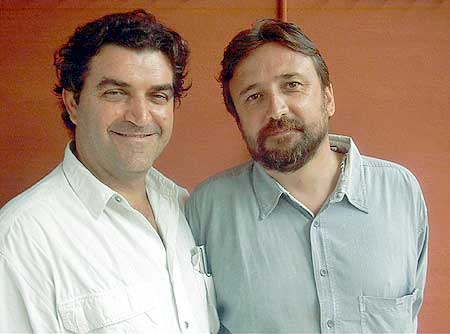
Luigi and Sauro
have been instrumental in linking Auroville to the Asia Urbs
programme. Auroville Today spoke to them after the conference to
find out more about Asia Urbs and the opportunities it opens up.
What exactly is
Asia Urbs?
Sauro: Asia Urbs is a European Commission programme for promoting
decentralized cooperation between cities in Europe and in Asia in
areas like urban management and information exchange. These kinds
of partnership are totally new and reflect the realization that
macro-projects quite often do not deliver the expected results.
Consequently, there is a new emphasis upon small projects which
involve local communities, and in this context cooperation between
the cities of different countries is perceived as being
potentially a very effective tool.
In 1998-1999,
Auroville first submitted a project which was primarily concerned
with our own urban management. Last year Asia Urbs invited project
submissions in a new area - information-sharing. We decided to
apply in this category also because we'd already been trying to
strengthen our contacts with other cities, but the funds we
received under the first project were inadequate for this. So now
Auroville has two projects running under Asia Urbs. Under the
first one, which runs for two years from last March, we are
partnered with the cities of Venice and Cologne. We receive
funding for projects like the Town Hall annexe and expert
assistance from both India and our European partners in
formulating a more detailed Master Plan. We also undertake to
organize workshops for local municipal officers to expose them to
best practices elsewhere. The second project - which will run
until October - includes the organization of the conference which
has just taken place, and the creation of information tools like
databases of European and Indian cities and a website for cities
to exchange information and discuss developments. The website, (www.citynetworking.net)
which will be operational very soon, will initially be managed by
one of Auroville's partner cities, Venice. Paris, another of our
partners for the second project, is coordinating the database of
European cities.
Why did you want to link Auroville to the Asia Urbs programme?
Luigi: The whole thing started for us about 6-7 years ago. During
a meeting about city development, Toine suggested that we ask
cities around the world for support in creating an ideal city. The
idea really resonated with me, and we decided to start approaching
various cities with this in mind. To our surprise, we discovered
that cities understood Auroville much better than other
institutions, and many responded enthusiastically to our
invitation. For example, the chief town planner of Venice told us,
"In our cities it is hard to change something. But you still
have everything open, and that is fascinating."
Sauro: For many years
we'd been frustrated because all of our fund-raising efforts with
big funding agencies came to nothing - either Auroville was too
small for them, or our activities didn't fall within their
parameters. So when the European Commission began talking about
cooperation between cities we thought this might be a better way
to find partners. Originally our motivation was to secure funding
for our own development, but as we networked to achieve this
objective we came to the idea of networking, of facilitating
partnerships, for others also. Hence this conference.
A number of the
delegates remarked that the success or otherwise of the conference
will be determined by the number of practical projects which
evolve out of it. Do you already know of any such projects?
Sauro: There are already a number of different ideas. For example,
Udaipur has plans to link with Venice and Bruges in a project
involving water and heritage preservation. And both Chandigarh and
Dehra Dun have asked Auroville to find them European partners.
In other words, Auroville is becoming a marriage agency!
Luigi: Yes, something like that. It is increasingly being
recognized that Auroville is in a unique position to bridge the
gap between India/South Asia and Europe, and more and more cities
are approaching us to find partners for them. For example,
Pondicherry wanted assistance with a heritage project, and we
found partners for them in Urbino in Italy and Villeneuve-Sur-Lot
in the south of France.
Two main themes for projects emerged out of the conference. One
was heritage preservation and development, which is exemplified by
the Pondicherry project. The other main theme was the promotion of
the concept of "cities of dialogue". Historically
certain cities, like Toledo in Spain, were meeting-points for some
of the monotheistic religions of the world, and consequently
places of tremendous cultural exchange. In the wake of September
11th there is a renewed interest in recreating such multicultural
conditions in the cities which originally fostered them. So we
suggested to Toledo that they explore this idea with similar
cities elsewhere, and at present they are exploring partnerships
with Bhubaneshwar in Orissa and an association of cities in
Greece.
All of this is not only giving Auroville a much higher profile
internationally. It is also demonstrating that we have the skills
and capacity to take on this work, that we are concerned with more
than just our own development, and that money spent in Auroville
is well spent.
This sounds
exciting. Yet there have been some questions raised in the
community about Auroville's involvement in the Asia Urbs programme.
For example, it has been suggested that Asia Urbs may used by some
Aurovilians to steer the development of Auroville in a certain
direction, specifically in the direction of the Galaxy model.
Luigi: Like all other
cities in the project, we have to provide some indication of how
we want to develop. In our case this is the Auroville Master Plan.
This was recommended by the Auroville residents after a long
participatory process, endorsed by the Governing Board and
approved by the Ministry of Urban Development. There is no
question of imposing any plan but of evolving a sustainable
township within the flexible framework of the Master Plan.
Sauro: At the time of making the project application we wondered
if becoming involved with a project funded by an external agency
like the European Commission might fix the lines of our future
development, or create some lack of flexibility in our internal
process. But the first point to make is that the European
Commission is not sanctioning our present Master Plan: they are
merely providing the financial means for us to elaborate it in
more detail so that we can make informed decisions about it.
Secondly, the project we've submitted involves a long phase of
community participation. The idea is that we collect data for 6-8
months (this phase is almost finished), then we elaborate a
preliminary proposal, and then we dedicate 6-7 months for
citizens' participation and discussion. We are already bringing
together Aurovilians involved in activities like water management,
energy and solid waste disposal to see how we can combine
different perspectives and experience. Then, beginning
August-September, we will have a series of one day workshops on
town planning, transport, energy, waste disposal and water
management in which we can discuss our ideas among ourselves and
with visiting experts.
Luigi: Interestingly, other cities involved with Asia Urbs have
told us that it has often been very influential in getting
departments of their municipalities to begin working
collaboratively again. In this sense, Asia Urbs is not only
linking us externally with cities around the world. It is also
linking us within through forcing us to transcend our differences
and work more closely with each other.
|