|
April 2002
Partnerships for Progress?
- by Alan
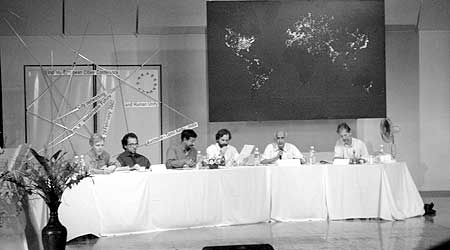
During the last decade, new forms of international cooperation,
aid and sustainable development have been experimented with. One
of those experiments is Asia Urbs, an initiative of the European
Commission. Asia Urbs is based upon the premise that cities and
large towns have common or related problems but that often they
don't share their experience or accumulated wisdom.
Consequently, the Asia
Urbs programme was set up to promote partnerships between cities
in Europe and Asia which would lead to long-term cooperation in
areas like energy generation, waste management, urban planning,
environmental protection and heritage preservation. To date,
forty-five partnerships exist between European and South or East
Asian cities: ten of these partnerships are with Indian cities.
Many of these
partners, both European and Indian, attended the Asia Urbs
conference in Auroville, along with a number of other cities and
towns which are actively seeking partners.
What common themes
emerged? One was the inability of governments and State Sector
enterprises alone to cope with many of the maladies of modern
urbanism - social disintegration, ethnic violence, drugs and
crime, pollution, the destruction of the environment etc. A key
response here was devolution - devolving power to local
communities to allow them to make decisions about the issues which
affect them most. This can take many forms. In Vyara, a town in
Gujurat, the local citizens group (made up of 80% of the
electorate) is represented on all important civic bodies. Under
the influence of this participatory local government, only 22% of
the total income of the town goes to staff expenses (45% is the
norm in India), elected representatives pay for their own travel
and upkeep even while on city business, and tax recovery has
averaged 95% over the past three years. All this has allowed this
small town (population 36,000) to construct a swimming pool and
health center open to all citizens, an old peoples' recreation
center, and a 70-bed hospital.
Last year, Gujurat was
the scene of a massive earthquake. Sandeep Virmani used his
presentation to demonstrate how people's power in Kutch has helped
make the reconstruction process appropriate to local needs. In
many villages, for example, the village committee (containing many
women) surveys the housing needs, receives grants from the
government, then purchases and distributes construction materials
to the inhabitants, many of whom help in the design and
construction of their own houses. In one village, 350 families
chose five from among themselves to form a judicial 'Panch' which
they empowered to settle all disputes.
The process of
devolution has been encouraged by the 74th Amendment to the Indian
Constitution under which the government created, in 1994, a 'Third
Tier' of local government inspired by the old 'Panchayat Raj'
system. This has not only allowed municipalities more control over
their own development, it also has encouraged some of them to
devolve certain responsibilities to their citizens.
Meanwhile, Hans Elemans, mayor of a suburb of Rotterdam in the
Netherlands, has initiated a 'bottom-up' approach to solving
racial tensions, high unemployment, poor housing and other social
problems. The municipality actively elicits ideas from
marginalized sections of the population about how their situation
can be improved. It then tries to act upon them, like demolishing
30% of the old tenements and building affordable but more varied
accommodation. For other European cities represented at the
conference devolution was more about transferring State-run
projects to the private sector.
The trend towards
devolution has been accelerated by the revolution in Information
Technology (I.T.). This has vastly increased the possibility of
disseminating information and of on-line debate, thus allowing
more people than ever before to feel they are 'plugged in'. Anna
Lisa Boni from Brussels expanded upon this in her presentation on
'telecities'. This is an open electronic network through which
over 120 European cities share experiences and help each other
develop practical solutions to problems.
I.T. is also going
down big in India where the first step in urban renewal and
development is often the computerization of existing records. In
towns like Guntur, Ramagundam and Mirzapur this has facilitated
the collection of taxes - a major concern for cash-starved urban
centers. I.T. is also being used to increase municipal
transparency: in the above towns, the progress of complaints,
building permissions, municipal projects etc. can be tracked on
the municipal website.
Another major theme of
the conference was sustainable development, or development which
enhances rather than exploits the environment. In this context,
Jan Dictus presented the 'Eco-Business Plan for Vienna'. The 240
participating companies learn about environmental audits, about
how they can increase productivity and profitability through
environmentally-sensitive practices, and they receive subsidies to
assist them in the 'greening' of their businesses. So far the
saving to Vienna Corporation has been 90,000 kg of non-hazardous
waste, over 12,000 kg of carbon dioxide emissions and 27,000 hours
of kilowatt energy.
Chennai is Vienna's
partner in this project. In Chennai some of the threats to
sustainability were listed as high waste and low efficiency in the
delivery of electricity, high levels of soil, water and air
pollution, poor sanitation, ground water depletion and a high
incidence of poverty. An attempt is being made to remedy some of
these through energy-efficiency programmes in industry and
schools, through promoting renewable energy and water harvesting,
through investigating the possibility of 'eco-earnings' - i.e.
through using waste products as raw materials or turning organic
garbage into compost - and through developing 'eco-enterprises'
which will provide training and employment to the poor.
The final thread woven
through the conference was that of the necessity to preserve
heritage. There was little disagreement that towns like Bruges in
Bel-gium or Jaipur in Rajasthan have a unique architectural and
social fabric which should be preserved. But how? The usual route
so far has been tourism, for this can fund preservation and
restoration projects. However, tourism has the capacity to destroy
as well as preserve local monuments and traditions. A
complementary approach, therefore, focuses upon making the
citizens more aware, and therefore more concerned about, their own
heritage. In Jaipur this is done through the creation of a
'Heritage Walk' which takes people through some of the oldest and
most beautiful parts of the city - the walk begins at a temple and
ends at a mosque.
Was the conference a
success? On many levels, undoubtedly yes. One purpose was to bring
together many different cities in an atmosphere where
cross-fertilization and partnerships could evolve, and this, the
participants agreed, was triumphantly achieved. Another was to
demonstrate a variety of possible responses to the urban
challenges of the 21st century. Here, also, many of the
presentations embodied both a high degree of creativity and
optimism.
However, to the extent
that some of the presentations were intended to be examples of
'best practices' in the areas of urban development certain
reservations need to be expressed. For example, hardly anybody
referred to the actual process by which best practices were
implemented in their town. This left huge question marks. How many
of the best practice objectives, for example, had actually been
implemented? How successful have they been? How did the local work
force respond to new approaches and, if there was resistance, how
was it overcome? Is it possible to transfer practices that have
worked well in the West to Indian towns and cities where the scale
and nature of the problems may be quite different? How well,
indeed, have the existing Asia Urbs partnerships worked?
In fact, listening to
some of the presentations one could be forgiven for concluding
that practices like e-governance or the computerization of records
or the privatization of public works projects are a magic panacea,
universally applicable and universally effective in hastening
change. Yet from the only detailed presentation made - Scott
Gibbons' explanation of the way in which the Mirzapur project was
planned and implemented - it is evident that the magic ingredient,
the "x" factor, in many of the successes presented is
not I.T., nor even the amount of funding available, but the
quality and commitment of the people who are implementing the
programme.
But is this
transferable? And if key people move on, will the structures and
technologies put in place be sufficient to ensure that the
momentum of the project is maintained? How far, in other words,
can technology change psychology? Can corruption in India really
be controlled or even nullified by providing for the possibility
of on-line payment for telephone connections and taxes?
Finally there were the
big terms that hung over the conference like a banner:
"sustainable development", "human unity",
"peoples' empowerment". What exactly do they mean? Do
they require some fundamental change in the way we act and
perceive the world, or are they merely stick-on labels which allow
all of us to proceed much as before but with a mollified
conscience?
The conference didn't
address such fundamentals. No doubt, that was not its immediate
goal. But if such questions are not asked at some point along the
line, then the danger is that Asia Urbs, for all its idealism
regarding strengthening the links between different cultures, will
tend to perpetuate the underlying problems associated with modern
development rather than offer radically new solutions.
|