|
April 2002
Chairman's push results in new Working Committee
- by Carel
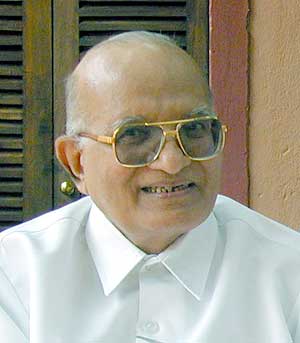
It required the personal intervention of Dr. Kireet Joshi, the
chairman of the Auroville Foundation, for the community to come up
with a new Working Committee. It will hold office till September
10th.
For the last few months, Auroville's internal organization has
come close to being dysfunctional: the Executive Committee had
ceased to exist and the Working Committee had been reduced to one
person. The community was waiting for a new internal organization
to take shape to remedy the situation. But when, in a General
Meeting on February 13th, the sixth draft of a proposal for a
revised internal organization (Towards a Divine Anarchy), failed
to achieve consensus, it became clear that the wait was not over.
Would the dysfunctional situation continue as well?
Dr. Kireet Joshi, the Chairman of the Auroville Foundation,
strongly objected. He insisted that the community select a new
Working Committee immediately. He therefore convened on February
22nd an extraordinary meeting of the Residents' Assembly. A
subsequent public notice from the office of the Secretary of the
Auroville Foundation allayed fears that the Chairman would
intervene in the 'internal workings' of the community. Stressing
that the current situation has risen to the level of an emergency,
the object of the meeting was to encourage the Residents' Assembly
to take up its responsibilities and form the Working Committee
immediately, so that the process to come to a revised
organizational structure could continue unimpeded.
Addressing the meeting, Dr. Kireet Joshi emphasized the urgent
necessity for Auroville to get its act together. He reiterated
that the Auroville Foundation Act, at the explicit request of the
then Prime Minister of India Ms. Indira Gandhi, was drawn up in
such a way that the Government does not control Auroville and that
the members of Auroville are free to develop Auroville according
to the Charter of Auroville. "There was," he recounted,
"at the time a great pressure to provide in the Act for a
committee of non-Aurovilians nominated by the Government to take
decisions. I was able to resist this and explained to the
Government that the residents of Auroville should be free to
decide the manner in which they want to manage their affairs and
that the Act should not contain any prescriptions that might
curtail the freedom of the experimentation of Auroville. This is
based on the ideals which Sri Aurobindo has put forward in his
book The Human Cycle, in the chapter The Ideal Law of Social
Development. This law has never been implemented in world history,
and Auroville should be the place where Sri Aurobindo's ideal can
become implemented. The Government accepted this argument and that
is why the Foundation Act specifies that the residents of
Auroville are free to determine the process by which they want to
constitute their Working Committee and to determine the form of
governance that they want for Auroville. But even after the Act
was passed the attempts to control Auroville from the outside have
not diminished. It is for this reason, in the years that I have
been here with you, that I have been stressing that an appropriate
internal organization should come up in Auroville as a result of
which no group, no government pressure, no political party and
nobody can have the power to disturb the freedom of the Residents
Assembly. It was from this point of view that the Governing Board
constituted a Unity Committee which recently produced the document
Towards a Divine Anarchy draft VI which is now further being
discussed by the community. For it has become urgent that the
community has its internal organization in place, that it has a
clear decision-making process, that decisions have legitimacy and
can be implemented. There are many decisions that are not being
taken, leading to injustices; there are many problems that remain
without solutions; as no decisions are being taken, false
developments happen in consequence. This cannot continue. If this
situation would continue, the Governing Board will have no other
option than one day to take the whole power in its own hands. This
Governing Board would not like to do that, as it is very dedicated
to this idea of freedom.
While the discussions to come to a suitable internal organization
should continue, today's immediate need is to have a proper
Working Committee in place which would hold office until the
community has agreed on a new internal organization."
Dr. Kireet Joshi then made a proposal about how to select a new
Working Committee. As voting, in his opinion, leads to
polarization, he proposed that each Aurovilian nominates one
person and that the persons who receive the highest nominations
constitute from amongst themselves the new Working Committee. The
Residents' Assembly, after some discussion, amended this proposal
to the effect that each Aurovilian bring out two nominations, one
for a woman and one for a man, and that the 30 highest nominees
endeavor to constitute a gender-balanced Working Committee.
The nomination process started a week later. A total of 1056 forms
were distributed to Aurovilians of 18 year and older, but less
than 45% of them filled them in. More than 100 people were
nominated; but only one person received over 90 nominations, and
two persons received between 40 and 55 nominations. None of the
others received a significant number of votes.
It took two meetings for the top 37 people (position 30 was shared
by 8 people) to select from amongst themselves a new Working
Committee. Do we want experienced or new people? The final choice
was a combination of both. The new Working Committee consists of
two experienced Aurovilians and of five people new to the job.
Four experienced former Working Committee members agreed to act as
adjuncts. The other 26 nominated people accepted to act as a
support group for the new Working Committee. It was also agreed
that this Working Committee will hold office till September 10th,
when a new organization should be in place.
|