|
April '03
The aesthetic side of the being
- by Emmanuelle and Priya Sundaravalli
From February 21st to
28th, the Pyramids Art Centre exhibited works of students from
Deepanam and Transition primary schools, from the high schools
Future School, Last School, and After School, and from free
students.
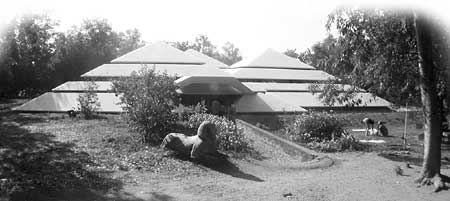
True art means the expression
of beauty in the material world. In a world wholly converted,
that is to say, expressing integrally the divine reality, art
must serve as the revealer and the teacher of this divine beauty
in life. The words of the Mother are a beacon of light guiding
the Art Exhibition at the Pyramids, an exhibition put together
after a break of four years. The primary aim of this exhibition
was to be an exercise in collective learning for the students
of Last School-Super School.
Art and creativity have a very important place in the Free Progress
system of education visualized by the Mother for Auroville. They
aspire to awaken in students a sense, perception, conception and
intuition of beauty. According to Sri Aurobindo, The mind is profoundly
influenced by what it sees and, if the eye is trained from the
days of childhood to the contemplation and understanding of beauty,
harmony and just arrangement in line and colour, the tastes, habits
and character will be insensibly trained to follow a similar law
of beauty, harmony and just arrangement in life of the adult man.
The Pyramids Art Centre receives students of all ages from many
of the Auroville schools. In their approach to teaching art, the
teachers believe in four stages of development and have formulated
appropriate methods for each stage. The first stage is the stage
of the child/youth who has little contact with his aesthetic being
or with the materials of art. In stage two, a certain level of
interest has been awakened in the pupil, which often results in
a spontaneous expression of concentration, a primary quality demanded
in art. In the third stage, the teacher reverses the approach
and begins to require more, to limit and to create a stricter
frame of reference, always and only with the conscious collaboration
of the student. Here the student discovers the tapasya of creativity.
The final stage, which the teachers at the Pyramids confess has
not yet been fully explored, aims to enter into domains of intuition,
to know through experience the capacity to fly high and see far,
so that finally one can identify with the object of work. This
stage is said to correspond to the 'No School' phase of self-development.
The Mother describes artists at this final stage as yogis: For
like a Yogi, an artist goes into deep contemplation to await and
receive his inspiration. To create something truly beautiful,
he has first to see it within, to realize it as a whole in his
inner consciousness; only when so found, seen, held within, can
he execute it outwardly; he creates according to this greater
inner vision. This too is a kind of Yogic discipline, for by it
he enters into intimate communion with the inner worlds.
The setting-up of this exhibition had three aspects to it: the
physical dimension, the psychological dimension, and the educational
dimension. The challenges in the physical dimension included the
full commitment of all students for at least two weeks to plan
and execute the installation, and to make a choice of the art
work and the area of the Pyramids where these would be displayed.
As a collective learning exercise, the students of Last School
were given the full responsibility of creating and putting up
the exhibition, only assisted by the teachers when necessary.
The students were divided into groups, who created displays for
the different types of artwork and mounted them in various areas
of the Pyramids. Equal space, effort and consideration were to
be given to all the work to be displayed - stained glass, sculpture,
sketches, drawings based on architectural perspective, abstract
paintings and craft work, as well as studies of various kinds
and explorations in colour and matter and contrasts in black and
white.
The psychological dimension was more complex, and demanded several
innate strengths and behaviour patterns from the students and
teachers. For the students, this included the necessity to maintain
a collective harmony, to discover for oneself a source of self-confidence
within, to have the ability to make decisions yet harmonize them
with the other team members, to take responsibility and meet the
commitment within the two-week time-frame, and most importantly,
to awaken care and concern for all others in the team. The challenge
for teachers was in their ability to remain available yet as far
in the background as possible.
The educational dimension was aimed at going beyond the outer
forms of aesthetics and skills, aspiring towards a truer measure
of achievement, such as the extent to which deeper issues were
consciously met, understood and surmounted.
"Art is nothing
less in its fundamental truth than
the aspect of beauty of the Divine manifestation".
The Mother
|