|
April '03
Earobic language training
- by Carel
Problems associated with
learning a foreign language may soon be overcome by the efforts
of Auroville's language laboratory and their Electronic Ear
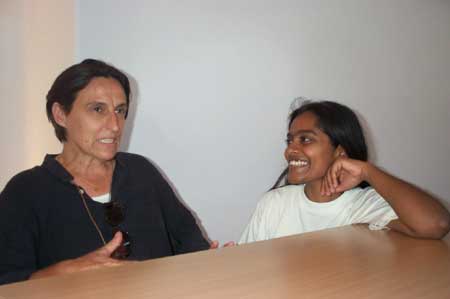
The Auroville
Language Laboratory plans to import an "Electronic Ear,"
a machine devised by the late French scientist Dr. Tomatis, to
facilitate language learning. The function of this machine is
to train a language learner to hear and reproduce the sounds of
the selected language accurately before the normal learning of
a language begins. "You could say that we'll introduce an
adult kindergarten for language studies," says Indian Mita
Radhakrishnan smilingly. Together with French Tapas Desrousseaux,
she is the driving force behind the research and development activities
of the Auroville Language Laboratory.
Dr. Alfred Tomatis was a French ear, nose and throat specialist,
who, along with his wife, Léna Tomatis, conducted research
in audiology, phonology and psychology for over 50 years. Focusing
on the ear as a primary organ of the body, his approach integrated
the study of hearing, voice, speech, language, social-emotional
functioning and behaviour. The interaction between hearing and
the production of sound is called the "Tomatis Effect",
for which he was honoured by the French Academy of Science and
Medicine in 1957.
"The voice can only produce what the ear hears," is
a major axiom of Tomatis' work. If the ear hears properly, the
voice is properly produced. Especially during infancy and childhood,
an intense and continuous learning process occurs on both listening
and movement levels. But these processes can be disturbed by numerous
factors, for example by ear infections, emotional difficulties
such as distress, sensory-motor deprivation etc. He discovered
that the reduced ability to neuro-cognitively process sound and
to listen well is one of the leading causes of learning disorders
such as dyslexia, or in related challenges such as autism. He
devised a machine called 'the electronic ear' to help solve these
problems. This machine helps a person to hear again properly.
But the machine has more than only medical applications. We know
today that during the first half of pregnancy the foetus already
begins to experience and learn, both through listening to its
mother's voice, and through her and its movement. Tomatis has
shown in his experiments how, while already in the womb, we incorporate
the rhythm and melody of our mother's language into our developing
body's movement and respond to them. This influences our later
language skills. Tomatis also discovered that every language has
a particular range of sound frequencies and that a person's ears
are gradually 'set' to that particular set of frequencies. With
the growth of the body, the ear tends to become closed to other
frequencies, making the process of learning a foreign language
more difficult.
Tomatis' research led him to discover the frequency ranges of
all the European languages, as well as of some non-European languages
such as Hebrew, Arabic, Japanese and Chinese. He has installed
these frequencies in the 'electronic ear.' Using this machine
one undergoes a kind of "earobics", whereby the ear
is trained to actually hear the frequencies that one is not used
to hearing.
Mita explains, "There is a passive and an active phase when
one undergoes 'language ear training' using the electronic ear.
In the first passive phase, one listens to the filtered sounds
of the language one wants to learn. You don't hear fully discernible
words. The machine replicates the sounds that a baby hears in
the mother's womb. When Tomatis did studies with pregnant women,
he found that the amniotic fluid that surrounds the embryo acts
as a filter. The filters in the machine perform the same function.
Through the Electronic Ear one is bathed in the language as a
baby would be in its mother's womb. In the active part there is
a repetition of the words by the individual. There is a kind of
voice control which helps you to gradually come closer to the
correct pronunciation of the language you want to learn. So the
machine gives an ear training which precedes the language class.
Once the ear is open to the frequencies of a particular language,
it is a lot easier to learn that language. It has been found that
in some cases the learning time was reduced by nearly half.
"We had been trying to get in touch with Dr. Tomatis since
1998," continues Mita. "Finally, in December 2001 we
had an opportunity to meet him and his wife, Léna. When
we arrived, he had just been admitted to a hospital, where we
had a truly incredible meeting with them. It appeared that he
very much knew and respected Sri Aurobindo's work, and was very
open to our proposal that the machine would be set to include
Indian languages and that the Auroville Language Laboratory would
bring the method to India. Dr. Tomatis passed away a few days
after our meeting."
The Tomatis project will be of great importance to the work of
the language laboratory. Says Mita, "Mother has called us
to build Auroville and one of the crucial steps is to become a
multi-lingual society. She has given four languages to be taught
here, namely Tamil, French, simplified Sanskrit to replace Hindi
as the language of India, and English as the international language.
Our role is to help in this process, for it would be a tremendous
step if all Aurovilians would become multi-lingual, speaking these
four languages, apart from their mother tongue."
The work of the language laboratory is now to select the texts
to be recorded, make audio-recordings and send them to Belgium
where the sound frequency analyses and the adjustments of the
Electronic Ear will be done. "We aim for the time being at
three languages: Tamil, Sanskrit and Hindi," says Mita. "For
the Tamil recordings we have been selecting Ramana Maharshi's
hymns to Arunachala, Sri Ramalingam's poems, and some works from
Thirukural, Periya Puranam as well as Subramania Bharati; for
Sanskrit it will be selected passages from the Bhagavad Gita,
Vedic hymns, stories from the Panchatantra; Hindi we have not
yet decided. After the analysis has been done, we'll both go for
an extensive training period to Belgium. Hopefully, the machine
will be operational in Auroville by the beginning of 2004. It
will help those who want to study any of these three Indian languages,
as well as the other languages in which Dr. Tomatis has done research.
As ten users at a time can be connected to the machine, we expect
that the machine will be tremendously helpful for future language
teaching."
Though enjoying a high priority, the Tomatis project is not the
sole preoccupation of the Language Laboratory. "We have just
moved into our new location in the Last School compound, which
offers great potential. We are setting up a modern media centre
which will give access to audio-visual materials in various languages
through computer workstations. Each workstation will be equipped
with headphones to enable guided and self-study, in addition to
re-organizing the teaching schedule for different languages. We
are also engaged in producing material such as the Spoken Tamil
Book and CD. Then there are other language research projects such
as the 'super-learning' system of the Bulgarian Ivanov, and our
software programme for Tamil and Sanskrit which combines sound
and colour frequencies. But," concludes Mita, "that's
for another article."
contact: mita@auroville.org.in.
|