Repos,
a beach community, works to create a relaxing place for residents
of Auroville while facing many challenges
Entering the
gates of Repos,
you find yourself on sandy grounds shaded by tall coconut
trees. Children are running about bare-bottomed while surfers
clean their boards in the sun. Groups of people sit around
small circular tables discussing life in a leisurely fashion.
Some lie in hammocks reading or simply relax to the methodical
sound of crashing waves. Rainbow colours splash the walls
of the Sunbliss Café where you can buy fresh fruit
juices and sandwiches. A small blue gate leads you out to
the beach where groups of people or individuals lounge on
their blankets and beach towels as others swim out into the
warm waters.
Residents of Repos work hard to keep this Auroville beach
community as it was originally intended to be: a place of
rest (the English translation of Repos) for Aurovilians and
their guests. Today, eight Aurovilians and five Newcomers,
including children, live in Repos and aside from making it
their full time residence, they work together to provide two
recreational outlets for Auroville. One outlet is the community
itself and the other is the beach area lying between Repos
and the ocean where beach-goers can feel comfortable spending
an afternoon. But there are many challenges concerning beach
harassment, sweet water depletion, relations with the neighbouring
villages and the expectations of visitors, as well as the
unpredictable waters of the Bay.
For some years after the Repos community was established,
the beach remained a place for fishermen and was used as a
local toilet. The arrival of Aurovilians in their western
swimwear brought disturbance for everyone. Beach harassment
and thefts were a constant concern and Repos residents worked
to find solutions to these problems. One of the most important
initiatives was building a good relationship with the neighboring
villages. Chinnamudaliarchavady lies to the south of Repos
and survives as a fishing village. With their fishing rights,
they felt that the beach was theirs and the new influx of
visitors was threatening their position. Through communication
and contributions to the village, conflicts were eventually
settled and the fishermen agreed to share the space. Bommayarpalayam,
lying to the north of Repos, is also the home of many fishing
families and similar approaches had to be taken. Although
today there is a much greater understanding between these
villages and Repos, it is still a delicate situation and a
relationship that can't be taken for granted.
Another challenge for the Repos community is dealing with
the harassment from beach visitors. Western swimwear is far
more revealing than any dress a Tamil woman would wear in
public. This is a temptation for many men with nothing better
to do. They arrive in groups, often inebriated, and walk up
and down the beach gawking at women, trying to get the best
view possible and sometimes verbally harassing them. Another
temptation is there for petty thieves who see expensive cameras,
and other valuables lying in tourists bags on the beach while
the owner enjoys the waters. In an attempt to eliminate these
problems as well as to protect people from drowning, Repos
organized a team of life guards. The lifeguard's work is a
difficult one on all these accounts and deserves appreciation
from the Auroville community. After receiving permission from
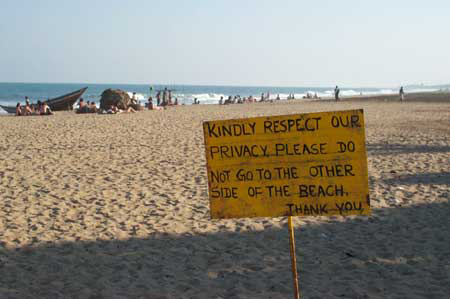
the local police, sign boards were put up in both English
and Tamil saying "Kindly respect our privacy." This
is only calling upon a natural sense of courtesy and restraint
and works very well with Indian families and most individuals.
Yet some people react, feeling that a bunch of foreigners
have no right to dictate boundaries on an Indian beach, especially
considering that beaches in India cannot be privately owned.
An example occurred two months ago when a group of six men
from Pondicherry nearly drowned after consuming alcohol. One
of the lifeguards managed to bring all six men to safety who,
after recovering, proceeded to roam the beach and harass women.
When the lifeguard asked them to move down the beach, he was
beaten up and the police had to be called.
The Bay of Bengal is unpredictable with its strong currents.
Individuals have drowned over the years (though none from
Auroville), despite the presence of the lifeguards who undergo
intensive training once a year with a Swiss swimming master
and regularly practice with an experienced swimmer from the
Repos community. However, many Indian passers-by who don't
know how to swim shouldn't be an additional responsibility
for the life guards as is the case now.
The infrastructure of the Repos community faces its own daily
challenges. Over the years, it has grown to have two showers
for swimmers, a hand-pump for rinsing bodies or surfboards,
toilet facilities and a friendly little café called
Sunbliss. But the public area is not that large and the facilities
are ill-equipped to support the increasing influx of those
seeking a day at the beach. For example, salt water percolated
into one of the two wells last month and the community members
are trying to raise the needed Rs.50,000 to buy a desalination
device. With this and other concerns on their minds, residents
of Repos feel very strongly that Repos is not meant to be
a commercial beach resort. However, it is a continuous work
to keep drawing lines and one that is not very gratifying.
On a more local level, many Tamils who are not residents of
Auroville but who live in close proximity and perhaps work
in Auroville feel they too should have access to Repos, which
is granted whenever possible. Also, tourists from abroad who
have no connection with Auroville see the gates of Repos as
the public entrance to the beach and want access. At one point
the watchman at the Repos gate was given a list of Aurovilians
so that he could regulate those who entered. But it was difficult
to do this and eventually it was given up. Auroville guests
do show their guest card, and an Auroville identity card may
help solve the problem in the future.
On a wider level, Repos receives calls from cities like Bangalore
from families asking to rent ten capsules for two weeks. Why?
A lot of the interest is due to the efforts of the Pondicherry
Tourism Department which has been marketing the area as a
beach resort. As Pondicherry is a seaside city, this has attracted
many vacationers. Unfortunately, the beach in Pondicherry
has vanished and there are few other resorts nearby. Repos
residents would like to encourage the Pondicherry Tourist
Department to create attractive resorts, which could benefit
all. In the meantime, many tourists learn about Repos and
come in the hope of finding a place to stay. When they are
told at the entrance that they cannot come in and must follow
a narrow path cluttered with trash that leads around Repos
to the beach, negative reactions can be expected.
Another challenging relationship is with Periyamudaliarchavady.
This is the village bordering the road that leads to Repos.
Often in villages, the main road is used as a social ground
for the community. Men and women sit on their front porches
while the children play games in the street. With the increase
of traffic from beach goers, this has become a dangerous situation.
Many families have chosen to put metal grills around their
porches to keep their children safe. But this is not a very
satisfying solution for people who naturally live in community.
Repos residents tried to create a parking space on the main
road but it did not work. On a more positive note, Periyamudaliarchavady
residents have seen ways to benefit from visitors and many
have opened little shops, café's and guest houses.
Yet, with all these daily challenges, a space for relaxation
has been created and many enjoy this community and the beach
beyond during their time off. The process of communication
with neighbours and friends is also seen by residents as an
opportunity for a wonderful learning experience and is especially
important where one is consciously working to live without
cultural boundaries. And in the early morning hours, when
the colors of the morning sun glaze the waters, or at night
when the full moon rises with an illuminating orange glow,
all the problems seem far away.