|
August 2002
The influence of Sri Aurobindo has to permeate more
- from an interview by Alan and Abha
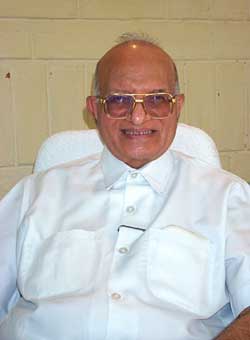 Dr. Kireet Joshi, Chairman of the Governing Board and
International Advisory Council, was in Auroville again recently.
He met many individuals and work groups and addressed the
Residents Assembly. Towards the end of his stay he agreed to an
interview with Auroville Today. Unlike previous interviews we have
conducted with him, the focus this time was upon issues
confronting India as a whole.
Dr. Kireet Joshi, Chairman of the Governing Board and
International Advisory Council, was in Auroville again recently.
He met many individuals and work groups and addressed the
Residents Assembly. Towards the end of his stay he agreed to an
interview with Auroville Today. Unlike previous interviews we have
conducted with him, the focus this time was upon issues
confronting India as a whole.
AVT: What do you
think are the major problems facing India today?
Kireet: There are
many. India is fragmented-when India became free, the Hindu-Muslim
problem was already there. Then there are the problems of casteism,
superstition, poverty, the relativism of ethics, and a pervasive
incapacity at all levels-physical, vital, mental, spiritual.
Once I asked the
Mother, "What is the most important problem of India?"
Mother said, "The constitution of India". It was a
revelation to me! Mother told me India should so change its
constitution that only the people who are capable and honest come
to power. This does not happen anywhere in the world at present!
But in India we have to arrive at a new situation more quickly
than anywhere else in the world because we have taken over from
the British a parliamentary system totally unsuited to our nation.
This problem pervades all other spheres of life, so I fully see
why Mother said this is the most important problem.
Compounding all these
problems, when India became independent we had a very great lack
of vision for the future. Our leaders were mainly socialists, the
rest were religious. Even today there is no other vision.
You mentioned
that Mother told you to go out and make people aware of Sri
Aurobindo's solutions to the predicaments of India. What are those
solutions?
When Mother told me
this in 1971 I began to study Sri Aurobindo from a new angle. The
inner solution to the panorama of problems facing India lies, to
my mind, in three sentences which he wrote indicating what India
has to do if she is to be able to help herself and be of service
to the world. The first task is the recovery, in amplitude and
fullness, of the ancient spiritual knowledge which India has
accumulated. The second task is to allow this ancient fund of
spiritual knowledge to percolate and irrigate various streams of
inquiry in the humanities, philosophy, science, technology, art
and crafts, so as to give a new vibration and fresh impetus to
these disciplines, while developing the critical knowledge to deal
with contemporary problems with originality. Thirdly, a synthesis
of all fields of inquiry should be developed and, particularly, a
synthetic base for a spiritualised society.
How do you
communicate this to people with no background in Sri Aurobindo?
For those who have no
background at all I often analyse certain problems for their
consideration. For example, one of the most important problems
facing India is that of poverty. I've made some study of the many
suggestions proposed to solve this and my conclusion is that these
studies leave out a very important element. There is no perception
that unless there is a tremendous drive in the world towards world
unity you cannot resolve economic problems; that it is only when
the world becomes one that the real economic problems of India and
the world can be resolved. I don't deny the value of programmes of
development, of progress in science, technology and education
which benefit the poor, but these will be accelerated and,
ultimately, only bear fruit in the context of the driving forces
which are trying to bring about the unity of mankind. Now this
dimension is clearly available in Sri Aurobindo. The reason he did
not write any book on the economic development of India is that he
saw that economic problems rest upon the more fundamental problem
of human unity.
Do the present
very pressing problems in Kashmir and Gujarat spring from the same
root cause?
The present situation
in Kashmir and Gujarat is basically a problem of Hindu/Muslim
unity. This is a very difficult problem to solve. It involves a
very deep study of Hinduism and Islam, and the ways by which the
two can be harmonized. Unfortunately, such a study has not been
made. Instead certain clichés have been developed which do not
engage with the fundamental issues.
Then there is a
historical aspect of the Hindu-Muslim problem in India which is
very often put under the carpet because it is feared there may be
major conflagrations if certain facts are brought out. There is a
danger that if these facts are brought out in an unintelligent
manner it may create lots of prejudices. Yet the psyche of India
continues to be greatly shaken by some of the things that happened
from 10th century onwards when Islam entered the subcontinent, and
scholars and thinkers have to come together in a serious manner
and squarely confront the deeper problems which are not allowing a
real union of its people.
Kashmir has been a
constant problem for so many decades now, but we have not
confronted the problem squarely. In Kashmir the problem is
connected with Partition. Unfortunately, the same argument which
was applied to justify Partition continues to be applied
today--the idea that religion is the basis of nationalism. This is
the basis of the whole conflict. Yet from early times there have
been many religions in India. When Buddhism came, India was not
divided on the basis of Buddhism and Hinduism, when Jainism came
there was no such division. If religion is the basis of
nationalism, every country should be divided. Therefore the whole
theory is false.
Do we not need
to move away from a society based upon religious differences
towards a spiritualised society in which such differences are
transcended?
That's true, that's
very true. But for many people such a solution seems too abstract,
whereas if you speak to them about nationalism it is
understandable. In what, then, consists nationalism? This is the
basic question which India, even after becoming free, has not been
able to answer. Sri Aurobindo pointed out that nationalism is
defined by certain elements. A nation has recognizable geographic
boundaries, a common history and, as a result of this common
history, a common aspiration, drive, which is shared by its
people. This aspiration is based upon the highest ideals, ideals
which are cherished, formulated and progressively reformulated, so
bringing about cohesiveness in the whole population because they
enable people to transcend their narrow personal interests. These
are the things which to be emphasized if the national spirit is to
be nurtured. However in India at present no national spirit is
being nurtured, which is a very pitiful situation. Today if you
look at any textbook on India you will find it very difficult to
find a real national history of India based on this large view.
What is it, then, that
has unified India throughout the ages? Sri Aurobindo revealed that
it is its cultural not its political history. If you read the
history of India, political divisions persisted, yet a cultural
unity of India was achieved long ago. All religions participated
in this. All amalgamated into one unity which is the cultural
unity of India expressed through dance, music, art, architecture,
literature-the fundamental rhythm of the literature of India
whether it be Tamil or Hindi or Sanskrit or Bengali. It is this
fact which has to be brought out very forcefully today.
How successful
have you been in communicating Sri Aurobindo's ideas in India?
It's been a painful
experience for me. Sri Aurobindo wrote a very small article
entitled "The Brain of India". In it he said that what
India needs most urgently is brain, brain-power. Unfortunately for
the last 100 years if there is one thing which has not been
developed to the required degree in this country it is
brain-power. The robust intellectuality which was a very important
characteristic of India has not been allowed to manifest because
the scheme of education introduced by Macaulay in the last century
has denationalized the nation. (Baron Macaulay was instrumental in
advocating the spread of Western knowledge through the medium of
English in Indian educational establishments eds.) Our lack of
intellectuality can also be ascribed to the influence of some of
the leaders of India who chose to influence and awake the masses
through mass media and mass language, and to a mindset which
questions the usefulness of any study which does not contribute
directly to economic development. The result? If you speak to
Indians today on any difficult subject at a deeper level, most of
the audience will begin to yawn. If you talk superficially, you'll
be applauded. This is why the influence of Sri Aurobindo has not
permeated more, because to read Sri Aurobindo requires tremendous
brain power.
How can this
situation be changed?
First of all we need
to create at least a hundred expert exponents of Sri Aurobindo who
can expound him in the true light. Not in the religious, dogmatic
kind of way which many disciples and devotees adopt, but as a
thought movement. This requires some preparation. Mother once told
me, at a time when I was teaching Sri Aurobindo in the Ashram
school, that a teacher should not be an intermediary between the
student and Sri Aurobindo. Rather, Mother said, a student should
be given the entire background to an issue, the problems should be
pointed out and then the student should be encouraged to find out
the answers to those problems in Sri Aurobindo's writings. I think
the hundred experts, in addition to being able to communicate with
different audiences in different ways, should have this
capacity--to take their students or audiences to deeper and deeper
levels, and then give them one or two lines from Sri Aurobindo as
a key. Afterwards those who are interested will study on their
own.
Secondly, we need to
prepare new educational materials which will assist people to get
to grips with the essential problems. Thirdly, those who have a
good understanding of Sri Aurobindo should participate fully in
the development of science, philosophy, and all areas of critical
knowledge in India so that Sri Aurobindo's influence can percolate
into these movements of thought.
Fourthly, our own
experimentation in the Ashram and Auroville has to be exemplary.
It's not merely that India needs successful models to emulate.
It's also because people who have passed through great
difficulties and arrive at solutions are the vehicles through
which great forces of thought are released. Unfortunately this is
not happening at present. We often tend to say in Auroville 'Oh
this is not possible, we've not reached that level, it will happen
in due course'. This is entirely inadmissible. Our path is a steep
path, but Mother will not propose something which is not
implementable. It requires a higher level of consciousness, but
that can be developed. We have extraordinary conditions here. No
other group in the world has the possibility of experimentation
that we have got here.
The connection between
Auroville and India is very intimate. If we don't take up the work
Mother calls us to do, the imperfections will invade us. Even the
provisions of the Foundation Act will not save us from the various
forces in India and the West which are bound to invade, and which
have begun to invade, this little place. Therefore we are at a
critical juncture, and we have to succeed. If India is to move
forward, it can only move forward only on the basis of the example
which Auroville can provide.
How optimistic
do you feel about a new movement, a new consciousness prevailing,
both in Auroville and India as a whole? Will we have to go through
many difficulties before it is established?
I'm guided by what
Mother told me in 1973. When the Dalai Lama visited, I had the
privilege of going with him to the Mother. He put a question:
according to him, the ideal would be if communism could be
combined with Buddhistic compassion. Could this happy dream be
realised? It will be done, she said, but if all goes on as it is
going now, it will take hundreds of years. However, if the
supramental manifests it will happen much more quickly.
Then I interjected,
'But the supramental force is now working very powerfully'. Mother
said yes, but then she reminded me of a message she had given me a
few days before:
Before dying,
falsehood rises in full swing. Still people understand only the
lesson of catastrophe. Will it have to come before they open their
eyes to the truth? I ask an effort from all so that it has not to
be. It is only the Truth that can save us; truth in words, truth
in action, truth in will, truth in feelings. It is a choice
between serving the Truth or being destroyed.
This message has
become my guiding force. I simply say to myself, the supramental
force is working very powerfully, therefore a new turning point
has been achieved in world history. If falsehood is rising in full
swing it means now the time has come for it to die. From that time
onwards I've observed falsehood after falsehood first rising then
dying. And this has been my reading of the whole history of India,
of Auroville, the Ashram, and of my personal life.
So my answer is I have
great optimism: in the inner condition of my life I feel very
happy because I have no doubt that the supermind is at work.
|