|
August 2002
Traversing the past with Nergez
- Nergez, a long-term Aurovilian, shares her
life with Abha
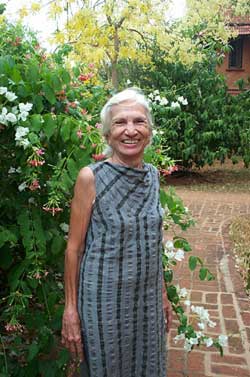 Few Aurovilians would
have experienced a time in India when a meal in a Chinese
restaurant cost less than five rupees and a haircut in an
upper-rung salon only three. Not many would remember the time when
three ships, docked in the Bombay harbour, with one of them
carrying cotton, ammunition, and surprisingly enough, ninety gold
bricks, exploded in a literal shower of gold. One brick came
flying through the roof of the Motiwallah family home, narrowly
missing Nergez's head as she stood day-dreaming in the gallery.
For her father, the head of the Parsi joint family, his daughter's
life had been spared by a divine miracle. The 22 carat gold brick,
with the Bank of England stamp on it and worth about 90,000 rupees
was of little value in his eyes. The following morning, amidst
much neighbourhood speculation, he returned it to the police who
came to pick it up in the official van. The year was 1944, Nergez
was twenty-three, and there were still twenty-eight years to go
before she met the Mother and decided to join Auroville. Few Aurovilians would
have experienced a time in India when a meal in a Chinese
restaurant cost less than five rupees and a haircut in an
upper-rung salon only three. Not many would remember the time when
three ships, docked in the Bombay harbour, with one of them
carrying cotton, ammunition, and surprisingly enough, ninety gold
bricks, exploded in a literal shower of gold. One brick came
flying through the roof of the Motiwallah family home, narrowly
missing Nergez's head as she stood day-dreaming in the gallery.
For her father, the head of the Parsi joint family, his daughter's
life had been spared by a divine miracle. The 22 carat gold brick,
with the Bank of England stamp on it and worth about 90,000 rupees
was of little value in his eyes. The following morning, amidst
much neighbourhood speculation, he returned it to the police who
came to pick it up in the official van. The year was 1944, Nergez
was twenty-three, and there were still twenty-eight years to go
before she met the Mother and decided to join Auroville.
Following the curve of
Nergez's life is much like traversing a multitude of terrains,
some smooth, others uneven. What is remarkable is the spectrum of
personas --the traditional Parsi girl, the fun-loving college
student, the sophisticated and glamourous hostess, the insatiable
traveller, and the undaunted peace-seeker-- that she has inhabited
over the years, dropping a few as she ventured further and further
away from the closed circle of Parsi culture towards the
realization of her truer self. The composite picture of Nergez,
however, would not emerge if any of these pieces of her self were
negated or lost; they are reminders of the transformative process
that she, like countless others, has undergone, before reaching a
state of contentment and unity within.
Born on November 3,
1921, Nergez's travels began in 1951 when she visited Europe with
a group of seven friends from Bombay. Within a budget of 5000
rupees each, they travelled through England, Scandinavia, France,
Switzerland and Italy. In the years that followed she continued to
reside in Bombay where she learnt Hatha yoga under B.K.S. Iyenger,
and became one of the first teachers at a professional level.
Marriage came later in the 1950s. And then the loss of her husband
in 1968.
Nergez arrived in
Pondicherry in 1972 with a group of 18 people, most of whom were
devotees of Sri Aurobindo, and the Mother. Having little prior
knowledge of their work, she briefly met the Mother at the Ashram,
after which her growing interest prompted her to visit Auroville.
She returned for short periods of time in 1974, 1975, and 1976. In
1977, in the face of stern opposition by her brother, she settled
in Utilitè Auroville, for the next three years helping out with
the various communal efforts that were being made there.
The experiences in
Utilitè remain close to Nergez's heart. Her various encounters
with snakes in her keet-roofed makeshift home, the experiments
with biogas, the friendships she formed in those early days, evoke
the feelings of enthusiasm, challenge, and adventure that coloured
her pioneer days, and that continue to motivate her even today.
But Auroville of the early days also contributes to a sense of
regret. The memory of the power conflict between the Sri Aurobindo
Society that wanted continued control over Auroville, and the
Aurovilians' striving towards greater autonomy with the resultant
divisive politics that drove them into opposing camps still hurts.
But her sense of optimism is undimmed. "Those wounds are
healing. There is greater harmony among Aurovilians today."
I persuade Nergez to
tell me more of her life before she came to Auroville. "My
memory is like a sieve, I can remember some things, not
others." Understandably so. Her eyes gaze into times and
spaces that no longer exist. She smiles. Remembers a Bombay of
long ago. The bustling joint family of seventeen people that lived
in the Motiwallah house with its large courtyard. Her schooling in
Alexandra Girls English Institute, and the quick imbibing of an
alien language, that washed as a wave over her whole
consciousness, that overran other alphabets, other worlds, almost
drowning out the Hindu culture that flourished in all its
diversity outside the guarded gates of her home and her school.
Interestingly, Nergez discovered this fecund cultural landscape
through the writings of Sri Aurobindo. Savitri ,for example, was
an eye-opener for Nergez. She read the book, she says, "like
a novel. The language was something that drew me. The similes
elaborated a world that I knew very little about. Hindu mythology
was always something that was outside. Outside the family fold,
the school premises. I still feel sad that I don't know Hindi as
well as I should. But I'm so grateful for knowing a tongue that
helps me to read Sri Aurobindo, and to appreciate the nuances of
his style, the beauty of his thoughts translated into words."
Having read Savitri
more than thirty times, Nergez is an active member of the Savitri
Bhavan study group that hosts many activities during the year. At
eighty she still has a busy life, and is difficult to catch at
home. Nergez enjoys socializing and has always liked community
living. Having contributed in a significant and consistent way to
the evolving city of Auroville, she has served on several
important committees for many years. In the past ten years she has
been part of the Entry Group and taken a prominent interest in
formulating the new entry rules for those joining Auroville today.
Presently, she works for the Housing Group, which continues to
face the challenge of providing viable solutions to the acute
housing shortage in Auroville.
After more than 25
years of living in Auroville, during which time she also briefly
visited Russia, Africa, Iran, and North America, today Nergez
lives in Samasti, after having moved house several times. But if
you thought the Samasti house would continue to always be her
home, think again. "I'm moving to Creativity soon" (a
new community that combines communal facilities with private
living space), she says with her characteristic sunny glee,
"and I will move on to Arka (another innovative
residential-cum-research project that seeks to create a protected,
yet active environment for people above a certain age) after
that!"
Nergez's journeys
continue, and who knows one day we may even catch up with her.
|