|
April 01
Releasing the Aurose
- by Carel
 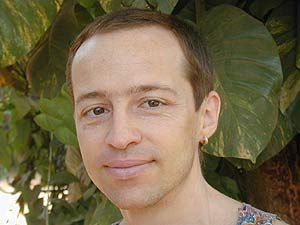
Olivier,
who has been an Aurovilian for the past 12 years and who heads
Auroville's cheese factory at La Ferme, explains the scope of
the Aurose, the new complementary exchange system to be used
within Auroville.
Almost all financial transactions in Auroville go through the
Auroville Maintenance Fund. This has minimised the need for pure
cash payments within Auroville. Most Aurovilians and Auroville
units have an account.
A few years ago the
Economy Group introduced for each Aurovilian who receives a
community maintenance two types of account, a 'kind' and a
'cash' account. The portion of one's maintenance put in the
'cash account' can be withdrawn. The balance is put on the 'kind
account,' which is exclusively used to electronically pay for
purchases made within Auroville such as groceries from the Pour
Tous stall and meals at the Solar Kitchen, or for services
billed through Auroville units such as telephone, electricity
etc. Money from the kind account cannot be withdrawn as cash.
As a first step
towards introducing a complementary exchange system - which in
Auroville would be called "Free-Flow" - it is proposed
that the double accounting be extended to include all
Aurovilians, Auroville units and others who now have only a cash
account. The 'kind' account will be renamed 'the Aurose
account'. The name "Aurose" comes from the combination
of the words Auroville and Rose. The rose is the flower whose
inner truth, Mother said, is Love. It was decided that the name
Aurose would be a beautiful symbol for internal exchanges as
ultimately it is love we are trying to convey through all our
exchanges. There is no plural of Aurose as it expresses the
totality of the energy and creativity of the Auroville
community. Aurose, also, is not a currency, a coin or value
note; it is just the name for how we track our internal energy
exchange through an electronic means of transfer.
The second step is
that the form of the monthly statements of account that each
Aurovilian and unit receive will slowly change so as to make the
Aurovilians aware of where the products and services they use
come from. In future, the Aurose statement will show clearly
which products come from Auroville and which from outside. In
this way, a beginning will be made to create clarity on the flow
of goods and services within Auroville. It is very important to
understand that when we buy from each other we maintain each
other with means that would otherwise have to be earned in hard
cash from outside. We become more self-maintained,
self-sustained.
A next step will be
to stimulate the production of goods and services for use within
Auroville. Nearly all of Auroville's commercial units are
oriented to the making of profit, which they, to a considerable
degree, share with Auroville. But an economy in which we produce
for the outside to earn money that is distributed to Aurovilians
who in their turn spend it outside of Auroville, is not a viable
economy in the long run and now we face the consequences of this
trend. We propose that the units who choose to join the
experiment make their products available to the Aurovilians at
cost-price (the price of raw material, labour, loan
reimbursements and depreciation, but excluding reserves for
future developments) and that the amount of the profit they lose
by not selling the product outside will be booked in their
accounts as a donation to Auroville. Thus, the totality of a
unit's donation to Auroville will consist of a cash donation as
at present, plus the donation of the 'profit loss' that they
have by supplying their products at cost price to Auroville. In
this way, there will be no loss for the unit. Rather, there will
be a stimulus to gradually produce more for internal consumption
as the unit's products will become affordable to the Aurovilians
and the unit will effectively contribute to the ideal of
Auroville becoming a self-supporting township. In addition,
there will be a study of how interest-free loans can be made
available to new or existing units for the creation of products
for Auroville.
The units and
projects who choose to join the experiment will be paid for the
products they supply to Auroville on their 'Aurose' account. The
units will use their Aurose account in the same way as an
individual Aurovilian, except that the unit can transfer both
the Aurose and cash components of the maintenance given to
Aurovilians working for the unit directly into their respective
Aurose and cash accounts.
In case the unit accumulates too many Aurose and needs to obtain
rupees, the Financial Service will exchange the unit's Aurose
for rupees by debiting the Aurose account and crediting the cash
account. The parity will be one Aurose for one rupee.
The Aurose can also play a role in solving the problem of
Aurovilians who are under-maintained. At present, apart from
their regular work for which they get a maintenance, many
Aurovilians take up voluntary, unpaid work for the community
such as teaching or gardening or supervising the maintenance of
the community in which they live. Although this is a wonderful
way to offer service for people who have sufficient means, there
is no reason why this work could not be compensated in Aurose
for those who struggle to make ends meet, particularly if the
extra work could be a means towards a decent maintenance to be
spent in Auroville.
Gradually over the
next two, five or ten years, we can expect that Aurose will
facilitate a lot of exchanges based on the use of Auroville's
own resources and thereby promote increased prosperity for all.
When we have sufficient experience with Aurose, we could even
consider creating more Aurose to stimulate internal production
by sponsoring the creation of new units, or expanding production
of old units so that more products actually needed by
Aurovilians are produced, and for the building of the city. It
is envisaged that in the long run the Aurose will become
superfluous because if there is enough for everyone, we can do
away with the Aurose. And then we will have that economy Mother
spoke of, with no exchange of money, each individual giving of
his or her capacities, and the city maintaining them.
|