|
April 01
The true use of money
"Money is not meant to generate
money."
- by Carel
The concept of
interest is so common that few people ever give it a second thought. As
a rule, an individual puts 'unused' money on deposit against an
attractive interest or uses it for speculation on the stock market. If
you need money, you borrow it against interest. In all cases, money is
used to make money.
"Many of the great political
and religious leaders such as Moses, Jesus Christ, Mohamed, Luther,
Zwingli and Gandhi have prohibited interest payments," said
Prof. Dr. Margrit Kennedy in one of her 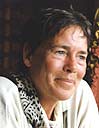 well-attended talks in Auroville on interest and the role of money.
"The prohibition of interest payments by the Popes during
the European Middle Ages shifted the problem to the Jews, who
became, at the time, the leading bankers of Europe. While the
Jews were not allowed to take interest from each other, they could
do so from the Gentiles. In Islam, people do not pay interest
for a loan, but the lending banks or individuals become shareholders
in their business and take part of the ensuing profits."
well-attended talks in Auroville on interest and the role of money.
"The prohibition of interest payments by the Popes during
the European Middle Ages shifted the problem to the Jews, who
became, at the time, the leading bankers of Europe. While the
Jews were not allowed to take interest from each other, they could
do so from the Gentiles. In Islam, people do not pay interest
for a loan, but the lending banks or individuals become shareholders
in their business and take part of the ensuing profits."
Why was the making of
interest forbidden? Margrit explained it was because of the need to
reduce social injustice. Another answer is provided by The Mother, who
explained to Satprem: "Money is not meant to generate money; money
should generate an increase in production, an improvement in the
conditions of life and a progress in human consciousness. This is its
true use. What I call an improvement in consciousness, a progress in
consciousness … everything that leads humanity towards its future
realization. Money should serve to augment that and to augment the
material base for the earth's progress, the best use of what the earth
can give - its intelligent utilization, not the utilization that wastes
and loses energies… it must be used to enrich the earth: to enrich the
earth, to make the earth richer and richer, more active, generous,
productive and to make all life grow towards its maximum efficiency.
This is the true use of money." 1
That this statement also condemned
speculation is obvious. Earlier she had said: "… to say that one
cannot make a heap without making a hole is all right for those who
speculate, who do business on the Stock Exchange or in finance - there
it is true. It is impossible to have a financial success in affairs of
pure speculation without its being detrimental to another." 2
That money as a force should flow and not be hoarded, can also be
inferred from her suggestion to abolish the system of inheritance -
which indeed would free tremendous amounts of blocked energy.3
In relation to Auroville Mother repeated her views: "Here is the
basis on which Auroville is established. Money is not meant to make
money. Money is meant to prepare the earth for the new creation."4
Margrit Kennedy raised four
practical objections to the principle of interest. The first is that
interest, and in particular compound interest, is not sustainable. Based
on interest and compound interest, the value of money doubles at regular
intervals. For the receiver this creates an exponential growth pattern;
but it acts like a cancer in the economic development of those who have
to pay the interest, instead of contributing to a healthy growth. The
recent inability of some developing countries to pay their national
debts was quoted as proof of such unsustainability.
Her second argument is that
the prices of all products contain a concealed interest component. The
exact amount varies according to the labour versus capital costs of the
product. But on average, states Margrit, we pay about 30% to 50%
interest in the prices of our goods and service. Interest is the major
cause of rising prices since it is hidden in the price of all that we
buy.
Her third objection is that
the interest system has proven to favour the rich at the cost of the
poor. The interest system has allowed for a hidden redistribution
mechanism which constantly shuffles money from those who need to work
for their money to those who have more than they need and therefore can
lend out their money and earn without having to work for it. As a
consequence, ever larger amounts of money are concentrated in the hands
of ever fewer individuals and corporations. In fact, these corporations
get so rich that often their earnings on interest exceed their earnings
on their normal business activity.
Lastly, there is the role of
inflation in our economic system. Most governments in the world borrow
to finance their activities, and pay interest. The discrepancy between a
government's earnings through various taxes and the interest it pays is
one of the causes of inflation. Margrit gave the example of the Federal
Republic of Germany. In the period between 1968 and 1989, the
government's income rose by about 400%, while its interest payments rose
by 1360%. Inflation then serves to diminish the gap between income and
debt.
In fact, concluded Margrit, the world economic system has become
uncontrollable. Speculation in money alone is now responsible for 98% of
all money transactions of the world, while only 2% deals with financing
world trade. Many leading economists now foresee a major global economic
breakdown.
Margrit's words reminds one
of Mother's prediction made in 1956: "The age of Capitalism and
business is drawing to a close…"5
Mother indicated that money should circulate. Margrit, suggested that a
'parking fee' on money would serve the purpose to keep money in
circulation. She gave the example of the small Austrian town of Wörgl.
"Between 1932 and 1933, this town started an experiment and issued
32,000 'Work Certificates' or 'Free Schillings' (i.e. interest-free
Schillings), covered by the same amount of ordinary Austrian Schillings
in the bank. The citizens built bridges, improved roads and public
services, and paid salaries and materials with this money, which was
accepted by all. The fee on the use of the money was 1% per month or 12%
a year. This fee had to be paid by the person who had the banknote at
the end of the month, in the form of a stamp worth 1% of the note and
glued to its back. Otherwise, the note became invalid. This small fee
caused everyone who got paid in Free Schillings to spend them before
they used their ordinary money. People even paid their taxes in advance
to avoid paying the small fee. Within one year, the 32,000 Free
Schillings circulated 463 times, thus creating goods and service worth
over 14,816,000 Schillings. The ordinary Schilling by contrast
circulated only 21 times. At the time when most countries in Europe had
severe employment problems, Wörgl reduced its unemployment by 25%
within this one year. The fees collected by the town government which
caused the money to change hands so quickly amounted to a total of 12%
of 32,000 Free Schillings, or 3,840 Free Schillings. The experiment
ceased when the Austrian National Bank, fearing for its monopoly on the
printing of money, prohibited the local money. The experiment with
alternative currencies, however, did not cease with Wörgl. As of today,
many places in the world use alternative means of exchange
successfully," explained Margrit.
Would an alternative means
of exchange work in Auroville? Nobody knows. Margrit, however, is
convinced that it will not only work, but will bring much wealth to the
community. Warning once again that the global economic system will break
down at some point in time, she advocated the introduction of a
complementary, means of exchange which could operate parallel to the
existing one. In answer to the observation that 90% of Auroville's
requirements come at present from outside - and so will have to be paid
in rupees - she stated that the internal system would create awareness,
independence and allow the gradual increase in production of products by
the city for the city, and would so contribute to the ideal expressed by
Mother that "Auroville will be a self-supporting township."
And she once again referred to the Wörgl experiment: "The town's
mayor convinced all the citizens there that they have nothing to lose if
they would start the experiment. The same goes for Auroville. If
Auroville wants to take up the challenge to become a research and
demonstration site of a replicable economic model elsewhere, an
experiment with a complimentary means of exchange is the obvious next
step."
1 Mother's Agenda
I, October 4, 1958 p. 204-205
2 Talk of May 3, 1951, Mother's Collected Works Vol.4, p. 377
3 Mothers Agenda X, August 27, 1969 p. 311.
4 Mother's Agenda I, undated 1958, p. 206
5 Mother's Agenda I, March 21, 1956, p. 70
|