|
April 01
Beyond capitalism and socialism ?
A perspective on Auroville's Commercial Units
- by Jean-Yves
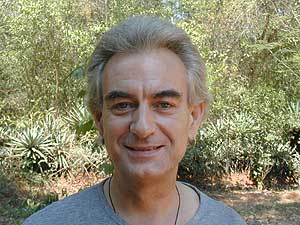
Jean-Yves came to
Auroville six years ago, and has been teaching at Last School ever
since. His main fields of research are history, economy, arts and
literature. In France he was active as a management consultant and
advised on the start-up of new businesses.
We often fail to take the
time to observe our collective life, but if we do not evaluate our
experiment, we don't know were we are. Sometimes we even forget where we
want to go.
Historically, the commercial units have developed mainly as a response
to the shortage of funds generated by the crisis between the Aurovilians
and the Sri Aurobindo Society in the early years of Auroville. They have
not developed as an organic response to internal needs. Some of them
have succeeded. The advantage is that Auroville now has a stable source
of financial support through donations; the disadvantage is that we have
not created ways of responding to internal needs because we mainly
export what we produce and mainly import what we consume, thus
maintaining the need for using money. In other words, we have increased
our monetary resources more than we have induced an internal economic
development. An Auroville economy based on another movement than the
exchange of money still has to manifest, and is only now beginning to be
explored. Nevertheless, when we examine the performance of our
commercial units, some interesting features appear. But we must first
remind ourselves of the context of their activity.
Everywhere in the world, the
economy is powerfully structured by two elements. Firstly, the right of
private property, which is often presented as an essential condition for
free enterprise, risk-taking, progress, wealth creation and competitive
innovation. Secondly, the enlightened Welfare State taxing the economy
in order to redistribute and re-allocate the wealth created. The first
element is at the basis of capitalism, the second one at the basis of
socialism. They generate two types of tax, one on capital, in the form
of interest, the second on the collective, in the form of sales tax and
income tax. These are the pillars of the world economy, and you will
find no expert in the world ready to say that they are not essential for
wealth creation and distribution.
Yet, these two pillars have been removed by the Mother at the outset of
Auroville: no private property, no state, no tax. What will fulfill
their social function?
What is happening is that in
the financial year 1999-2000 the Auroville commercial units had a
turnover of 254 million rupees (US$ 5.5 million), generating profits of
around 20% of the turnover. Around 50% of the profits are allocated by
the units as donations to Auroville, either to specific projects and
needs (they are then called 'specified donations'), or to the Central
Fund for collective use (the so-called unspecified donations). The
tendency, as shown over the last six years, is that donations from the
profits are on the increase and, equally, that there is an increase in
donations given unspecified to the Central Fund. Looking at the balance
sheets we note good solvency, an almost total financial independence
(few loans), and a cash situation representing 3.5 months of turn-over.
This cash, which is accumulated from net profits after donations, is the
financial resource for future investments.
These figures tells us two things: firstly, that the absence of
ownership and of profit-distribution to owners of capital does not seem
to be an indispensable ingredient for commercial dynamism and
profit-making. Secondly, that the absence of a tax system does not
prevent the units contributing to Auroville's collective life, and at a
rate superior to many income tax rates in the world. The sacred pillars
of both capitalism and socialism have been remo-ved, yet still there is
commercial and financial development that could satisfy, to a large
extent, those who believe in free enterprise and those who believe in
state regulation.
One could conclude that Aurovilians are really great! But some
scientific prudence is needed here, for we know very well that we are
not so great. Firstly, it should be noted that the majority of the
commercial units are small and the profits can hardly do more than
support the unit holder and his family. One unit is far ahead of the
others, representing 30.5% of the income, 69.8% of the profits, and
44.5% of the donations. Small units tend to contribute more out of their
profits (between 60% and 80% or more), but big units tend to contribute
more through unspecified donations. Then there are some weak points:
Auroville depends on a few units for its financial resources. It is true
that we often have a high contribution rate but the specified
contributions are not clearly known and cannot be studied and
interpreted.
Also, cash reserves are kept as a security when they could circulate
more if more transparency and mutual trust existed. I would rather
credit the systemic effect for what is positive in our performance: when
you remove private property, interest, dividend and state-tax from an
economic system and replace them by a set of values centered around
self-giving and service, something is bound to happen. If the units can
allocate around 50% of their profits toward the collective without
hampering their development, it is for macro and micro-economic reasons.
On the macro-economic side, the absence of private property has a direct
consequence on the capacity of the units to contribute, for when no
dividends have to be paid to share holders and no loans taken (the
assets do not belong to the unit and thus cannot be used to mortgage
loans) then no interest has to be paid and you get more available profit
to contribute to the collective. On the micro-economic side, the
readiness of the unit holders to contribute is greater when their
contributions are not fixed under a compulsory tax system. But these
technical features do not work on their own. Their final outcome depends
on the social system of which they are part, organized around a specific
set of values, oriented to service and giving, which have been accepted
by the community and thus arbitrate more or less the collective life and
the individual decisions in a manner which tolerates even defects in its
application. The creative role of values in economic mechanism has thus
begun to be illustrated here in Auroville, and this is already a useful
contribution in the present economic context of globalization.
|