|
Aug 2001
A true fraternity?
Is Auroville living up to
the Mother's vision? Perceptions of Tamil Aurovilians
- by Shanti Pillai
based on interviews
by Ann Riquier, Pooja Triveni, and Shanti Pillai
From Auroville's inception,
Mother encouraged the participation of local Tamil people on equal
footing. Illustrative is her reply to the question of whether at that
time the houses of the Westerners were to be different from those
planned for Tamil people.
"No, those who
cannot accept to have the same houses are not ready to live in
Auroville. The stinginess must stop. It is not only the houses but the
condition of the soul which must be built in Auroville." (1)
And she wrote a message to
the inhabitants of Aspiration about the need to develop a true
fraternity with the villagers:
"A relationship that
is not only cordial but friendly with the inhabitants of the
neighbouring village is absolutely indispensable. For the realisation of
Auroville the first step is to establish a true human fraternity - any
shortcoming in this regard is a grave mistake which can compromise the
whole work.
My blessings are with all sincere effort towards harmony." (2)
 Syamala, who was one of
those asked by Mother to speak about Auroville in the village of
Kuilapalayam, remembers that the response to the idea of Auroville was
at times negative, due to the fear that outsiders would appropriate
scarce resources. Mother was well aware of this inherent mistrust. In
July 1972, she wrote to someone who had offered to help clean Last
School: Syamala, who was one of
those asked by Mother to speak about Auroville in the village of
Kuilapalayam, remembers that the response to the idea of Auroville was
at times negative, due to the fear that outsiders would appropriate
scarce resources. Mother was well aware of this inherent mistrust. In
July 1972, she wrote to someone who had offered to help clean Last
School:
"It is all right.
But while putting things in order, be very careful not to offend the
people from the Tamil village. It has been very difficult for us to win
their confidence and nothing should be done which could make them lose
this new-born confidence which is of capital importance.
Take with you someone who knows and speaks Tamil fluently so that you
can talk with them and explain things to them.
They are your brothers in spirit - this should never be forgotten."
(3)
The villagers, however, were
receptive to Auroville's spiritual ideals. Syamala observes,
"Collectively, their psyche was 100% ready for the manifestation
that was to take place." With Mother's approval some local families
and individuals integrated into Auroville. Six families began to
participate in agriculture and to work in the kitchen or health centre.
Their integration took place under the conditions of a moneyless
economy. Like everyone else, they received no cash, but had basic needs
met, including a school for their children. They were Aurovilians, there
was no discrimination. Indeed, many Tamil people who lived through this
experience feel that at that period there was a greater sense of
fraternity than today. Youth especially did not feel separate from
others growing up. During Auroville's conflict with the Sri Aurobindo
Society (1973-1980), however, most of the original integrated families,
uncertain as to where to pledge their allegiances, returned to the
village. Several re-joined Auroville later.
What brings Tamil people to Auroville now?
Whereas few Tamil people
became Aurovilian at first, as the community grew their numbers
increased, and today they constitute a large percentage of applicants to
become 'Newcomers' in Auroville. While some come from elsewhere in Tamil
Nadu and are well-educated and knowledgeable about the community's
philosophical base, the majority of these applicants hail from the
surrounding villages, where they had little opportunity to receive a
proper education. Many come into contact with Auroville first as
workers. Others are family members, including newly wedded husbands and
wives, of those who are already Aurovilians. A new category are the
young adults who have been educated at New Creation or at After School.
The reasons for joining Auroville are varied. According to an Entry
Group member, some come because of their contact to Mother and Sri
Aurobindo, ex-pressed less as knowledge of their teachings than through
bhakti [devotion]. Quite a few emphasize that they like the quiet of
this place, as compared with the strife of village life. Many are
attracted by the idea that Auroville is a place for people to live as
equals.
Along with these statements delivered to the Entry Group, however, there
are in some cases other motivations. The opportunities that Auroville
provides for a better material life cannot be overlooked and it is only
natural that villagers, like people anywhere, seek out Auroville as a
means for improving their standard of living.
This situation is not only
upsetting to some Westerners. It also upsets some Tamil Aurovilians, who
feel that more should be done to ensure that Auroville is not used as a
conduit for economic advancement.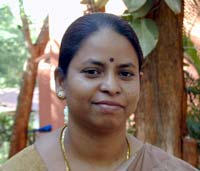 Surya-gandhi, for example, who plays
an important role in the dental clinic, stresses, "Auroville is not
a place of assistance. However, economic aspects are often what attract
local people. This mentality must change and they must learn to follow
what Mother established for becoming Aurovilians. They must realize that
life here is not as easy as it seems. Coming here means dedicating
oneself to the aspiration of Auroville, and this demands many
sacrifices." Surya-gandhi, for example, who plays
an important role in the dental clinic, stresses, "Auroville is not
a place of assistance. However, economic aspects are often what attract
local people. This mentality must change and they must learn to follow
what Mother established for becoming Aurovilians. They must realize that
life here is not as easy as it seems. Coming here means dedicating
oneself to the aspiration of Auroville, and this demands many
sacrifices."
Dealing with people who join
Auroville for motivations other than those set forth by Mother is not a
problem restricted to Tamil people, but can be said of individuals
coming here from anyplace. As an Entry Group member states, however,
members of the Entry Group, most of whom are not Tamil, have difficulty
evaluating a Tamil applicant because of cultural differences. "Its
easier for me to read Europeans," tells the Group member.
"Shared culture makes it easier to communicate and discern
someone's intentions." Resolving these ambiguities may happen in
time. At present there is a move to involve more long-time Tamil
Aurovilians in the entry process. Such people would play an important
role in communicating Auroville's goals and helping Tamil Newcomers to
participate fully in communal life.
Economic concerns
Not so long ago the Entry
Group closed Auroville for a while, as there was a substantial lack of
housing for Newcomers causing many of them to live in unacceptable
conditions such as in sheds and storerooms. The Auroville Economy Group
warned that the community was unable to build free houses for those
without their own financial means. While Auroville has again opened its
doors, the housing situation has not substantially changed. Although
many Westerners with limited resources are caught in the same dilemma,
the situation is particularly acute for those who come to the community
from the local region. This remains a serious handicap for many aspiring
Tamil Newcomers.
Unfortunately, there is also
no easy solution, as the maintenances earned in Auroville are, in the
best case, sufficient to make a living, but insufficient to save to
build a house.
It may not be surprising
that some Tamil Aurovilians supplement their incomes by running side
businesses, often profiting from skills and contacts made in Auroville.
Money earned in these ways may go towards building a house, and
fulfilling the many economic obligations that several Tamil Aurovilians
have with their families both within and outside Auroville. Living
frugally and using benefits provided by the community, such as free
education, subsidized clothing and house repair maintenance, some
families manage to do well financially.
Some even invest in
"chit funds" (group organized loan pools) that allow them to
amass considerable wealth, that is then used towards educating children
outside Auroville, or, as it is rumoured, investments in immoveable
property elsewhere.
The growing materialism of
some Tamil families has garnered the disapproval of some other Tamil
Aurovilians interviewed. Manifesting as gold ornaments, or elaborate
childrens' birthday parties, these new forms of wealth often remain
hidden to other Aurovilians, sometimes leading to situations in which
people who have sufficient resources of their own still seek support
from communal resources. However, this is not a problem restricted to
any one population. Any increased emphasis on financial gain must be
read within the context of the growing materialism in Auroville as a
whole.
Education
Although Mother has said
that Auroville is to be a place for "unending education," at
the level of adult education little has been done. Many Tamil people
underline the importance of education to help in orienting themselves
towards Auroville's ideals and concur that the process of explaining the
significance of Auroville must begin the moment an application is given
to the Entry Group. Some believe that the creation of special programs
for Tamil women would be efficacious in the development of the community
as well. As one woman explains, "It is not easy for a Tamil woman
to integrate. While they may find work in an Auroville unit, at home
they are dedicated to family life as if they would be living anywhere
else in Tamil Nadu. Some form of education is necessary to broaden their
experience, to integrate them in the society of Auroville on their own
merits instead of as an appendix of their husbands, allowing them to
take more initiative than they are used to."
But education is two-sided.
While understanding the aims and ideals of Auroville should be mandatory
for any Newcomer, so also should be a basic understanding of local
culture on the part of those who come to Auroville from other places.
Many Tamil Aurovilians interviewed feel that Westerners should receive
instruction in Tamil culture and language, and also in Indian history.
Many concur that several misunderstandings might be avoided were
Westerners more sensitive to the "do's and don'ts" of local
custom, let alone if more had a minimal knowledge of Tamil. Some are
hopeful that the situation will eventually change. In a promising
development, a new Entry policy attempts to provide education on the
ideals of Auroville to Newcomers, while other groups are promoting more
than ever language classes in English, Tamil and Sanskrit.
Cultural identity
Auroville is a place in
which the best elements from all the world's cultures should contribute
towards the future. In light of this, the position of Tamil culture is
ambiguous. Some Tamil Aurovilians remain tied to their cultural identity
in ways that do not permit them to gain a broader perspective. Because
family is such a central part of anyone's life in India, many Tamil
Aurovilians regularly visit extended family living outside the
community. These interactions reaffirm ties to the customs and religious
beliefs that give meaning to daily life in Tamil Nadu, in addition to
involving some Tamil Aurovilians in local grievances and politics. Jothi,
who grew up in Auroville, sees this situation as partially problematic.
"Quite a few Tamil Aurovilians live no differently than in the
village. This prevents them from focusing time and energy on Auroville's
progress and from orienting their thinking towards human unity and a
moneyless economy."
At the same time, some Tamil
Aurovilians express feeling a sense of loss of cultural identity.
Interacting with an environment that is ostensibly Western, some Tamil
people have a tendency to forget 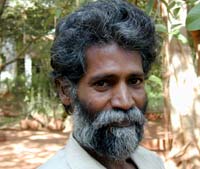 the value of traditional practices.
Raman points out how neglecting the beauty of the past may not be in
Auroville's interest. "Auroville made me lose and then rediscover
the value of my roots. When all Aurovilians realize the true wisdom of
their own cultures, then the collectivity will form better. And when you
appreciate the value of the past, you aren't so into modern
consumerism." the value of traditional practices.
Raman points out how neglecting the beauty of the past may not be in
Auroville's interest. "Auroville made me lose and then rediscover
the value of my roots. When all Aurovilians realize the true wisdom of
their own cultures, then the collectivity will form better. And when you
appreciate the value of the past, you aren't so into modern
consumerism."
So far, there is little
interest in Tamil culture in Auroville. Sporadically,
Tamil cultural events are organized, such as Tamil New Year and
Deepavali, with dinner and fireworks. While such activities are well
attended by Tamils and Wester-ners, a majority of Tamil Aurovilians may
not participate. As for classical or folk arts, apart from some
bharatanatyam dance performances, surprisingly few events are organised
that express the incredible richness of Tamil culture. Most Tamil
Aurovilians interviewed acknow-ledge that they have only little
knowledge about their own literature and art and therefore do not or
only marginally contribute to the organization of cultural events. Many
Westerners, on the other hand, do not seem overtly interested to learn
about Tamil tradition or language. In this context it is not surprising
that plans for a Tamil Heritage Centre remain unfulfilled.
Discrimination?
In asking Tamil Aurovilians
to describe the difficulties they experience in Auroville, the terms
'racism' and 'discrimination' are often used as an emotionally charged
way of describing the treatment they sometimes encounter. Few people
reported of incidents of physical violence, but many gave examples of
subtle forms of perceived discrimination.
One of the hallmarks of racism is that people are not seen as
individuals, but rather as part of an undifferentiated mass. Some of the
people interviewed here cited the fact that many of the Western
residents never learn the names of the Tamil Aurovilians, even those
with whom they interact regularly, which is experienced as arrogant
discrimination. Alternatively, Tamil Aurovilians are even misidentified
as either someone else or as 'workers.'
Other forms of
discrimination are experienced at the workplace. Though quite a few
Tamil Aurovilians have become unit executives or hold other positions of
responsibility, many Tamil Aurovilians work at the lower ends of
work-place hierarchies, often with western Aurovilians as employers. As
Raman points out, "This worker-boss relationship makes it easy for
those with more capabilities and power to feel superior to those with
less. Just because a person did not have the circumstances that allowed
him or her to come up in this world, does not mean that they do not have
the same spiritual aspirations." The ways in which this false sense
of superiority gets expressed is often unacceptable. For example, many
of the interviewees expressed their frustration over being yelled at by
Western Aurovilians, or generally reprimanded in the workplace as if
they were children, in the presence of co-workers. "I wonder if any
of these Westerners would behave like this in their own country,"
observed one of the interviewed. "These instances affirm the fact
that some Westerners do not understand Tamil culture, and have not yet
cared to learn to communicate better with Tamil people. It also
demonstrates their tacit assumption that Tamils should always
accommodate them." Such arrogance contributes to Tamil people's
common perception that foreign Aurovilians believe themselves to be
superior. As one Tamil woman forcefully puts it, "Foreigners come
here and think they can do as they please. Half the time they don't
think that a Tamil Aurovilian is capable of doing anything." Such a
comment reveals much about the experience of Tamil Aurovilians. At the
same time it demonstrates how stereotypes exist on both sides.
Being treated with unfounded
suspicion is another form of discrimination. Raman explains, "In
the past, when there was less theft, everyone moved freely and received
a warm welcome. These days Auroville is not a free city. Whites enter
places easily, while we must answer many questions. Our own people, who
work as watchmen, respect foreigners more!" Other examples display
some Wester-ners' fears that only selfish interests motivate Tamils.
Hari, who grew up in Auroville and runs the Transport 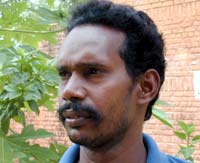 Service, cites a
time a couple of years ago when some Tamil Aurovilians called a series
of meetings with the aim of discussing how to encourage Tamil
Aurovilians to take more active roles in Auroville's decision making
processes. "The response to these meetings was mistrust,"
relates Hari, who explains that few Westerners tried to find out what
was truly going on and to support the effort to involve people in
Auroville whose participation is often marginal." Service, cites a
time a couple of years ago when some Tamil Aurovilians called a series
of meetings with the aim of discussing how to encourage Tamil
Aurovilians to take more active roles in Auroville's decision making
processes. "The response to these meetings was mistrust,"
relates Hari, who explains that few Westerners tried to find out what
was truly going on and to support the effort to involve people in
Auroville whose participation is often marginal."
Towards integration
But integration is in
progress. For example, the number of young people living in mixed race
relationships, Tamil and Western, has increased. How to promote youth
integration, however, is still a difficult question. At Transition
primary school, for example, where more than 50 percent of the children
in the lower classes have Tamil or mixed Tamil-Western parentage, it is
observed that Tamil and Western children tend to form their own
respective groups, even though they may learn and play side by side.
Similarly, the list of names of those who attended this year's annual
Berijam summer holiday camp would lead one to conclude that western
youngsters are associating with western kids, while Tamil children are
hanging out with other Tamil children and that not much is being done to
integrate them. But this may be a misleading conclusion. Says one
teacher: "I find that the Tamil children are more independent and
even assertive in this current generation. The children are clearly much
more tolerant of cultural diversity than adults are and the learning and
playing side by side is serving to widen the tolerance. The grouping is
natural and not disturbing and helps them connect to their own
culture."
Coming to terms with social
and cultural differences needs to become part of a conscious process
along the road to achieving Auroville's goals. Under-standing the
challenges Tamil people face is one step towards solving some of the
many institutional and everyday obstacles.
As Mother explained to some
Aurovilians in Aspiration, "For the realisation of Auroville the
first step is to establish a true human fraternity - any shortcoming in
this regard is a grave mistake which can compromise the whole
work." (2)
Thirty years later, this
human fraternity is beginning to be realised.
(1) March 4, 1968
(Auroville in Mother's Words p. 134)
(2) November 23, 1969 (Auroville in Mother's Words
p. 230, Collected Works Mother Vol. XIII, p. 249)
(3) July 1972 , (Auroville in Mother's Words p. 438, Collected Works
Mother Vol.XIII, p. 251)
|