|
Jan 01
Auroville: what kind of future
city?
- by Alan
Auroville Today examines
the latest thinking about making cities more livable and sustainable,
and asks if we have anything to learn from the urban renewal movements
which are becoming increasingly influential in the West.
Here’s a paradox: for the first time in
history more than 50% of the world’s population live in cities, yet
surveys demonstrate that many city dwellers would prefer to live
elsewhere if given the chance. Why?
The answer lies in understanding how and why
cities have evolved.
Cities past and present
The first cities were
constructed at least 5,000 years ago. People chose to live in cities
because of the need to defend themselves against enemies, but also
because cities, in their density and diversity, offered a more diverse,
stimulating and cultivated lifestyle than that of smaller social units.
It’s no accident that the term ‘civilization’ comes from the same
root as ‘city’. “People come together in cities in order to live,”
wrote Aristotle. “They remain together in order to live the good life”.
|
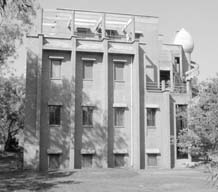
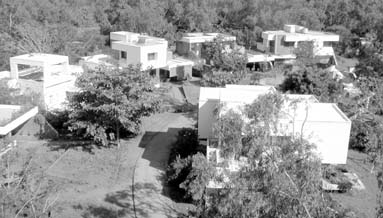
Which way will
we go?
Medium density
apartments
in Vikas
or
suburban housing
in Surrender? |
|
Most early cities were
small: when Greek cities approached about 10,000 they tended to throw
off new colonies, as if they sensed that a larger unit would be
unmanageable. By the Middle Ages cities in Europe, the Middle East and
China were becoming larger, often approaching 50,000 inhabitants. These
cities were high in population density, yet they were friendly places
because they provided, through their squares and secluded streets,
plenty of opportunities for people to meet each other and experience
community. From a modern point of view their inhabitants lacked many
conveniences yet, as urban historian David Morris points out, “there
is solid evidence that their standard of living compares favourably in
many respects with that of our own era. For the vast majority of people
today, attaining the living standard of the typical medieval city
inhabitant is still a distant dream.”
The industrial revolution
created a new kind of city. As the mill and factory owners constructed
thousands of cramped, featureless dwellings for their workers, cities
expanded enormously and their ethos changed. Now profit became more
important than culture, mobility more important than social interaction.
This was reflected in the fact that the volume of traffic within and
through cities increased exponentially, public spaces were reduced, and
urban architecture became more functional, linear than the ‘organic’
style of the medieval city. The great buildings of the modern industrial
city are banks and office blocks rather than the cathedrals and temples
around which pre-industrial cities coalesced. The industrial city
remains the dominant model today. However, some of the old cities of
India, China and the Middle East, have preserved more of their medieval
fabric, and along with that a greater sense of community.
As city life became less
pleasant, it generated a reaction. In the late 19th century, the new
discipline of town planning saw high-density living as an evil,
responsible for major health and social problems. Consequently the
concept of the ‘garden city’, a city of parks, private gardens and
generous spaces around dwellings, was born. The garden city, in turn,
spawned the concept of ‘New Towns’, relatively low-density
settlements where strict zoning principles were applied to ensure that
residential areas were separated from places of work and industrial
manufacture.
New Towns were most popular
in Europe. Meanwhile, in post-1945 America, the government provided
loans to city dwellers to buy homes in newly constructed suburbs: at the
same time an extensive freeway system began to be constructed. The
result was a mass migration from inner city areas to the suburbs, and
the continuing development of those suburbs along the routes of major
roads in what has become known as ‘ribbon development’ or ‘urban
sprawl’.
The worst of all possible worlds
The consequence of all these
developments is a worst-case scenario. The suburb, as urban planner
Peter Newman describes it, “is the most unsustainable form of
settlement yet developed” because detached houses with large gardens
take up an enormous amount of land which could be used for agriculture,
the distances between residences and shops often means that car
ownership is essential and low-density settlements weaken the sense of
community. Meanwhile many inner city areas have become vandalized
ghettos for the poor and marginalized.
Traditionally there was a
reciprocal relationship between a city and its surrounding countryside:
the city provided a market for the farmer and rural artisan. However,
today’s megacities, whether of the East or West, have entirely
distorted this relationship. To sustain their enormous metabolisms,
these cities suck an enormous amount of energy – in terms of food,
petroleum, raw materials, labour, intellectual capital etc. - not only
from the surrounding countryside but also from countries far away. The
pollutants and waste they generate are then ‘externalised’, released
into the air, the soil or the seas to poison the lives of those far
beyond the city limits. “In the name of progress, development and
growth,” writes Satish Kumar, editor of Resurgence magazine, “modern
industrial cities have embraced the manipulation of nature, the
subjugation of people and the exploitation of the countryside.”
Reviving cities
How to change this? Urban
activist Richard Register points out that the problem is not with cities
per se, but with the way that we conceive of and build them. For
potentially city living has a lot of advantages. Their higher population
density means that there are lower costs per household for services,
there is reduced demand per capita for land (an apartment in a
medium-rise building has only one eighth of the ecological footprint of
a detached suburban home) and there is the possibility of minimizing
transport use. Moreover, the concentration of production and consumption
makes for more efficient use of resources.
In recognition of this fact,
a new movement aimed at revivifying existing cities and creating ‘sustainable’
new ones has grown up in the past 30 years. Variously known as urban
ecology, neo-urbanism, the eco-city or sustainable city movement, it
attempts to make cities once again places of exuberance and community by
“making them greener and more human” (Peter Newman). This involves,
among other things, creating high-density but diverse neighbourhoods
where homes, shops, public spaces and offices are intermixed. Each
neighbourhood would be well-served by public transport, but many smaller
roads and streets would be traffic-free to allow them to become the ‘outdoor
rooms’ which are such a valuable feature of medieval cities.
Pedestrian and cycle paths would run everywhere: in fact, everything
would be arranged to discourage the use of private motorized vehicles,
for these are one of the main sources of air and noise pollution (and
social alienation)in cities today.
In the new type of city
people would live in close proximity, but architecturally there would be
much greater variety in styles of construction. However, the ‘language’
of a particular neighbourhood or bioregion would be preserved through
the use of local materials and indigenous stylistic details. In between
high density clusters there would be squares, parks and other public
spaces. The natural environment would be brought back into cities
through opening up creeks and rivers which had been buried under
concrete, through restoring wasteland and through extensive tree
planting.
Proponents of sustainable
cities argue that the city has to become far more self-sufficient in
terms of resource and energy generation and waste disposal. This means
everything from encouraging greater food production in the city itself
to promoting the widespread use of renewable energy sources, recycling
and energy conservation.
Social sustainability is
also encouraged through the intermingling of different economic groups
and cultures: this avoids the ghetto effect and stimulates a wider sense
of community. Finally, while the ‘neo-urbanists’ argue against
zoning (except for heavy industry) because it results both in uneconomic
transport use and the creation of dead areas outside the hours in which
zones are used, they believe that a city has to have well-defined limits
to avoid urban sprawl.
The relevance to Auroville
How far is this relevant to
the proposed city of Auroville? In many ways, Auroville is a special
case. Auroville began by restoring rather than by laying waste its
environment, and the designated city area is very small so that
accessing different parts of it is not a major problem. Again, a city
which puts Matrimandir at its centre is clearly not based upon the same
premise as the industrial city.
In other respects, the
present reality and plans for the future already incorporate many of the
eco-city recommendations. City parks and forest corridors will ensure
that the city is green, while existing settlements in the residential
zone already employ renewable energy systems, low energy construction
materials and natural waste recycling (although not to the extent that
neo-urbanists would wish).
Having said this, there
remain areas of concern. Medieval cities like Siena or Oxford are
welcoming because they are human-scale and constantly offering the
unexpected. Small, winding alleys suddenly give onto secluded squares;
the façade of one building is picked up and played upon by the façade
of the next; in the midst of busy streets there is an enticing glimpse
of a river or open fields. These cities have not been designed by a town
planner. They have evolved out of the myriad experiences of generations
who shared, however, a common sense of community and a commitment to a
particular place. Neo-urbanists designate these ‘organic’ cities.
The question is, are we in
Auroville with our present rather fragmented sense of community (and
zoning principles which will ensure that shops, cultural arenas and
residences are kept separate) able to create such organic spaces? Or
will we take the failed New Town route of ‘engineering’ social
spaces which attract nobody?
Again, a city planned for
50,000 in such a small area will need to be quite high-density. Yet
relatively few Aurovilians seem ready to live in such close proximity at
present, preferring the unsustainable suburban model of large gardens
and thirsty lawns even within the designated city area. Then again there
is the question of architectural style, the ‘language’ which
identifies us as a community rather than as clusters of individuals.
Cities like Siena in Italy had a ‘pattern language’ which enabled
great diversity to be expressed within an overall unity. Auroville as
yet lacks such visual cohesion, reflecting more the different styles and
preoccupations of various architects.
Then there is the question
of the roads. Today, aspects of the ‘Galaxy’ plan are retained in
the planned configuration of the feeder roads which will sweep in
regular arcs through the zones. As these ‘geometrically pure’ roads
take no account of the landscape or of human-scale perspectives, this
seems to represent the triumph of aesthetic over organic principles of
growth.
Finally there is the matter
of the means of transport. At present Aurovilians have grown accustomed
to using private transport - the consequence of living in a community
where facilities are spread out over miles of dusty roads. As more and
more facilities are located in the city area itself such private
transport should become less of a necessity, particularly if a good
public transport service evolves. But old patterns may be hard to break…
Perhaps the main effort at
present, therefore, should go into preventing the proliferation of motor
roads (and motorized access) in the city. This could be achieved by
clearly defining ‘no-go’ areas, and by creating a comprehensive,
shaded and well-maintained network of pedestrian and cycle paths (in a
city zone the size of Auroville’s it should be possible to reach
anywhere by cycle within 20 minutes).
Can Auroville be a model?
When Mother spoke of
Auroville as ‘the city the earth needs’ it seems she was referring
to the need for Auroville to spiritually embody and resonate principles
of human unity and truth. Yet in terms of modern India, which contains
not only some of the biggest but also some of the most polluted cites on
the planet, it seems reasonable that Auroville should also find
practical ways of alleviating these problems by developing practices and
techniques which can be replicated in urban India. For as the proportion
of humanity which lives in cities continues to grow, it’s time to
recognize, as the town planner Harley Sherlock puts it, that cities must
become “the major ingredient of any ecologically sustainable way of
living in the 21st century”.
|