|
Jan 01
Food-processing unit
desperately seeks new location
- by Carel
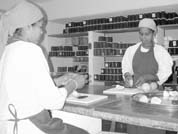
Jars jam the shelves of the crammed area in
the Bharat Nivas restaurant where Auroville’s food-processing is
located. The unit has to move out soon, but there are no funds for a new
building.
“We are being shown out. This building will
finally get finished, starting some time next year when the government
grant arrives. And that might mean the end of Auroville’s
food-processing service as we have no money for a new building. It’s
just too bad,” says Martina.
It all started eight years
ago when kindergarten teacher Martina, unhindered by any professional
knowledge, decided to do some food-processing – making jams, pickles
and marmalades, learning about nut butters and other consumables. The
location that was offered to her – a shed adjacent to the Pour Tous
building – was sub-standard by any yardstick, but she managed there
– for three years. Then she moved to the Bharat Nivas restaurant –
one of the grand unfinished structures dating from Auroville’s early
years – where she was given a small corner. The unit has done well and
now employs 16 people.
“This unit was started in
order to serve the needs of Aurovilians, but soon spawned a commercial
arm called ‘Naturellement’ to sell its products in Pondicherry,”
explains Vishwanathan, the unit’s accountant. “Now roughly
two-thirds of the products are sold in Auroville, and one-third outside.
The profit margin is extremely small, less than 10%, and the unit has
never been able to make any substantial savings.”
At first glance this is
surprising since the products are highly priced by Indian standards. A
400 gram jar of marmalade or peanut butter costs slightly under Rs 50.
“The prices in fact are
not high enough,” retorts Martina. “We make high-quality products
which, in Europe, would be sold in exclusive health food stores and in
delicatessens for high prices. You can’t compare them with
industrially-made products.”
“Our prime aim is quality.
We check our raw materials with minute care, selecting out the bad and
even slightly damaged products, and washing non-organic fruits in
vinegar water before processing. We do this in order to prevent there
being pesticides and aflotoxins in the end product. The presence of
pesticide residues is common in the produce we buy from Pondicherry. For
example, they sometimes add a handful of DDT to a bag of sesame.
Aflotoxins are another great source of concern. Aflotoxins result from
mold growth on foods. These toxins remain in the food long after the
mold producing them has died and can be present in foods that are not
visibly moldy, and they survive cooking and processing. One variety of
aflotoxin, aflotoxin B1, is most frequently found in food [particularly
in peanuts] and is one of the most potent carcinogen known. Liver cancer
due to aflotoxin ranks high in India. So we try to prevent this. The
Auroville laboratory in Aurobrindavan regularly tests our products for
the presence of pesticides and aflotoxins.
“Another of our aims is to
contribute towards the self-sustaining city Mother had envisaged. When
we started, we decided to support Auroville farms. We always try to buy
as much as possible of their products. In return they support us by
giving us a good rate during peak fruit seasons.
“And then there is our
employment policy. We operate throughout the year which is unusual for
food-processing units. Usually such units close down when there is no
supply of raw material. But we care about our employees. We work with 12
ladies from the nearby villages, who have shown an exemplary dedication
to the unit. They all have gained a lot of status and self-esteem
because of their work. We do not want to send them home when there is
nothing in season, so we struggle to keep them usefully occupied in the
slack seasons. The two main fruit seasons are from May-June (mangoes)
and July-August (lemons). Out of season I deal with any other fruits
that are offered, such as starfruits, papaya, kumquat, nartanga; with
seeds such as sesame and mustard; with groundnuts; or with eggs for
mayonnaise. In all, we make over 40 different products.”
“All this would not have
been possible without the financial and moral support from two donors in
particular, the Dutch Stichting de Zaaier and an Aurovilian, Ila. If it
were not for them, the unit would not be what it is today. But
notwithstanding their supports, today we are at a crossroads. If our
unit is to continue as a service unit, the community has to come forward
and help.
Auroville, in fact, has
already come forward. A location has been found without any of the usual
problems that go with trying to find a site in Auroville. But money is
needed, about 24 lakhs (US$ 50,000) for the building and 11 lakhs (US $
23,000) for equipment which includes a generator and steam boiler. “If
we do not get donations or soft loans from within Auroville, there will
be no option but to go in for a commercial loan, something I would not
like to do,” says Martina, “for we would have great trouble repaying
it. It would mean that we would have to become 100% commercial, and sell
our products exclusively outside Auroville in exclusive shops in Bombay
and Bangalore, for that is the only way we would be able to repay our
loans. It wouldn’t be too difficult to find and supply that market –
but it would be to the detriment of Auroville.”
Quo vadis? Nobody yet knows.
(For more information contact Martina at: avfoodpro@auroville.org.in
or write to Auroville Food-processing, Bharat Nivas, Auroville.)
|