|
June - July 01
Art in Auroville
- by the AVToday editors
"It is in
the service of spirituality that art reaches its highest
expression"
(Sri Aurobindo)
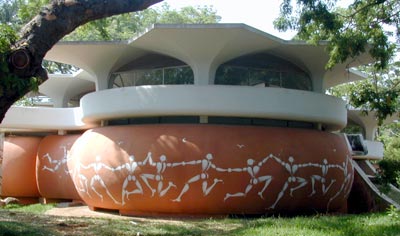
Art has played a
role in community life from the very beginning. Auroville, for
many old timers, was not just a desert to be afforested, but
also a play of light and space and austere beauty, a place of
magic and creativity, a cradle, in Mother's words, for the
creation of a new world. Ever since, many Aurovilians have been
inspired to evoke this new world and to explore themselves
through the medium of art. Efforts to promote the arts, however,
were for a long time retarded by the need to first deal with the
rudimentary requirements of subsistence. As late as 1988,
Auroville was still regarded by some as a cultural desert.
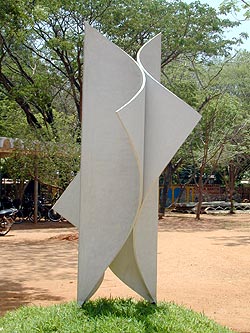 Auroville has come a
long way since. At present, many Aurovilians are involved in one
or more art forms. A multitude of expressions in dance, visual
arts, poetry, music, theatre, and sculpture, enhanced by the
rich interaction of eastern and western cultures, have become a
normal part of the daily life. More than sixty Aurovilians are
pursuing the arts either on a full-time or part-time basis.
Kalamitra (Friends of the Arts) formed by a group of Aurovilians
to stimulate cultural life in Auroville by promoting a wide
range of events and workshops has brought many top artists over
the years to perform in Auroville. More recently there have been
two initiatives - Khala Koj and the Visiting Artists Residency
project - which aim to bring artists from all over the world to
Auroville for brief or extended periods of time and to promote
artist exchange programmes. To this purpose Kala Khoj has become
affiliate member of the international 'Res Artis' network which
is represented in over one hundred and twenty countries . Auroville has come a
long way since. At present, many Aurovilians are involved in one
or more art forms. A multitude of expressions in dance, visual
arts, poetry, music, theatre, and sculpture, enhanced by the
rich interaction of eastern and western cultures, have become a
normal part of the daily life. More than sixty Aurovilians are
pursuing the arts either on a full-time or part-time basis.
Kalamitra (Friends of the Arts) formed by a group of Aurovilians
to stimulate cultural life in Auroville by promoting a wide
range of events and workshops has brought many top artists over
the years to perform in Auroville. More recently there have been
two initiatives - Khala Koj and the Visiting Artists Residency
project - which aim to bring artists from all over the world to
Auroville for brief or extended periods of time and to promote
artist exchange programmes. To this purpose Kala Khoj has become
affiliate member of the international 'Res Artis' network which
is represented in over one hundred and twenty countries .
These positive developments notwithstanding, resident artists
often complain about the almost complete lack of community
support. The Maintenance Fund, struggling as it does to provide
a minimum maintenance to those working for community services,
has hardly any artists on its maintenance lists. Neither is
there a support system to help artists to sell their works.
What, then, attracts
many artists to Auroville, or, as is often the case, turns
Aurovilians into artists? For the majority, the vision of Sri
Aurobindo and Mother is the most powerful inspiration - the
vision of a new world based upon a new consciousness. In fact,
many Auroville artists view their work of artistic creation as a
vehicle of their yoga. Mother spoke of an ideal place where the
exigencies of existence would be removed in order to allow the
individual the freedom to discover him or herself, and this is
another important factor. As one artist puts it, "One of
the greatest things that happened to me was finding this place
and environment where I can spend time and space to search for
the inner self, in my case through the arts." Another
attraction is the sheer diversity of cultures and individuals
represented here which, through the cross-fertilization of ideas
and perspectives, creates a ferment of creativity. And Auroville
also offers the possibility of continually reinventing oneself,
of taking up new ideas and activities without having to conform
to social or 'professional' norms.
On a more prosaic
level, for a community of 1500 people there are a surprising
number of venues at which artists can perform or present their
work. Visual artists can exhibit at the Savitri Bhavan, the
Centre for Indian Culture, at Pitanga Hall, the Information
Centre, or at the Solar Kitchen. Musicians and other performers
can use the open-air stage at the Visitors' Center, the large
auditorium at Bharat Nivas, the dance room in Pitanga Hall, or
the recently opened music salon Salle Auropax.
On the flipside, Auroville artists have to deal with a number of
discouraging factors. There are, of course, climatic factors
which play havoc with musical instruments and other
sophisticated or sensitive equipment and materials. Then again
exhibitions, while frequent, are not always well-attended.
Additionally, few Aurovilians have the means to act as patrons
or supporters of the arts through purchasing or commissioning
new work, although a few commercial units have commissioned
public art. Consequently, full-time artists have to market their
work outside Auroville in order to survive, a job for which most
artists are badly equipped. Some Auroville artists also resent
the fact that their work only gains public recognition when it
is used to promote Auroville at a public relations event or for
fund-raising efforts.
Another problem is the fact that only a small number of
outstanding artists or aficionados of the arts reside here -
after all, artistically we are still a very young and
undeveloped culture. For artists like musicians, it is hard to
achieve greater perfection or explore new territory without
regularly playing with other musicians of high calibre. For
visual artists it may be difficult to see things in new ways if
one is not able to challenge one's own thinking through seeing
the works and conversing with numerous others.
One possibility is for them to draw upon the experience of the
many visiting artists who come to Auroville for brief or
extended periods of time. They often regard Auroville as a kind
of paradise and are eager to share with other artists and to
impart specialised skills.
It would be wrong to
blame all the disincentives to artistic creation on the
community at large: the artists themselves must also take some
responsibility. Indian art in all its forms has wonderful
potential for expanding one's artistic horizons, yet this source
remains largely unexplored by Auroville artists. Again, it is
quite common in artist communities and centres of the arts
elsewhere for artists to come together frequently to discuss and
critique each other's work in a spirit of artistic
collaboration. Yet here such forums hardly exist. Another
criticism of the arts produced in Auroville is that many artists
are reproducing Western definitions of "high art". In
this concept art is seen as separate from the mundane world, to
be viewed in galleries, or heard in auditoria. The commitment to
this orientation explains why so few artists have experimented,
for example, with the use of everyday materials or performances
that break with the tradition of the proscenium stage.
An Auroville culture?
Is a distinct
Aurovilian culture or form of artistic expression emerging,
something different from what is happening elsewhere? The
majority of Auroville artists are cautious about making any such
statement, pointing out that a specific culture may take many
years to evolve. However, there are at least two indications
that something specifically 'Aurovilian' in artistic expression
may be in the first stages of birth. Firstly, Auroville artists
who exhibit or perform together outside Auroville are often seen
by outsiders to be expressing something 'different' from the
norm. Secondly, there is increasing evidence, particularly in
the realm of music, that Auroville artists are no longer merely
drawing upon existing material or trends but are increasingly
experimenting with new forms.
This raises the question of what Aurovilians expect from the
community's artists. A few years ago when Beckett's play Waiting
for Godot was staged, some members of the theatre going audience
expressed disapproval, stating that the play was inherently
irrelevant to life here. A similar verdict was pronounced on a
performance of Japanese butoh dance a few years later. The
suggestion is that only certain subjects are appropriate to be
worked on and viewed in Auroville - presumably those which can
somehow be described as 'spiritual' art. But how do you define
'spiritual' art? The more one thinks about it, the more
impossible it becomes, for almost any form of expression can be
a means of evoking or exploring the subtler realms in the hands
of an inspired artist.
Though there are
many concrete and mental stumbling blocks to artistic creation
in Auroville, there is a definite sense of the tremendous
potential this place has for the creative process, and there is
little question that the overall quality of artistic work is
steadily improving. With the diverse population and beautiful
environment, one may expect that Auroville will not only attract
many fine artists, but produce more and more of them itself so
that, together, they will make of the city and its greenbelt one
gigantic work of art.
Editors
|