|
March 01
We
need to upgrade the whole farm scene in Auroville
From an interview with Alan
Paul was educated as a
biodynamic farmer in Holland. For twenty years he has been farming
organically in different parts of the world. As a professional who has
been farming in Auroville for the past three years, he gives his views
about organic farming in the community.
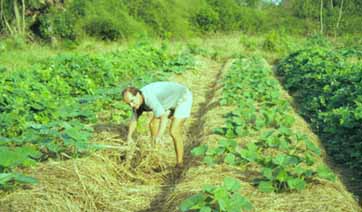
“The first thing which
struck me when I came here was the lack of a supporting structure —
outlets, marketing skills, finance etc. - for organic farming in
Auroville. This was a reflection of a certain neglect of agriculture in
Auroville. This is still the case, although the Solar Kitchen has become
a very important outlet and support for our products. They’ve proved,
in fact, that it’s not difficult to get Aurovilians to eat
locally-grown indigenous food, so much so that we can’t grow enough to
keep up with the demand. Yet I discovered that certain crops which grow
very well here were not being grown by our farmers because they didn’t
know about them, or how to grow them on a larger scale. In fact, I would
say there is only a small group of farmers in Auroville who have
developed a certain level of professionalism. For the rest we have a
number of enthusiastic and idealistic farmers, but often they lack
production and management skills.
“If the Solar Kitchen is
to be supplied regularly with the quantities it requires, then crops
have to be grown in a professional way. This means, if we are supplying
vegetables, there have to be successive plantings of the same crop every
few weeks in a very systematic fashion. But for many Auroville farmers
this seems unattractive. They have strong ideas about monoculture, mass
production and a capitalistic approach, so they do not want to work with
nature in a way which involves intensive and volume production. The
consequence is that, while we have more than enough land—an area of 40
hectares (100 acres) could supply all the vegetables we need in
Auroville at present—we’re not farming it in a way which makes the
most out of it.
“There are other
circumstances which make it difficult for the farms to become more
efficient. For example, the farms are collectively owned by the
Auroville community: the money that is put into them is not ‘earned’
by the farmer having to compete with other farmers. There are dangers
with private enterprise and market economies, but I also see that
everywhere in Auroville there is a definite relationship between the
possibility of making personal profit and increased enthusiasm and
responsibility. Profits or losses, after all, are a means of measuring
how well you are doing, something which can be obscured in a subsidized
farming system like ours. The reality is that most of our farms are
loss-making.
“But attitudes are
changing. More and more of our farmers are aware of the necessary
changes to be made. The Farm Group office in particular has made big
efforts to improve the quality of the farm scene through streamlining
information collection, and the Farm Group now asks the farmers to come
up with a proper business plan if they want a loan or a grant. Moreover,
the Farm Group has recently decided to call upon the services of a
professional external consultant to undertake a comprehensive and
time-bound study. The objective of this study is to analyse the present
farms and local consumption patterns, to identify necessary changes to
be made (policy, pricing, farming methods, infrastructure, land, etc.),
to prioritise these changes, and to detail an action plan for the
future.
“Perhaps the key to
upgrading the whole farm scene in Auroville is in understanding that
becoming more business-like and efficient does not mean that we have to
give up our ideals. In fact, it might even speed up the realization of
those ideals!”
|