|
May 01
The right of free access
- by Shanti
For those who do not have
full physical mobility, such as the elderly or those needing a
wheelchair, accessing public places in Auroville is an unpleasant
challenge. There is as yet too little awareness in the community that
this is unacceptable.
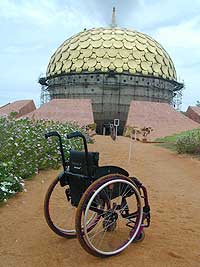 Freedom of movement is
something that many of us take for granted. We jump on our bikes to get
to where we need to go, and without a second thought move in and out of
our home, work, and play spaces. The landscape we know as Auroville,
however, can appear quite different if we do not have full physical
mobility. For a person living in a wheelchair, or for an elderly person,
accessing public places can be a daily challenge. Freedom of movement is
something that many of us take for granted. We jump on our bikes to get
to where we need to go, and without a second thought move in and out of
our home, work, and play spaces. The landscape we know as Auroville,
however, can appear quite different if we do not have full physical
mobility. For a person living in a wheelchair, or for an elderly person,
accessing public places can be a daily challenge.
Let's say that in the
morning you want to go to the post office. The stairs at this Bharat
Nivas facility would make that errand into a real task, and one that
would obligate you to involve others. If after that you want to pop over
to the Boutique in the Visitors' Center you may feel doubly frustrated
as your shopping could be easy were it not for the couple of steps
between you and the shop. Let's say by now its time for you to head over
to Pour Tous. You can enter the store, but the aisles are so narrow that
it is next to impossible to manoeuvre your chair. If you'd like to stop
and have a juice at the snack bar, you could get put off by the extreme
grade of the ramp that stands in your way. By now it's time for lunch.
New Creation Corner? Hmmm, more steps. Maybe you prefer the Solar
Kitchen and that's a good thing because the Kitchen is really a
friendly, manageable space, with the exception of the bathrooms, which
are not at all user-friendly. And of course, you won't be joining anyone
for coffee afterwards upstairs in the Coffee Shop. As the afternoon
draws to a close, it seems almost natural that you can't go and sit by
the beach with all the sand around. But not so natural is the fact that
you do not have ready access to Matrimandir. Maybe on some days you
don't mind having to ask the Matrimandir Group to arrange for four
attendants to carry you up and down in the special chair kept on hand
for such occasions. But at other times, maybe you really resent not
being able to just go by yourself and meditate as long as you like,
without having to worry that some people are waiting to carry you down
again.
Until now the Auroville
community has lived largely unaware of the problems that failure to
provide proper handicapped access can imply for those living with
disabilities. A common excuse offered is that so far no Aurovilians have
such needs. For anyone in the world who has met with an accident,
however, and knows first hand how the limitations of one's body can
change from one second to the next, and even for those of us who have
had to live temporarily with restricting injuries, the flimsiness of
such justifications is obvious.
Moreover, the number of
older Aurovilians is increasing with time and their need for mobility
will be an issue that the community cannot ignore.
It is perhaps a bit
embarrassing that the problem of access should be illuminated by the
presence of disabled guests to Auroville, rather than through the
consciousness of Auroville residents. After all, many Aurovilians come
from countries where significant efforts have been made in the past ten
years to make public places and bathrooms available to everyone. Even in
India, the need for "barrier-free architecture" is becoming
more accepted, with institutions such as the Indian Institute of
Architects establishing some basic guidelines.
The problem is neither lack
of know-how, nor resources, as such fittings do not demand elaborate
techniques or money. As Christel, a long-term guest who has been living
in a wheelchair since she met with an accident some years ago, explains,
"It's not that so much as to be done. The problem is for people to
think about it". Christel has been visting Auroville 5 months a
year for the past six years and has always felt strongly that it is in
the community's interest to consider the needs of people such as
herself. "In the future, Auroville will become a city. Many more
people will be coming here and living here. Some of them may be like me.
There will also be older Aurovilians. And then, what about mothers with
baby carriages!"
Increase in awareness
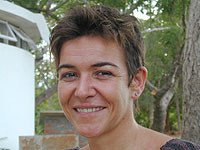 Out of the strength of her
convictions, Christel made a visit to the Develop-ment Group about three
years ago. The initial reaction of the Group was one of embarrassment as
they witnessed first hand the effort that Christel had to make just to
enter their offices. Encouraged by the members' seeming willingness to
take appropriate measures, on her return to France Christel sent the
group complete documentation detailing the exact specifications for
making public spaces and toilets accessible for the disabled. In the end
nothing happened: the present members of the Development Group do not
even know what became of the information provided by Christel. There is,
however, more awareness of the need to begin to insist that architects
and project holders take the necessary steps. Josebas of the Development
Group confirms that, "When we approved projects in the past, we
were not looking at these kinds of details. But now we realize that we
must start doing so. For example, the proposed Town Hall and Plaza
designs include wheelchair access ramps." Architect Anupama adds,
"I would suggest that we create a budget specifically for rendering
all our public buildings barrier-free." Out of the strength of her
convictions, Christel made a visit to the Develop-ment Group about three
years ago. The initial reaction of the Group was one of embarrassment as
they witnessed first hand the effort that Christel had to make just to
enter their offices. Encouraged by the members' seeming willingness to
take appropriate measures, on her return to France Christel sent the
group complete documentation detailing the exact specifications for
making public spaces and toilets accessible for the disabled. In the end
nothing happened: the present members of the Development Group do not
even know what became of the information provided by Christel. There is,
however, more awareness of the need to begin to insist that architects
and project holders take the necessary steps. Josebas of the Development
Group confirms that, "When we approved projects in the past, we
were not looking at these kinds of details. But now we realize that we
must start doing so. For example, the proposed Town Hall and Plaza
designs include wheelchair access ramps." Architect Anupama adds,
"I would suggest that we create a budget specifically for rendering
all our public buildings barrier-free."
But will the Development
Group ensure that these ramps meet with the necessary specifications for
width and degree of incline? Moreover, there is still the issue of
ensuring that there are appropriate bathroom facilities. Until very
exact guidelines are followed, it is not always clear if a building is
indeed accessible. For example, while some contend that the new SAWCHU
building is accessible from the back side, Christel asserts that it is
impossible for someone in a wheelchair to enter the building unassisted.
The failure to give adequate attention to this issue may stem in part
from the attitude of some people in the community that physical
disabilities are like illnesses, and that illnesses are somehow
associated with spiritual weakness and an inability to make any
effective contribution to society. In response to the first idea, that
being handicapped is like being sick, Christel remembers a moment when
someone commented to her that she could never think about becoming an
Aurovilian, since Mother had said that she did not want "ill
people" coming here. "But I am not ill!" was Christel's
reply. "I am probably in better health than you!"
As for handicaps and spirituality, Christel reminds others that people
like herself actually have much to impart. "In dealing with our
situation and learning to walk again, people like myself are engaged in
real research on the body and matter. Was this not the work of Mother
herself? We work on our will, our faith and patience. In this way we
have a very active inner life and so many things to give to
others."
A different perspective
In developing greater
consciousness about handicapped people, however, it is important not to
lump such individuals into one category and assume that they all feel
similarly about their situation. Yuyu is another regular long-term guest
to Auroville who has faced difficulties in moving himself with his
wheelchair through the community. Whereas he agrees that handicapped
access will become an increasing concern in Auroville as it continues to
grow into a city, he is not entirely discouraged by the present
situation. As someone who has learned to see the bright side of even the
most difficult circumstances, Yuyu states that sometimes he does not
mind asking people for assistance, because it becomes a chance to meet
others. With a wry smile he adds, "I have even been carried in the
arms of beautiful women!"
It is encouraging to note
that Yuyu has found Aurovilians to be very ready to lend him a helping
hand. "Sometimes in France, I wait 15 minutes in my car before I
see someone looking friendly enough for me to ask them to help me out
and into my chair. Here that's never the case." As such, Yuyu's
experience would seem to confirm that when it comes to face-to-face
interactions, many Aurovilians are quick to demonstrate their concern
for others. The next step remains to translate that personal care into
taking the appropriate actions at the collective level.
|