|
May 01
Supporting spiritual search
- by Alan
How much support does the
community provide to those who want to understand the spiritual
foundations of Auroville and the nature of the integral yoga?
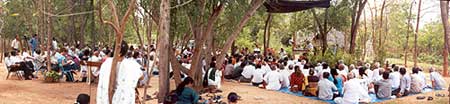
Mother stressed that it was
important that the Aurovilians have a good knowledge of the writings of
Sri Aurobindo. Consequently, in the early years certain Ashramites -
including M.P.Pandit, Amal Kiran, Nirodbaran, Aravinda Basu and Udar
Pinto - came regularly to Auroville to speak about Sri Aurobindo and
Mother. The talks, which were held in venues like Last School
amphitheatre and the Matrimandir Camp, were well-attended and lively.
However, in 1979 they stopped. Why?
Most obviously it was
because of increasing difficulties with the Sri Aurobindo Society (S.A.S.)
and the Ashram. Some of the Aurovilians wanted to break links with the
Ashram because they felt it had 'betrayed' Auroville by not supporting
it in its struggles against the S.A.S., and because it was believed to
be victimising Satprem for his efforts to publish The Agenda. As more
and more of The Agenda was published, some of Mother's comments also
appeared to support Satprem's assertion that the Ashram was
"finished", and that Aurovilians had henceforth to walk their
own spiritual path. Underlying this was the sense that the age of gurus
and religions was over, that Mother had announced the birth of a new
world which superceded all that went before, and that now one only
needed to open oneself to and work with the force in order to progress.
This fitted well with the
spirit of that time, for in Auroville it was a time of spontaneous
action and of the rejection of established modes of thinking and
authority ("too mental" was one of the devastating put-downs
of that period). The Auroville schools remained shut (although a few
small-scale educational experiments continued) and some of the books in
the Auroville library were burned.
By the early 1980s, however,
it was clear that there was a cost to this radical clearing of the
decks. Many children were receiving no education and, as the political
situation stabilized and energy turned again towards building the
township, it became evident that very few Aurovilians really understood
what Mother had intended for the detailed organization of the community.
There was also growing concern that not only Newcomers but also many
Aurovilians lacked a basic understanding of the Integral Yoga and of the
significance of Mother's intentions for Auroville.
Consequently, along with the
re-establishment of formal education in 1984, there was a new movement
of research and documentation. For example, one of the first tasks of
the newly-established Laboratory of Evolution (LoE) was to make
compilations of the texts of Sri Aurobindo and the Mother on topics like
Integral Yoga, the psychic being and the 'Avatar's Model Town'. It also
built up a library which includes not only works of Sri Aurobindo,
Mother and their followers, but also texts on related fields like the
new physics and alternative approaches in health and healing. "In
this way," explains Bhaga who coordinates activities at the
Laboratory of Evolution, "the LoE has become a bridge between the
yoga as practised in Auroville and what is happening regarding evolution
in the larger world, about which we still know far too little."
It's an approach which has had its critics, notably those who believe
that the yoga of Sri Aurobindo and Mother is unique and cannot be
explained by or compared to any other path. There also remains a deep
suspicion among some Aurovilians of what is perceived to be 'New Age'
homogenization and superficiality. However Bhaga has seen a definite
change in the past two years, with far more people coming to borrow
books not only on the yoga but also on allied movements.
A turning point
By the early 1990s the
somewhat strained relationship between Auroville and the Ashram was
beginning to ease. Crucially, the completion of the inner chamber of
Matrimandir drew Ashramites to the structure which many had worked on in
the early years. At the same time, the reintegration of the so-called
'neutrals' (Aurovilians who had favoured dialogue with the SAS without
being of that party) back into the community also facilitated a greater
interaction with Ashramites, for many of these Aurovilians had retained
strong links with individual Ashramites.
The interactions, however,
remained informal, and while senior Ashramites like Champaklal and
Nirodbaran visited Matrimandir and Aurovilian friends, they did not give
talks. The turning-point came in 1994 when Nirodbaran was invited to
Pitanga Hall to speak about his recollections of Sri Aurobindo. The
deeply-felt and enthusiastic response of the Aurovilians to his talk
made it obvious that there was a tremendous thirst not only for more
knowledge, but also for increased contact with those who, like
Nirodbaran, had had direct experience of Sri Aurobindo and Mother. 1994
was also the year the Savitri Study group began meeting regularly, and
this was to become the seed of the Savitri Bhavan project.
Today there are regular
well-attended classes and talks at Savitri Bhavan on 'Savitri', 'The
Life Divine' and other works by Sri Aurobindo and Mother, given by both
Aurovilians and Ashramites like Dr. Ananda Reddy, Dr. Nadkarni and
Sraddhalu. The Welcoming Group, which organizes introduction weeks for
Newcomers, always includes a session on the spiritual foundations of
Auroville, while the Auroville Library, the Laboratory of Evolution and
the House of Mother's Agenda continue to loan out books and tapes and
mount mini-exhibitions on topics related to the yoga. There is even a
new service which offers to make compilations on demand of any aspect of
Auroville and the yoga.
In this sense one can say
that the community is, once again, taking up the responsibility of
disseminating knowledge about the yoga to all who are interested.
However, important lacunae remain. Many of the local villagers who join
Auroville are illiterate or semi-literate and have little or no
knowledge of the yoga or the purpose of Auroville. This is not easily
remedied as there are very few easy-to-read books in Tamil on the yoga
(and the ones that do exist are not widely distributed) and there are no
regular presentations on the yoga in the Tamil language.
Then, again, the larger
question of how far one needs to study the yoga in order to become an
effective instrument remains unresolved. One reason why there is not
more widespread study in the community of Sri Aurobindo and Mother is
that some Aurovilians seem to assume that merely to live in Auroville is
to be on the royal road to transformation. Bhaga, who makes
presentations to newcomers on the spiritual foundations of Auroville,
sounds an additional note of caution. "We must beware of turning
Sri Aurobindo and Mother into a religion. The world is not interested in
us adoring something, but in our demonstrating that we are evolving. We
need knowledge but, above all, we need to make it living."
|