|
Nov 2000
Views from over seventy
Carel and Tineke interview Aurovilians
who are over seventy and still going strong in the community.
You hardly notice them. The
septuagenarians blend so easily into the flow of everyday life that
there is little awareness of the fact that some of them chose to join
Auroville at an age when others were contemplating taking life easy. The
reason why they chose Auroville is a spiritual one - not bhakti or jnana,
but karma yoga, the path of works.(1)
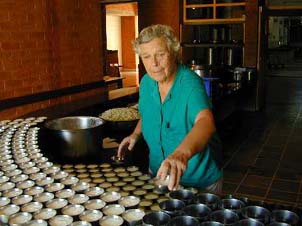
Ilse serving lunch at
the Solar Kitchen
Take, for example, the case
of Krishna (78) and Kamla (73). They came to Auroville in 1976 after
Krishna’s retirement at 54 as a Major-General in the Indian army.
Having been a man of action dedicated to the ideals of karma yoga for
his entire life, Krishna felt that Auroville was the next logical step.
“Those who wish to lead a spiritual life after retirement, usually go
to an ashram and pursue a bhakti or jnana yoga. This is the case, for
example, with the majority of those who join the Sri Aurobindo Ashram
after their retirement. But here was the challenge to build an
international township in an Indian setting! The idea was fantastic and
both my wife Kamla and I liked the project immediately.” Kamla fondly
remembers the meeting with Mother on February 22nd, 1972, and the day
earlier when she and Krishna stood at the excavation pit for the
Matrimandir during the deeply moving foundation ceremony. “At that
moment something clicked. I knew then that Auroville was my place, and
not the Sri Aurobindo Ashram. I knew I would come here, even if, at that
moment, I didn’t know when. The choice was made.” And she adds: “It
seems to me that many people come to Auroville because some aspect of
Auroville appeals to them, not out of a conscious choice for Auroville
itself. For us it was different.”
Ursula (76) from Germany
also recalls her meeting with Mother as one that changed her life
forever. “She did not speak but put her hand on my head and inwardly I
talked to her and told her that I was not ready to join Auroville,”
she says recalling her meeting with Mother in 1971. “And The Mother
answered silently, “But you must!” Ursula met Mother twice
afterwards, and finally moved to Auroville in 1989, when she was 65.
“Mother’s face was
compassion personified,” says Nergez (78), a Parsi lady from Bombay,
who met Mother in 1972 – exceptionally as Mother had at that time
stopped seeing people. “That was such an experience – it changed my
life completely. For a few seconds the feeling of ‘I,’ ‘me,’ ‘myself,’
left: there was nobody anymore; it was as a drop that merged in the
ocean. Initially, when I first saw Mother during the balcony darshan, I
was very skeptical; but when I was face to face with Her in Her room,
and looked into Her eyes…You see, I was a hairdresser and beautician,
and would normally observe the colour of somebody’s hair. But as of
today, I still do not know the colour of Mother’s hair! I saw the
expression on Her face and never thought I could see an expression like
that…I joined Auroville in 1977 when my social responsibilities in
Bombay had ended, having visited Auroville in each of the three
preceding years. Mother surely prepared that step.”
Ilse (70) from Holland met
Mother only once, in 1973, “but that was more than enough,” she
says. “I still feel the little tap Mother gave on my head. It changed
my life. After meeting Her, I knew inwardly that my time for Auroville
had not yet come and that I had to go back home to continue my work. In
1996 I got the clear indication ‘from above’ that it was time to
come, and I joined Auroville soon afterwards.”
Not everyone had the good
fortune to meet The Mother. Erica (79) learned about Sri Aurobindo and
The Mother in 1974 while flying from her native Germany to Australia.
She re-routed her return trip to visit the Sri Aurobindo Ashram, where
she settled shortly afterwards and worked with Norman Dowsett on
educational projects. She moved to Auroville in 1992.
Ellen (72), also from
Germany, had read about the inauguration of Auroville in 1968 and knew
about Sri Aurobindo’s and The Mother’s teaching. “But it was not
really possible for me at that time to go to India because of my family
situation. That changed after my retirement. Then I decided that I
wanted to look forward, not backward, and start a new life in a new
place. That place was Auroville, as it offers a future. Here the word
‘yoga’ is common parlance and there is the freedom to develop
oneself inwardly in the way one thinks fit, without a living guru and a
restrictive set of spiritual guidelines. Also, the experiment of a
spiritual township, where such a variety of people from all age groups
live together, greatly attracted me.” The freedom to follow one’s
own path, with even the freedom not to focus on the teaching of Sri
Aurobindo and The Mother, also attracted Ilse. “In Auroville you can
discover your own spiritual way, nothing is obligatory. That for me is
the major attraction,” she says.
Karma yoga
Notwithstanding the fact
that all those interviewed are financially independent, most of them are
working. “The Auroville Charter,” says Krishna “mentions that
Auroville will be the place of an unending education, of constant
progress and a youth that never ages. I have always taken this as my
leitmotif. The secret is to remain active as it is work that keeps you
young. And it is important to pursue a variety of interests. Auroville
gives that possibility as there is no hierarchy, and each one has
complete freedom to do whatever he or she feels like doing. I worked at
Matrimandir, then developed 35 acres of land (Amba Garden in Auromodèle,
now Jardin de Mère) before I started the Auroville Archives.” Kamla,
who was a doctor in the Indian army, continues her practice in
Auroville.
For Ilse, the question of
‘rest’ never really came up. Even before she joined Auroville, her
name had already circulated as one of the future coordinators of the
Solar Kitchen – which she took up as soon as she entered Auroville.
“They call me granny in the kitchen, which is quite funny, actually.
For I feel like 50!”
Ursula, too, fitted in
seamlessly. She continued her work as a physiotherapist, giving massages
and physical education classes until, in June this year, she had a
serious fall and needed a hip replacement. “It slowed me down,” she
laughs, “but I think I will be active again soon.” One of her
classes was physical exercises for the elderly, as “keeping fit is a
lifelong pursuit”.
Isolation and loneliness
Kamla explains another
advantage of work: it is a unifying factor. “There are people here who
are growing old and isolate themselves. But I think they have partially
themselves to blame as often they do not make sufficient effort to meet
other people. People must seek help, and not hesitate to ask. On the
other hand, the community should also make more efforts to call upon the
elderly. Often they are not asked to participate enough. The community
should pull them out more, for they have a valuable life experience to
share. Auroville should particularly help new people to interact. After
all, we all come here for a work-oriented and collective approach.”
Ellen is one of those whose
experience of trying to integrate has not been an easy one,
notwithstanding her participation in work as well as in Auroville’s
cultural activities. “Aurovilians tend to be self-centered and do not
show much care for the elderly. In the beginning I suffered from the
fact that my attempts at true contacts did not work out and from the
resulting isolation, and it was necessary to go back to the West to
regain my perspective. I had to learn to live with loneliness and to
understand my own need for social interaction. My work and cultural
contacts did not necessarily develop into friendships. I finally learned
not to bother anymore and have no expectation patterns. From that moment
on, things went better. But there were times when I felt very lonely,
even when eating in the midst of a crowd at the Solar Kitchen.”
Ellen’s experiences are
not unique. There are more elderly people who have not managed to find
suitable interaction or work and stay at home as a consequence. Erica
too often feels that her talents are unused. She worked at Matrimandir,
the Information Centre and the Kindergarten, but is at present not
actively participating in any particular work for the community. You can
often find her sitting at her terrace, counseling Aurovilians in need.
“I know that I am needed in Auroville,” she says. “I think that
older people have a long life experience, which they can pass on. I will
keep myself together until the very end, but this I do with Mother’s
help. She is the only one I have long conversations with.” While
loneliness affects many age groups in Auroville, it appears that as one
gets older, it is harder to make social contacts.
Social and medical care
Ellen’s observations touch
a sore spot: the community’s social care for the elderly leaves much
to be desired. For many of them it is difficult – or will become so in
the foreseeable future – to attend meetings, go shopping, visit the
Matrimandir or go out for cultural events in the evening. Though the
community has organized a bus service to Pondicherry thrice a week,
regular bus services within Auroville do not exist. Those who wish to
visit the Matrimandir but who cannot climb stairs have the additional
difficulty of having to arrange their visit in advance, since the only
way for them to go up to the Chamber is in a chair carried by four
strong men. Says Ellen, “I think that the community should start
thinking about these requirements. For example, can’t it organize a
transport system where a bus picks us up and drops us back whenever
there is a cultural performance? That would be a tremendous help! For it
is really no fun to drive alone on your moped at night.” Ellen’s
suggestions are shared by other senior Aurovilians, including Nergez,
who no longer drives a moped and so hitchhikes her way through
Auroville.
Auroville’s medical
care-taking is better. Ursula, for example, is very appreciative of all
the help she received from Aurovilians when she was in hospital. “But
it was not an easy job to get all the people in time,” says Sourya, a
French nurse who organized the care-taking roster and the blood donation
roster for Ursula. As Indian hospitals do not provide food and often
have insufficient nursing care, constant attendance is required, which
implies a minimum of three Aurovilians for each 24 hours. “That type
of care puts a great strain on people. Auroville really needs to get an
emergency team of qualified individuals together as there is an
increasing number of people needing medical and surgical care –
sometimes urgently. Auroville has no ambulance and no 24-hour emergency
aid facility, not even a 24-hour emergency phone number. Victims of
accidents - and elderly people have a higher chance to be among them –
have to rely on a taxi, or an ambulance from Pondicherry, and on
Pondicherry hospitals for qualified medical help.” Ellen wryly
confirms Sourya’s observations. Not too long ago she suffered severe
burns. The doctor couldn’t come and advised her to call a taxi. A
friend helped out, but “without her I might have died,” she says.
An old-age or nursing home?
Is an old-age home the
solution? Without exception, all the people interviewed by Auroville
Today responded to this question with a categorical ‘No!’ Old-age
homes are judged to be isolating places while on the contrary, a mixing
of all age groups is seen as essential. “In India, in the old
joint-family situations, the elderly took care of the grandchildren
while the children went to work. Likewise in Auroville, a system of
collective housing would create the necessary interactive unity among
different age groups. That, and the fact that people should continue to
contribute their work to this community till they really no longer are
able to, would guarantee a social interaction,” judges Kamla. But she
feels that a proper nursing home, a facility where one can take care of
the elderly in periods of convalescence after illness, is essential.
Plans for a small nursing home with 24-hour service are ready, but the
project lacks funds.(2) Nergez too strongly feels the need for “a good
holistic nursing home” where all approaches to healing are welcome.
An age limit for joining Auroville?
Is the lack of medical and
social care a reason to advise elderly people not to come to Auroville?
“No, not at all,” objects Kamla. “Older people are very important.
They no longer have the turbulence of the youth but they contribute
instead a mature life experience. If we would not invite them to become
Aurovilian, we would not be following the Charter of Auroville. But they
should only come if they have an inner or higher reason to do so.
Auroville certainly is not for those who want to enjoy ‘a
well-deserved rest’ after their retirement! They would not be
sufficiently motivated to stand the climate and the hard material
conditions!” Inner growth and spiritual focus can mitigate the often
harsh outward conditions.
“The attraction of
Auroville,” says Krishna, “is for the deeper things of life. Here
you are introduced not only to the writings of Sri Aurobindo and The
Mother, which you keep studying as a matter of course and with
increasing interest, but there is also the rich interaction with so many
other seekers – I consider every Aurovilian a seeker – which is a
great benefit. From the spiritual point of view (after all we are a
spiritual project) the 24 years spent in Auroville have given me a
deepening involvement. We would certainly have missed out on a large
part of our inner development if we had lived our lives elsewhere.” It
is a statement with which the interviewed wholeheartedly agree. “I
cannot express how very thankful I am to the Divine for bringing me here
in my late fifties!” says Nergez. Ursula sums it up for all of them:
“We came for the ideal, and it has become part of us.”
Based on interviews with
Kamla and Krishna Tewari, Ellen Tessloff, Ursula Mack, Nergez Pesikaka,
Ilse Breijman and Erica Schumacher.

(1)
Jnana yoga: the Path of Knowledge aiming at the realization of
the unique and supreme self by the method of intellectual reflection.
Bhakti yoga: the Path of Devotion, aiming at supreme love and bliss
through adoration and self-offering. Karma Yoga: the Path of Works,
aiming at the dedication of every human activity to the Supreme Will.
Hatha Yoga: selects the body and vital functionings as its instruments
of perfection and realization.
(2) For more
information on the nursing home write to Anamika,
Gaia, Auroville 605101, Tamil Nadu.
|