|
Nov 2000
Renowned Malayali director visits
Auroville:
An Adoor Gopalakrishnan film festival
by Bindu
Aurofilm recently hosted a film festival
featuring Adoor Gopalakrishnan’s work. At the invitation of Aurofilm,
the internationally renowned director from Kerala himself came to
Auroville for a couple of days to present his work.
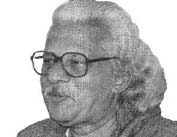
Adoor Gopalakrishnan is
arguably one of India’s finest film-makers. Often compared to
legendary film-maker Satyajit Ray, Gopalakrishnan is realistic in his
style. But perhaps even more so than Ray, Gopalakrishnan imbues his
films with a deep symbolism. He has scripted and directed eight feature
films in all and more than two dozen shorts and documentaries. Seven of
his eight feature films have bagged prestigious national and
international awards, including the highly coveted British Film
Institute Award. In 1983 the Government of India conferred on him the
Padmashri, one of India’s highest honours, for his outstanding
contribution to Indian cinema.
His work
After the success of his
first film “Swayamvaram” in 1972, Gopalakrishnan along with other
film-makers launched an alternative movement through a network of film
societies and theatre owners to promote art or non-commercial films in
Kerala. Today, Kerala has established a benchmark in India for producing
meaningful and realistic cinema as opposed to the standard “Bollywood”
fare and non-realistic song-and-dance routines churned out by commercial
film-makers.
At a sprightly 59 years,
Gopalakrishnan is soft-spoken and unassuming by nature, but
uncompromising in his work. In an earlier interview about his films he
said, “I like to challenge my audience, provoke them into thought and
give them an experience to remember. Every time I make a film, I ask
myself why anyone should want to see it. But I don’t make compromises,
concessions. I want the viewers to see my work on my terms. I don’t
want them leaving the theatre saying ‘I’ve seen it before, I knew
what he was going to say.’ For them as for me, the film has to be a
constant process of exciting discovery and enquiry.” Gopalakrishnan
does not like his works to be called “experimental”, claiming that
he makes films for the lay public and not for critics. Nevertheless his
treatment of themes is unusual and perhaps sometimes too complex to be
grasped by the audience.
The film festival
“Mukhamukam” (Face to
face), one of the films screened at the festival, is an example of where
the director’s intentions are not always clearly communicated to the
audience. Mirroring the fortunes and debacles of the Communist Party of
Kerala, the film depicts Sridharan, a small town revolutionary, who
successfully unites industrial labourers to fight for their rights.
Eventually, in Sridharan’s absence, some of the leaders of this labour
union form the ruling political party. In the second-half of the film,
one sees Sridharan, who had gone into hiding for ten years return to his
town. However, he is no longer the torch-bearer for society who had once
been a source of inspiration to many. He returns as drunkard and a
wastrel. Says Gopalakrishnan, “Sridharan is in fact a projection of
the people’s own selves and thus an inconvenient and embarrassing
revelation. Unable to face the reality and the human weaknesses of their
hero, someone eventually kills Sridharan, and the film ends with the
whole society resurrecting an untarnished image of the man.
One of the themes that
Gopalakrishnan explores in this film is how, over time, people mould
reality to suit their perceptions. What is interesting but is often
missed by film-goers, is that in the first half of the film one does not
to get to see Sridharan as he actually is. One sees Sridharan through
the selective memories of other characters. Also in his desire to show
“a society in crisis,” Gopalakrishnan eschews a narrative plot and
the individual nuances of a character. But many in the Auroville
audience bemoaned the loss of details in the story and the flatness of
the characters.
The other two feature films
in the festival, “Elippathayam” (The Rat-trap) and “Kathapurushan”
(The Man of the Story) were better received in Auroville. “Kathapurushan”
too depicts the fate of an individual, Kunjunni, caught in meshes of
Kerala society, but unlike many of Gopalakrishnan’s
protagonists, Kunjunni has the moral courage to face the reality of his
life and to transcend it through his creative urge as a writer.
“Elippathayam,” made in
1981, is Gopalakrishnan’s first colour film, and almost the entire
film is a sequence of beautifully framed shots of rural life in Kerala.
Colour is used sparingly and mainly as a symbol to depict the nature of
a character. On the whole, the film is highly imaginative and, one must
add, relentless in its portrayal of the protagonist, the last heir of a
disintegrating feudal order, as a rat caught in a trap. Gopalakrishnan
explained that change always occurs, whether one consciously makes a
choice or is a victim of others’ choices. The Auroville audience found
the pace of the movie inexorably slow, but the director held that the
subject, the imperturbability of a rural setting, and in this case the
lazy lifestyle of a landlord, did not lend itself to fast cuts.
In response to a question
from the audience as to why he does not choose his themes from modern
life-styles, Gopalakrishnan, borrowing a metaphor from photography,
answered that he does not yet “have the focal distance” to be able
to view contemporary life in proper perspective. He added that the
emotions he depicted in his films were universally experienced, even
though his stories were set in a Kerala of forty years ago. When asked
about the relevance of screening his films in a forward-looking society
like that of Auroville, Gopalakrishnan answered with a smile that while
ideals were good and necessary for a society, it was important that
people had the sincerity to face and accept the reality of their lives
and not live in a comforting illusion buffered by their ideals.
The film festival also
screened several of Gopalakrishnan’s documentaries which gave the
Western section of the Auroville audience a chance to taste the culture
of South India-the rich and highly stylized theatre and dance forms of
Kerala and the awesome temples built by the Chola dynasty.
|