|
Nov 2000
Making Auroville truly international:
Are money and politics a bar?
by Shanti
Auroville is an
international township with people from over thirty countries. Thus not
all the world’s countries or cultures are represented; in fact, some
of them are conspicuously absent. Some people believe that the
explanation lies on the occult level, with each part of the planet
following its own destiny in its own time. Nevertheless, many reasons
can be found right here on the material plane, foremost among them
political and economic circumstances. Shanti, who lives in Ecuador,
explains.
Most of the countries that
are not represented in Auroville are the so-called developing countries
of Africa, Latin America and some parts of Asia. The simple argument
that people from these areas do not come here due to their economic
inability to do so is a difficult one to swallow for many European and
American Aurovilians, who valiantly came to Auroville and built lives
for themselves with scant resources. For them, with the noteworthy
exception of those coming from Eastern Europe, a life without the
possibility of travel is hard to imagine; which is not to say that it is
easily affordable. For when you don’t have money, even “budget”
travel is expensive. It is, nonetheless, within the realm of
possibility. In western countries one can still manage to earn, scrimp,
and save enough money to come to a place like, for example, South India.
Once the ticket is in hand, obtaining a passport is a matter of due
process. The Indian visa, particularly an entry visa, can be trickier,
but generally speaking, when all is said and done, most Europeans and
Americans are granted such visas without significant hassle.
 None
of these steps might be within reach if you happen to be a citizen from
some other region of the world, for instance, if you are a citizen of
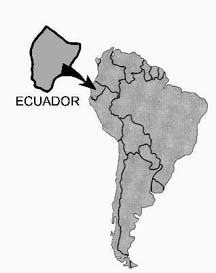
the South American country Ecuador. This small, peaceful “banana
republic”, like so many Latin American nations, has always been
dominated by the United States, which from an early period has ensured
that this country remained a cheap source of agricultural produce and an
open market for American goods. Maintaining this comfortable arrangement
has involved assistance, in the form of electoral contributions,
training, etc. to politicians who don’t upset the boat and who don’t
meddle with the powerful oligarchy that makes economic and political
exploitation possible. The system basically appeared to be “working”,
not because Ecuador was truly democratic or working its way towards
greater equity, but because it got lucky and discovered oil. As a
result, the Amazon jungle was plundered and some rich people became
richer. Some of the goodies trickled down to a not-so-educated middle
class, made to feel content enough to be able to sit on chairs
upholstered with American cloth and watch American television shows on
American TV sets. None
of these steps might be within reach if you happen to be a citizen from
some other region of the world, for instance, if you are a citizen of
the South American country Ecuador. This small, peaceful “banana
republic”, like so many Latin American nations, has always been
dominated by the United States, which from an early period has ensured
that this country remained a cheap source of agricultural produce and an
open market for American goods. Maintaining this comfortable arrangement
has involved assistance, in the form of electoral contributions,
training, etc. to politicians who don’t upset the boat and who don’t
meddle with the powerful oligarchy that makes economic and political
exploitation possible. The system basically appeared to be “working”,
not because Ecuador was truly democratic or working its way towards
greater equity, but because it got lucky and discovered oil. As a
result, the Amazon jungle was plundered and some rich people became
richer. Some of the goodies trickled down to a not-so-educated middle
class, made to feel content enough to be able to sit on chairs
upholstered with American cloth and watch American television shows on
American TV sets.
Such good things do come to
an end, and they did so some years ago when Ecuador’s fragile economy
and political stability collapsed. From one day to the next, the
financial situation, provoked by absurdly greedy politicians and
bankers, spiralled down. The price of the dollar skyrocketed and
inflation went through the roof. In an incomprehensible effort to
stabilize things, the government froze every citizen’s private bank
account. Whole life savings, so painstakingly accrued for a child’s
education, a house, or perhaps travel to some distant place like India,
were gone and most probably will never be recovered. The final blow came
when Ecuador, bowing to the unmerciful experimentations of the
International Monetary Fund, “dollarized” its economy. Today the
national currency, the sucre, no longer exists and everything has a
price in dollars. This does not mean, however, that people are earning
even at the level of the pittance that illegal migrant farm workers earn
in the United States. Ecuadorians have to make do somehow, earning like
third-world citizens and paying like first-world ones even for
life-saving medicines. It goes without saying that there isn’t too
much money around for travelling, let alone relocating elsewhere.
Then, of course, there is
the matter of a passport and visa. There were some days in the turmoil
that ensued in Ecuador last year when there would have been no office to
which to apply for a passport, as there was no identifiable central
government in operation. Even most of the time, however, when the waters
are not so rocky, it is not an easy process. As in many developing
countries, in Ecuador a passport is not really regarded as a citizen’s
entitlement; in other words, there is no assurance that you can get one.
Firstly, it is expensive. Secondly, obtaining one requires a series of
other documents, which in turn require a birth certificate, a paper
which significant numbers of Ecuadorians do not possess. Finally, there
is the question of what kind of weight such a passport carries in the
international arena. An Ecuadorian I know was once stopped while coming
through Indian customs not only because the customs officials had never
heard of his country, but also because they could not fathom that such a
handwritten (only in Spanish), homemade-looking document was actually
legitimate.
And this particular
Ecuadorian citizen was actually lucky to have come as far as the customs
queue, for the obtaining of an Indian visa is no small feat. The hassle
begins with the fact that India has no embassy in Ecuador: if you want
even a tourist visa, you must send your application to Colombia. This
adds to the expense. Once your passport reaches the embassy, there is a
good chance that Indian officials will think twice before granting any
kind of extended stay. The Ecuadorian citizen has earned the sorrowful
distinction of possessing a nationality that even other developing
countries are sometimes reluctant to provide with visas.
Suffice it to say that even
the most committed and impassioned Ecuadorian would find it very, very
difficult, if not impossible, to get to Auroville. And such Ecuadorians
are hardly alone. There are whole populations in the world whose
political-economic lot is far worse: people who have no nationality;
people who live virtually imprisoned by their governments without the
possibility to leave; people living amidst warfare, and people whose
currencies mean absolutely nothing in dollars or even rupees.
Everyone makes deep
sacrifices to come to Auroville. Sometimes it is important, however, to
realize that the capacity to make such sacrifices is actually a
tremendous privilege based on economic status and nationality, and not
only a function of one’s spiritual growth. This kind of awareness can
be very humbling, and can also be very powerful on a collective level.
Ultimately, understanding the material conditions which facilitate one’s
choice to participate in the Auroville experiment, and limit another’s
possibilities to do so, can be an important step towards recognizing,
and eventually overcoming, some of the concrete obstacles to achieving
human unity.
|