|
Oct 2000
Looking at Auroville
through photographers' eyes
by Shanti
Many Aurovilians and visitors see the large,
color photographs hanging in the new exhibition on Auroville in the
Visitors’ Center. Still greater numbers of people see photographs of
Auroville in Auroville Today or on the Auroville website. These images
are meant to give people a sense of Auroville in a way that simply
reading or hearing about the community does not. After all, everyone
knows the old cliché, “A picture is worth a thousand words.” What
we don’t always realize, however, is that pictures, here and
everywhere, conceal as much as they reveal. Hidden from view are the
processes of selection and edition made by the photographer and later by
exhibitors or publishers.
The issue is an important
one as Auroville relies increasingly upon visual representations and
their accompanying texts. Auroville is presented to the outside world
through brochures, postcards, books, T-shirts, videos and CD-ROMs. The
motivations behind such representations vary, ranging from the pursuit
of art or education, to fundraising or personal profit.
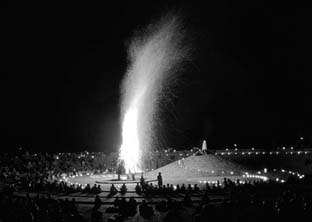
Olivier considers
this picture of the bonfire at the amphitheatre as one of the best for
representing Auroville. Says he: “The people gathering together, the
Urn symbolizing the aspiration for human unity, the bonfire
symbolizing the spiritual aspiration…there is no better way to
portray the essential Auroville.”
OF COURSE, not everyone
working with images in Auroville is attempting to “represent” the
community. Nevertheless, these images may also come to be associated
with Auroville in the minds of viewers. The Joy Postcards sold
throughout India and the travelling slide-show, “The Genius of
India”, are not meant to portray Auroville. In the case of the
postcards, however, the address on the back is enough for customers to
make the connection. As for the slide-show, the presenters’
acknowledgement of coming from Auroville, in addition to the
philosophical nature of the show can forge an association for the
audience. As a result, such materials come to form part of the
constellation of visual perspectives that outsiders identify with
Auroville.
Challenges in selecting Auroville images
In investigating the
processes behind the production of images on Auroville, the first thing
one encounters is the is a relatively anarchic approach to the various
forms of communication. Since there is no one body vested with the
authority to generate official representations of the community, the
visual materials that exist circulate largely through the efforts of
specific groups of interested individuals.
These groups are frequently
trying to do their best under considerable constraints. The team behind
the Visitors’ Center exhibition is no exception. Franz, who was
closely involved in this project, explains that the problem was not only
insufficient funds. When it was time to select images, the team had to
deal with the scarcity of photographs. It is only in recent years that
there has been an interest in maintaining an archive of photographs of
Auroville. Much visual documentation, particularly of the early years,
has been lost.
Whatever the aims of the
presenters may be, many of them face the common challenge of attempting
to capture some aspect of spirituality. This is no easy task.
Spirituality, an abstract concept, is not easy to convey in a single
image. As the photographer Sven notes, “People, both visitors and
residents, come to Auroville for the inner experience. But how can you
possibly represent the inner to the rest of the world?”
This is true even when
presenters are working closely with a spiritual text, as in the case of
the “Genius of India” slide-show and exhibit. Team member Christine
tells it, the impetus behind the presentation was to “put Sri
Aurobindo at the forefront” in celebrating India. Seeking to
illustrate the tendencies that Sri Aurobindo attributes to the ancient
Indian mind, the team was able to choose from a wealth of photographs in
the collection of Olivier, who has been capturing the beauty and
timelessness of ancient Indian art for years. Even so, when it came to a
particularly complex concept, such as the tendency towards synthesis,
the group faced great difficulty in deciding which images would work.
How are images chosen?
In spite of the many
limitations and challenges, however, those who create and present images
are making choices, although to some of them their choices may seem
somehow “obvious.” The decisions they make depend upon their
intentions, in addition to the relationship that they want the images to
have with a written text. In the case of the Visitor’s Center, the
team’s primary goal was to educate the increasing numbers of visitors,
primarily Indian tourists to Matrimandir who know nothing about
Auroville. The exhibit text was guided by suggestions from Kireet Joshi,
the current Chairman of the Auroville Foundation. Kireet had observed
that the three questions he was most frequently called upon to answer
were: “Why Auroville?” “What has been accomplished in 30 years?”
and, “What is the community’s organizational structure?” The
Visitor’s Center text was an effort to respond to precisely these
questions. The accompanying photographs, commissioned from John Mandeen,
were to illustrate the text as closely as possible.
Given the educational aim,
it is not surprising that the panels of the exhibit remind one of a
museum display. The documentary style of the photos, the straightforward
tone of the text, and the addition of statistics about the community’s
size, etc. work together to give the impression of a factual and
irrefutable account of the community. What remains hidden to the eye of
the observer is that there may be many other points of view.
A different approach to
images was taken by the creators of the newest version of the brochure,
“Auroville: A Dream Takes Shape.” According to Alan, a member of the
Publications Group, which oversees that all brochures are up to date,
the creators of the booklet prioritized the images over the text.
Working once again with John Mandeen, the group gave the photographer
the written document and not only asked that he come up with apt
illustrations, but also encouraged him to create images which could
actually replace specific sections of text. “In the past, brochures
tended to be very text oriented,” says Alan. But after seeing the
impact of the exhibit at the Visitor’s Center, we thought that there
was something we could say better through pictures.”
The photographs for the new
brochure were selected with an eye to showing Auroville as an ongoing
process. This meant in part eschewing a rosy tone and incorporating
images that the team felt acknowledged the “down side”. “We
selected a photo which showed commercial development in one of the
villages,” says Alan, “as well as one that showed the motorcycle-car
aspect of life here.” At the same time, the group wanted photos that
portrayed a kind of intensity in human interactions. For example, they
selected an image of a Western man training a young Tamil man in a
workshop based on this criterion. .
Viewer perspectives
The same photo could,
however, be read in a different way. Some people are quick to identify
what they believe to be racist or colonial, especially when looking at
images that appear to affirm that foreigners have nothing to learn from
local people. Alan admits that it did not occur to the team that viewers
might read this photo in this way. This problem reflects the fact that
images do not have any intrinsic value, because they always depend upon
the myriad possible interpretations that specific audiences bring to
them. This problem is particular in representing spirituality. One case
in point is the Auroville boutique in Paris. When the shop opened, its
window displayed large photos of Mother and Sri Aurobindo. Within days
graffiti appeared outside with the condemning label, “sect”. The
boutique management responded immediately by replacing the photos with a
display of products. Whereas in India, people expect to see visual
references to the reverence for a guru, in countries such as France and
Germany, where the population is concerned about the dangers of
brainwashing and authoritative organizations, the photos of Mother and
Sri Aurobindo do not have the proper context for their public display.
The fact that there are many different audiences for Auroville images is
something that all presenters must keep in mind, and this is
particularly important when the aim is public relations.
The Auroville we don’t show
Given that many visual
materials are produced to “sell” the community, there is an impulse
to show Auroville as perfect. Perfection, however, does not always sell.
For example, as a German Aurovilian pointed out, people in Germany would
be more interested in seeing how people living in Auroville are facing
challenges. This raises the question of what could potentially be of
interest to some people, but which is not being presented. When we look
at the body of images as a whole, whether documentary in nature as can
be seen in brochures, or artistic as in the case of the portraits of
Ireno, it is clear that cultural diversity, harmony, spirituality, and
the environment have been the priority. Other versions of Auroville have
remained hidden, if not purposively marginalized. This is not because
these other dimensions of life are unimportant. In fact, they are quite
central to the ongoing challenges of living in Auroville and struggling
to make Mother’s dream a reality.
Among these themes are
labour relations with the local people, work in progress (finished
products are usually what get depicted), conflict and conflict
resolution, a range of human emotions, and the sheer diversity of
attitudes. The first response to this is usually that the community
feels threatened and as such is unwilling to portray anything that could
be seen in a simplistic, negative light. The situation, however, is more
complicated. Some feel that the problem arises from the insistence on
the part of some Aurovilians that all public presentations be kept on
the ideal level. It may also be a function of growing pains. As Carel
comments, “How a community represents itself is a maturity factor –
the more mature you are, the more you can accept failure and complexity.
If not, you need to show only beauty. It is only now that Auroville is
becoming more mature in this regard.”
Seeing into the future
It would seem that in the
end, any visual representation of Auroville can be problematic. After
all, no matter what the power of images, they only present partial
truths. Moreover, it is impossible to control the messages they
broadcast, as their meaning depends equally upon the perspectives that
viewers bring to them. For Auroville it is important that its visual
representations are never accepted as obvious or natural. Instead,
Auroville should constantly ask what its representations try to achieve
and what is consciously or unconsciously hidden. Part of the solution
lies in encouraging more Aurovilians to get involved in this field. As
more images come into existence, the greater the potential to resist
what are supposedly authoritative versions of Auroville and to represent
the full diversity and complexity of the community.
|