 |
|
|
|
Home > Journals & Media > Journals > Auroville Today > "Blessings for effectivity" |
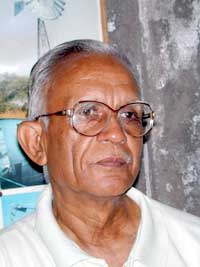
"India first started to take a serious look at its energy requirements in 1965. At that time, renewable energies were still considered to be the domain of backyard tinkers and not serious alternatives for solving the nation's energy requirements. The Mother, at the time, was truly far sighted. The Sri Aurobindo Ashram had the first biogas plant in south India in 1954, the first solar cooker in 1958, and the first multi-blade windmill in the early sixties. In 1965, a solar hot water system was installed in the Ashram. She wrote 'Blessings for effectivity' on the photo of the system and that has become the charter for renewable energy systems both in the Ashram as well as in Auroville," recalls Chamanlal Gupta who has been the moving force behind the introduction of renewable energy systems in the Ashram and Auroville." "Shortly afterwards the Indian renewable energy program took off. Now, 35 years later, India counts as the world's fourth largest wind-power user and the fifth largest user of solar photovoltaic programmes. The Ministry of Non-conventional Energy Sources (MNES) estimates that India has an enormous potential for renewable energies. "When Mother gave us her message, I wondered what She meant with 'effectivity'. Much later I found out that it means doing the right thing rightly. And in renewable energy, that right thing is contextual. The right thing for a village situation is not the same as a right thing for an urban or industrial area, which have the same objectives and mores as anywhere else in the world. Rural India has specific needs, mainly to create sustainable livelihoods at minimum capital investment. And then there are the niche areas, remote areas with tribal populations, and areas with difficult logistics such as hill areas and islands. The government, after many failures, has understood that a uniform approach is incorrect. Today, it has given the care of 18,000 villages that have no chance of being electrified ever to the Ministry of Non-conventional Energy Sources. Another 80,000 villages are likely to be connected to a grid, but may not get electricity in the foreseeable future." "There is another aspect to effectivity," says Chamanlal. "And that is product quality. We witness a tremendous development of renewable technologies in India that are well-engineered and well-made. All this has developed in the last 20 years. Still, I think, we are only in the first flush of youth. Better systems will come on the market." Though renewable energy is actively being promoted, it ranks fifth after coal, oil, gas and nuclear energy. India is equally actively promoting the expansion of its nuclear power program. Though he objects to nuclear energy, Chamanlal is not worried that its promotion will affect the future of the renewable energy sector. "Conceding the fact that India is energy starved, there is no alternative but having renewables together with creating public awareness about the need to be energy conscious," he says. "The target of achieving 10 percent of incremental capacity addition by renewable energy systems by the year 2010 is a realisable one, provided the achievement process is driven not by target but by the ground situation. And it will require an active government co-operation to do away with all the existing legalistic and bureaucratic barriers."
|
|||||||||||||||
|
Journals & Media > Journals > Auroville Today > "Blessings for effectivity" |
|
| Auroville Universal Township | webmaster@auroville.org.in |  |