|
Dec 2001
"All mankind must be healed"
- by Emmanuelle with Shankar as
translator
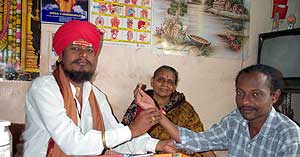
Tribal Adivasi Healers of the Indian state of Andhra Pradesh give
medical consultations in India's cities. Recently they came to
Pondicherry.
India has a great variety of
traditional healing systems. Over the centuries, the tribal Adivasis of
Andhra Pradesh have developed their own system. A decade ago, a group of
its healers decided to create awareness amongst the public about 'the
divinity of Adivasi medicine' by travelling all over the country and
setting up camps in different towns. Since September 2001, this group of
Adivasi healers, hailing from Gandasiri village, in the Khamam district
of Andhra Pradesh, has set up their clinic in Pondicherry. The group is
headed by the tribal chief and leading medical practitioner, Guruji
P.Srinivasaraju and his father and Guru B.Sahadevaraju.
Until some fifteen years
ago, the tribal Adivasis of the Khamam district lived in the deep
forests, like their forefathers remaining naked except for the lower
parts of their bodies, which they covered with bark, animal skin or loin
cloth. It was only recently that the Government allotted them land,
where they started cultivating chillies. Although some of them have
accepted 'modern civilization' to some extent, they still follow their
traditions and their children are still taught the old ways, including
the use of bow and arrow. They have their own systems of governance and
organization. Votes are cast orally, and the candidates get elected as
leaders when they have a majority. They do not depend on the police or
judiciary system to solve problems and settle conflicts. Although about
five villages, out of the eleven tribal villages of the region have
merged with neighbouring towns, there are many Adivasis who refuse 'modernisation'
in all its aspects. Oralaraju, Guruji P. Srinivasaraju's brother, is one
of those, who, with his wife and child, continue living in their native
forest. The Adivasis worship Vanadevi, the Goddess of the Forest.
The indigenous Adivasi
system of medicine has been handed down orally from generation to
generation. There are no written records on this branch of medicine. The
knowledge and skills are usually transmitted from father to son. The
children watch their elders diagnosing and treating patients from a very
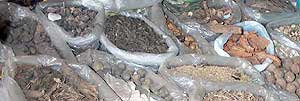
young age, and are taught to prepare medicines. All the ingredients for
the medicines are derived from nature. Besides herbs, seeds, roots and
barks, various minerals, metals and other natural matters in their
powdered form, are used for the preparations. The healers themselves
gather all the necessary plants and herbs that grow wild in the forests
intoning special prayers. The medicines are mostly prepared using a
mortar and pestle to pound the various ingredients together.
The Adivasi healers touring
the country speak about five Indian languages, including Tamil. Their
mother tongue is Telugu. The Telugu name for their branch of medicine is
"Erhulu Patchala Mulighalu".
The Adivasi healers claim
their medicine can cure over three hundred and fifty diseases, including
different types of colds and headaches, skin and eye ailments, various
types of paralysis, asthma, tuberculosis and certain cancers, diabetes,
problems of infertility and impotency.
The system of diagnosis is
through the reading of the pulse. The healer then makes a brief
commentary on the patients' constitution and prescribes treatment, which
is then prepared by the youngsters of the group. Many of the patients
they have successfully treated over the years had previously been seeing
allopathic doctors, who had not managed to find a cure to their
ailments. The Adivasi herbal medicines have absolutely no side effects.
On diagnosis and prescription, the Adivasi healers pay more attention to
the individual patient's physical constitution and nature than to the
specific symptoms of the disease.
The Adivasi healers do not charge a fixed rate for the treatment given.
Their livelihood depends on 'dakshina', or offerings, which they accept
from patients, who give according to their wishes or means. Although
they stress the need for more awareness on this branch of medicine, the
Adivasi healers do not want to 'sell their tradition', and they are
against the commercial cultivation of medicinal herbs. Chemical
fertilizers would be used to increase the yield and they feel this would
seriously affect the efficacy and healing powers of the herbs.
Traditional herbal medicine in general is of late facing a new threat.
The modern pharmaceutical companies are plundering the herbal wealth of
the forests for manufacturing their medicines. This endangers the very
survival of the species and makes it more difficult for traditional
healers to find the herbs they need for their medicines. Measures must
be taken to prevent this from happening before irrevocable damage has
been done. Another great danger is deforestation, and the Adivasis have
already held many protests against this practice, as for them, the
forest is their whole life.
The Adivasi healers tour the
country and set up camps in various states and different towns for six
months in a year. For the remaining six months, they return to their
native village to gather the herbs necessary and to prepare medicine.
They also gather herbs from forests in other states. For the last
decade, during their touring, they have met with many important
personalities, such as successive presidents, prime ministers and other
ministers and have treated some of them.
Pandit Jawaharlal Nehru had visited their settlements when Guruji P.
Srinivasaraju's grandfather was the tribal leader and was received with
great pomp and celebration. His daughter Indira Gandhi later came to
visit their village and expressed the wish that their indigenous system
of medicine be spread throughout the country because of its great
efficacy. Former Andhra Pradesh Chief Minister, N.T. Rama Rao was also
greatly impressed by their system of medicine, and during his tenure, he
allotted them forty acres of land so they could cultivate their
medicinal herbs, without the use of chemical fertilizers and set up a
centre for manufacturing their traditional medicine. He too expressed
his wish that they propagate and create awareness amongst the public of
their traditional medicine, which they had , until then, only practiced
within their own community. That is how the program of creating
awareness on Adivasi medicine was initiated and the tribal healers began
touring the country. They have also traveled abroad and set up camps in
countries like Malaysia and Singapore. Today, a great number of people
have discovered this unique system of medicine, a great number of the
diseased have been cured, and they are all grateful to those tribals who
have come out to offer their ancient medical knowledge.
In the future, the group of Adivasi healers plans to return to their
native village and set up an Adivasi Institution there, while
cultivating medicinal herbs on the land allotted to them by the
Government. The camps being held throughout the country would then stop.
The new generation would become the Adivasi healers' representatives.
They would continue to travel the country, and while the medicines would
now be prepared in their native village, they would bring them to the
patients. The elders hope that the youth, who is presently being
educated will, in the future, document their system of medicine, so that
this precious knowledge is not lost for the next generations. As Guruji
B. Sahadevaraju was quoted as saying in "The Hindu", in
1999,"Nature is an abundant store of herbs with magical properties,
but not many are aware of this. We, who are brought up in the lap of
nature, know it."
One can only applaud
Guruji P. Srinivasaraju and his group, for their dedication to keeping
their ancient medicinal traditions alive and making their medicines and
cures accessible to all. For, notwithstanding the so called 'progress
and development,' more and more people are becoming aware of the
shortcomings of 'modernisation' and are looking for alternatives, in
life styles and in systems of healing. The Adivasi healers help ensure
that the traditions and knowledge from the ancient past are not
forgotten and discarded by mankind and that modern city dwellers keep a
contact with nature.
Guruji P. Srinivasaraju and his group can be contacted at 81, Kamaraj
Salai, Thattanchavady, Pondicherry.
|