|
December '02
Top-class dental lab becomes independent
-
by Priya Sundaravalli
The Auroville dental laboratory has moved into new premises and
takes up work all over India
October 31st 2002 was
a special day for a small team of Aurovilians - Nicola, Pierre,
Grazi, Marc and Namgyal. It was the day that the Auroville Dental
Laboratory officially opened its doors as an independent unit
in its new home at the Aurelec premises. Besides the rain gods
who enthusiastically showered their blessings that day, a smattering
of Aurovilians braved the torrential downpours to participate
in celebrating its renewed beginnings. I met Nicola a few days
later for the complete story…
Nicola beams at me as
I arrive punctually that afternoon. We enter a large room painted
white. It is airy and full of light. The quietness of the space
strikes me when I notice two people intently at work. They are
Pierre and Namgyal.
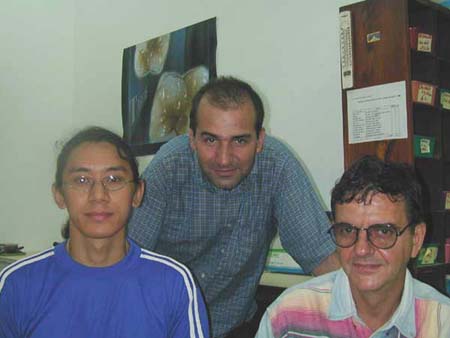
The place looks like
an unusual mix of an art studio and a chemistry lab. Posters of
crowns and bridges, perfect specimens from the prosthetic world
are prominently displayed. Workbenches with all kinds of gadgets
and tools, a pigeon-hole cupboard holding dental casts with name
tags identifying the mouths they belong to, a baking oven, a furnace,
mortars and pestles, glass tubes, and so much more - my eyes can
hardly take it all in…
Nicola is a dental technician
who was trained in Italy, and moved to Auroville 12 years ago.
He was responsible for the creation of the Auroville Dental Laboratory
in 1990. "I was visiting Auroville on a holiday from Italy. By
chance I got to meet a dentist here. He expressed a need in the
community for a dental technician. It was an exciting proposition;
I immediately moved my set-up from Italy, and I made my home here."
Nicola became an Aurovilian in 1994, and lives in Aspiration.
"Soon after, Pierre joined me from France and the two of us have
been working together since then. Over the years, three others
have joined our team.
"In the early days,
the dental laboratory was associated with the Auroville Health
Centre," Nicola explains. "Later it became part of the Auroville
Dental Centre. There we were working with Jacques and Suryagandhi.
Now we have created a dental lab unit that is separate from the
Auroville Dental Centre."
What was the reason
for this shift? "We have been feeling the need to focus more intently
on our profession which is very different from that of the dentist's,"
Nicola explains. "A place was available at Aurelec very close
to the Auroville Dental Centre. The conditions were just right.
Jacques supported our decision to move, and gave us all the equipment
that was part of the Auroville Dental Centre. Now we have the
opportunity to change the set-up as well as the space as optimally
as we envision. This will bring a new energy to the unit."
Did this move prove
expensive? "To install a dental lab, a lot of investment is needed,"
agrees Nicola. "This is because it is technology intensive. We
have been helped by a loan from the Central Fund that we have
to pay back monthly. Our ultimate aim is to be self-sustainable.
"A lot of equipment
is needed, and we have to keep up with the latest technology to
provide the best possible services that we can. While our primary
customers will be Aurovilians and the villagers who are patients
of the AV Dental Centre, we will also be opening our services
to the outside market." Nicola shows me some of the equipment
that has been bought recently for the laboratory. "Here is a micromotor
from Austria. It is cutting-edge technology used for sculpting
and grinding ceramic surfaces." Nicola hands me a device that
is about 15 cms long. The handle is ergonomically designed, and
the grip feels very comfortable. He turns on the machine and the
tip whirs silently. I can hardly feel any vibrations. He turns
it off and puts it back gently. "It costs approximately two motorbikes."
I gasp. "We have four such devices," he adds.
I gingerly ask about
the costs of dental work at their unit, and how affordable it
is. Nicola nods as if he expected that question, "When Aurovilians
go to the dental centre, they get charged. If they are not able
to pay by themselves, they are supported by the Central Fund,
which has a budget for this."
Since 1998, Nicola has
been a consultant to certain Italian and German companies in India.
They have been sponsoring him to attend dental conferences within
India, and also provided opportunities for offering workshops
to the dental community. This has provided him with valuable people
contacts, and given him a unique perspective and an edge over
his peers.
Nicola has a vision
of providing the products and services of the Auroville dental
lab to middle and higher range dentists in big cities like Chennai
and Mumbai. "These days, there are more and more patients who
are willing to pay for quality work. Since we can confidently
say that we are amongst the top dental laboratories in Southern
India, I am certain that we will find dentists with whom we can
work..
"In India, the market
is generally not concerned with quality but is focused on being
cheap and quick. Our approach is different. We propose a certain
quality on par with the standards set in the west. We import almost
all of our material, including new generation composites with
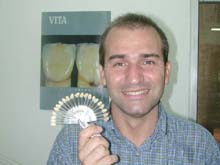
which we make ceramic crowns and bridges." Nicola pauses to show
me what he is talking about. He opens a cupboard that is full
of small plastic vials arranged neatly in rows. Each vial contains
different shades of bio-compatible ceramic material in powder
form that approximate the variations in teeth colour. They form
the raw material for building crowns.
Nicola is called over
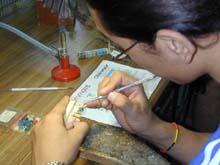
by Namgyal who is sculpting a ceramic tooth filling. I watch them
exchanging ideas intensely; then Nicola takes the hand tool and
demonstrates how the filling has to be surfaced. I am curious
about how long it will last. "Teeth which have received dental
care can last for many years, even up to 15-20 years. Much depends
on how it is taken care of by the customer. Tooth work can never
be guaranteed. But at our unit, we are ready to correct any problem
that may develop within 1 year.
What future visions
do Nicola and his team have for the unit? Our first concern is
to establish a high repute for our laboratory. We also see this
lab as a state-of-the-art training centre in dental technology,
both for technicians and dentists. One of my personal dreams is
to train an Aurovilian in this work. Is anyone listening?
One has to remember
that this work is both an art form as well as a science. Many
of us at the lab visit Paris annually to get exposed to the latest
developments in the field. We do feel that we should share this
knowledge with the dental community in India so that everyone
can benefit, especially the customers. We plan to move in this
direction in the future, and this of course will mean additional
work.
We are trying to do
our work with a lot of care and with professional integrity. This
is often not often recognised by Aurovilians. Even now it is hard
to make people understand what is implied by our work and the
effort behind it. He pauses as if he needs to clearly express
what he feels inside. Going only for cheap things is not a good
idea, especially when something really has a lot of importance
to your health and figures prominently in your body.
If there is one message
I absolutely want to share, it would be this: Look, there are
people here who can do this kind of work in a certain way. So
let us support them, and not go to Pondy anymore. Our doors are
open for any Aurovilian to visit us at any time. We would love
to have Aurovilians stop by, understand the environment we work
in, examine our products, and see what we are doing, invites Nicola
heartily.
Of course our best advertisement
is our patients who are happy, who can bite easily and have the
most perfect of smiles!
|