|
December '02
An avalanche of home-made food
-
by Carel
A large quantity of home-made and organic
food products is on sale in Auroville. Their number is daily increasing.
Of late organic and
home-made foods are widely promoted. The Solar Kitchen posts up
each day what elements of its menu have been grown or produced
in Auroville. The Pour Tous stall has a special section devoted
to organic Auroville-grown and home-made products. The Auroville
farms have started a massive jam and marmalade- making movement
offering stiff competition to the existing Auroville food processing
units. And the number of individual Aurovilians whose home-made
pickles, cookies and other consumables are fighting for shelf
space in Pour Tous is increasing to such an extent that the Pour
Tous team, in an announcement in the Auroville News, felt forced
to state: "We have already plenty of jams and biscuits. How about
some new ideas?" All this not only suggests that the organic idea
has taken firm root in Auroville, but also that there is a market
for home-made products, the average low monthly maintenance notwithstanding.
Maintenance needs
In fact, it is rather
the low monthly maintenance which has given the impetus to selling
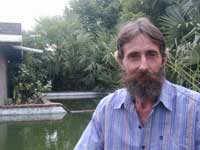
home-made products. Herbert, the manager of Siddhartha farm, recounts
that when he came to Auroville in 1983, there was not enough food
for everybody. "I was in charge of a huge piece of land in the
forest area, I had a watchman but the money to pay that watchman
often wasn't there. The basket, which all of us received from
Pour Tous, was often almost empty. I had no money of my own. Then
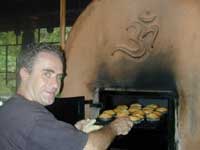
I decided to start making biscuits, using the oven of the Center
Kitchen from 8-12 in the night. I used local grains such as kambu
and mixed them with wheat flour, jaggery and some fruits. That
resulted in rather sturdy biscuits, each of which was said to
be a meal in itself. And I started to make peanut butter. The
income helped me to sustain myself and my family and pay the watchman.
And I never stopped. I moved to a new farm but I still make the
biscuits and peanut butter, though today's biscuits are better.
Nowadays I use varagu, ragi and kambu, and mix it with the jaggery
from the sugarcane which we now grow here on the farm. I also
sell cashew butter and roasted cashews. Most of the peanuts I
also grow here, though sometimes they come from Pondy. My focus
on using Auroville organically grown produce hasn't changed. And
as I have created a large rainwater catchment tank, I'll soon
also provide Tilapia fish to Pour Tous." Money problems were also
the reason for Jaya and Nico to start baking their by now famous
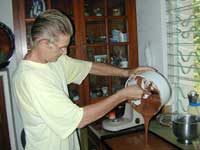
'brownies'. Says Jaya: "About six years ago we decided to send
our children to the Kodaikanal International School but we did
not have money and we felt that it would not be a good idea to
go back to our home country to earn. At first a number of Aurovilians
generously helped out. Then the idea of selling brownies came
up and that was a bigger success than we had anticipated. Obviously,
quite a few Aurovilians have a sweet tooth. We did have some moral
compunctions, though. But just when we were wondering if we shouldn't
stop promoting the vital gratifications of the Aurovilians, a
lady from Pondicherry approached me on the road and with simple
sincerity expressed her gratitude for the product. Somehow it
was a sign that it was ok to continue, and since then we have
diversified and are offering more products." Henri came to Auroville
in 1992. Being a professional cook with a two-star restaurant
background, the decision to be involved in the food sector came
naturally. "I worked in many Auroville restaurants, but then I
realized that I could never afford to construct a decent accommodation
if I continued in this way. So I went twice back to France and
spent a miserable time working very hard to get money to build
myself a house in Auroville. When I came back I decided that I
would not repeat that experiment ever again and that I would start
selling food products in Auroville to maintain myself. It was
the beginning of 'Royal'. Its first product was a chicken-liver
pâté, which still sells well today. More products followed soon
afterwards: biscuits, cakes, mayonnaise, mushroom à la grecque,
quiches, to name but a few. The reception of the products is good,
but after a while some items go down and I have to come with something
else. So I make some new products every few weeks. I have to find
a means though to balance my inner work with the outer activity."
Going commercial?
With the exception of
a few products that are available in Pondicherry, home-made food
is only sold in Auroville. There is not yet a drive to turn the
home industry into a real food-manufacturing business. Says Jaya:
"Many of our Auroville products are top notch quality and I think
that a bakery cum gourmet shop selling Auroville food products
in Pondicherry or elsewhere would be doing very well. But many
of the people involved in the production do not really want to
go commercial." Says Henri: "There would not really be a problem
to expand production. But it would make no sense to do that as
an individual. At present, all those who sell their home-made
products in Auroville do so in order to earn money to make ends
meet. If all would agree to join forces and not only concentrate
on making money for themselves but also on making money to support
Auroville, it would make all the difference. We would need a large
collective workshop and an Auroville sales organisation to market
the products and we would need to adjust the products for a longer
shelve-life. But this is a realistic possibility and I would like
to be part of it."
New food products
There is a lot of experimentation
going on to create new food products. Henri plans to start a product
line of instant-food. Packed in aluminum foil, these vegetarian
and non-vegetarian dishes only need to be kept for 5 minutes in
boiling hot water, and then are ready for consumption. Refrigerated,
the bags will keep for 3 days. Jaya too likes to experiment. "I
have always been interested in health food. Though I myself like
good cakes I didn't really feel happy baking all kinds of things
with sugar. When Don from America came to live in Auroville he
suggested we make breakfast cereals. We worked on that idea together
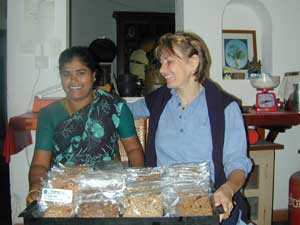
and it resulted in 'Granola'. It contains oats, wheat flour, dried
fruits, nuts and organic jaggery instead of sugar. But this product
still relies on grains that are not locally grown. Then, together
with Anandi, Martina and Don, we visited the Central Food Technology
Research Institute in Mysore, and that eventually gave the boost
to introduce a new product, called 'Dr. Nibbles'. It is a breakfast
cereal consisting of crispy flakes of organically grown local
grains, mixed with jaggery, and snippets of dates, ginger and
raisins. "This product is being extensively tested by a few Aurovilians.
Some are friends who eat these type of products regularly. One
of my testers has a very well developed sense of taste, and recently
I asked an Aurovilian who is involved with a physical fitness
program to give me feedback on how her body responds to these
foods. If 'Dr. Nibbles' and other products in this line are a
success, it would encourage both the AV farms and local farmers
in the village to grow these grains organically and the farm-group
could be supported in buying its own flaking machine. Another
planned activity is to meet with experts in the Ayurvedic health
tradition to understand more deeply how best to combine different
foods
Quality control
A rising concern is
the need for food quality control. So far, the Auroville sale
outlets accept the products as they are brought in. "The need
for quality control was voiced years ago by Dr. Lucas, Martina
and others, but it has not had a sufficient follow-up. Few people
will disagree that quality control is necessary, and that a 'food
quality control team' will be required soon. It probably is a
full-time job. They should not only check the end-product for
the presence of pesticides and toxins, but also the hygienic circumstances
under which it is manufactured. Ultimately, this should result
in some Auroville standards, and products that do not confirm
should simply not be sold," opines Jaya.
The maintenance paradox
Isn't it a paradox that
in order to increase one's low monthly maintenance home-made foods
are offered to those who have to survive on that same low maintenance?
Jaya admits that the question has relevance: "Some Aurovilians
who are on a low budget have an arrangement to get my products
straight from me, which is cheaper for them. Ideally, all of us
should be able to live without having to make a profit. But this
is not an ideal world. I have no problem that cakes and luxury
items carry a profit; but basic food items, such as the breakfast
cereals, should be within everyone's financial means." For Herbert,
this question arises to a lesser extent. Herbert's farm Siddhartha
is unique in Auroville as its location bordering the Irumbai lake
allows it to grow crops such as rice and sugarcane that require
large amounts of water. Along with Annapurna farm, he participates
in the Free Food program which was started a few years ago by
Auroville's commercial unit Maroma. Maroma donates the costs of
production to grow organic red rice and sugarcane, and Herbert
donates the rice and the jaggery directly to the Solar Kitchen.
But as the community does not pay for farm maintenance, the income
from the sale of foods made from the farms produce remains necessary
to run the farm. "The farm's productive area is still low, as
it consists of a lot of pieces that are not linked to each other.
But the piece of land right in the middle is now for sale. If
we can manage to buy that piece and raise the money for a well
and a pump, Auroville would have a productive area of 30 acres
instead of the 5 acres I manage today," he says. "And that would
vastly increase the amount of free produce I can offer to Auroville
under Maroma's scheme."
Meeting basic needs
Maroma's Free Food scheme
is certainly a step towards the realization of the Auroville economy
Mother wanted. For the township is supposed to meet everyone's
material needs on the basis of the most elementary necessities.
Says Jaya: "We have still a long way to go to provide basic housing
but we could look at places like Atithi Griha to get an idea how
to go about it. For clothing, Auroville has developed the Nandini
system: you donate a certain amount each month, and in return
you can take, within certain limits, whatever your requirement
is. It should be possible to create a place where Aurovilians
would get their basic food requirements in the same way."
|