|
December '02
An ideal protein provider
-
by Carel
An important food crop in China, Japan
and Korea, soybean products are only slowly gaining ground in
India. The same goes for Auroville.
Soybean or soyabean
is one of the most versatile pulses known to mankind. Its high
protein content makes it a substitute for expensive meat products.
It is estimated that one hectare of land used for grazing purposes
will produce enough meat to satisfy one man's protein needs for
190 days; planted in wheat it will provide enough protein for
2,167 days. But that hectare, planted with soybeans, will yield
enough protein for 5,496 days. Soybean finds hundreds of uses
in home and industry. Well-known processed soybean products are
tofu, soya sauce, tempeh (originally Indonesian), miso (Japanese),
natto (Japanese). and hamanatto (Korean). Soybean is also used
to produce textured vegetable protein to replace meat, a source
of oil, and is added to paste toppings, baby foods, candy bars,
cake mixes and bread.
In countries such as
China, Japan and Korea advanced technologies for the processing
and manufacture of palatable soybean products have been developed.
In India the introduction as a food item has proved difficult.
In Auroville too, soybean products are only slowly being appreciated.
About four years ago the unit Aurosoya was launched, but it is
still struggling to keep afloat.
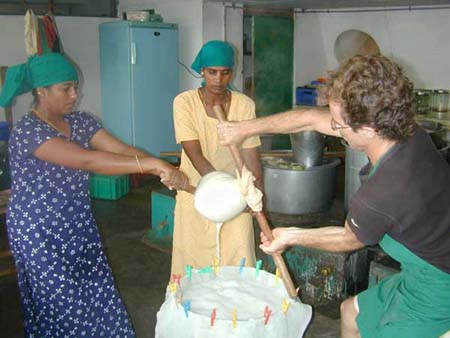
"Actually, the unit
would not have survived but for the help of the Dutch Foundation
Stichting de Zaaier," says Frederic who manages the unit. "They
have helped a few times in the past, and the result of their most
recent cash injection will come to Auroville soon: a soya cow,
a machine to process the soybeans. The machine's filter will remove
the particular smell and taste of the bean which some people don't
like, and it will be possible to introduce another product range."
In addition to tofu,
the white delicate soyabean curd that is sold in water-containing
plastic bags, Auro-soya sells soyabean milk (good for people with
high blood pressure and those who are allergic to lactic acid)
and tempeh. New products are cookies made from soya and wheat
flour, and muesli made from the bean pulp (called Okara in Japanese)
that remains after making tofu, mixed with raisins, dates and
jaggery. "When the soya cow is operational, we will soon produce
soya yoghurt and soya bean paste," says Frederic, "and I have
many other plans."
One of the uncertainties
of Aurosoya is the quality of the soybean that the market offers.
Are they genetically-modified? "There is no way for me to know,"
says Frederic. "Best would be if the Auroville farms would produce
the soybeans - assuming they can buy seeds that are not engineered.
But so far they supply less than 10% of my requirement. The only
thing I know is that my soybeans come from Madhya Pradesh, but
there is no certificate that the beans are organic."
Aurosoya's main sales
outlet is Auroville and there are a few shops in Pondicherry and
Thiruvanamallai that sell Aurosoya's products. Is there a prospect
of a quick development now that the soya cow is coming soon? Not
really, it appears. "Tofu is not well-known and it will take some
time to have the product accepted.
Then there is the marketing
and packing problem. I cannot sell tofu outside of Auroville in
the water-containing plastic bags I use here. To sell outside,
I would need a Rs 1 lakhs (US$ 2000) vacuum-sealing packing machine
which I cannot afford for the unit is under severe financial constraints.
As it has to move out of the Bharat Nivas complex as soon as the
government grant arrives to finish this building, I had to take
a loan to build a new unit. The pay-back time is 12 years! The
best result I can expect is that we will break even in the coming
years and that the marginal maintenance the unit now provides
me with will rise to an acceptable level."
|