|
December '02
On dark streets with solar
-
by Alan
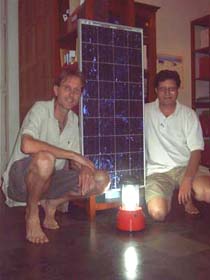
Hemant and Jos, the managers of AuroRE,
a unit responsible for promoting renewable energy applications
within and outside Auroville, talk about their new projects
It's dynamics.
We learn what works in Auroville,
we take it out to other parts of India where we learn new lessons
which, in turn, help us improve what we are doing here." Hemant
enjoys talking systems. He's also pretty nifty at setting them
up: he's about the only person I know who understands the complex
financial jugglery involved in allowing Aurovilians and others
to get their hands on solar pump sets at wildly discounted prices.
By 1995 about 150 of these sets had been installed in the community,
about 150 kW worth of installed capacity. The next year, however,
was a quiet one: both the demand and the subsidies dried up. Suddenly,
Hemant had time on his hands. "Every day I came to the office
just to metaphorically raise the flag in the morning and lower
it again in the afternoon." The next major project was the Matrimandir
Solar Plant, which was commissioned in 1997, but this was followed
by another two year hiatus. "I really began to wonder," recalls
Hemant, "if I shouldn't have been doing something else. However,
I took the opportunity to search out creative solutions for financing
solar developments, and this finally bore fruit."
The 'fruit' was a contract
to set up the financial package for providing solar pump sets
to farmers in the Punjab and other states: AuroRE was also responsible
for the installation and servicing. "There were times when I thought
we'd bitten off more than we could chew. We had to install 219
pump sets in 3 months over a huge area - from a border village
in Punjab to a place in West Bengal, from Kanyakumari on the southern
tip of India to the northernmost village in Gujarat - and we were
beginning from scratch: we had no office up there, no technicians,
no nothing! Fortunately at that moment Jos came along."
Jos has a degree in
Renewable Energy technologies and project management experience
in both Africa and India. "I knew we could do it," says Jos, "but
I also realized it would be a huge challenge. Apart from setting
up an office and mastering the logistics of getting all the equipment
sent to the right places, we had to train five teams who, at the
peak, had to install 7 systems a day. It also meant that Rishi,
Arnab and myself, the project managers, had to work 12-13 hour
days for three months without a break!" "We made plenty of mistakes,"
adds Hemant cheerfully, "because we had to design things on the
hoof, at top speed. For example, our first design for the tracking
mechanism had to be modified after some of the systems developed
cracks during an exceptionally windy summer. We ended up replacing
every single tracking mechanism, even the ones which had not developed
problems: after all, our reputation was on the line. But we learned
something invaluable - how to do far-flung projects."
Anytime light in
Ladakh
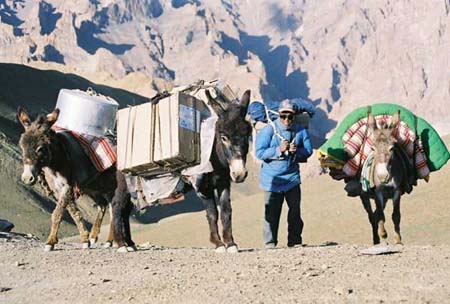
This was just as well
because the next one was even further flung: in remote and beautiful
Ladakh. This region is no stranger to solar projects as the high
altitudes offer ideal conditions - low ambient temperatures and
more sunny days per year than any other part of India - and the
huge distances and widely dispersed population makes the generation
of electricity by conventional means unviable. Yet even by Ladakh's
standards this is to be a huge project: over five years, at a
cost of 433 crore rupees (approximately $86 million), thousands
of home-lighting systems and solar lanterns will be distributed,
and solar power plants, similar in size to that at Matrimandir,
will be set up to provide electricity to remote villages.
"Fortunately," says
Jos, "this time we were only responsible for the project coordination
of part of the first phase, but this still involved supervising
the installation of 8,700 home lighting kits - comprising a 37
Watt solar panel, battery, charge controller and two 11 Watt lights
- and 6,000 solar lanterns. The latter went mainly to nomadic
herdsmen while the home lighting sets were for houses in remote
villages. What was unique about this scheme was that, unlike previous
schemes, the government was not giving away the systems free.
Instead, the end-user had to make an initial down payment and
thereafter pay a small fee every month. The funds collected pay
for regular servicing by technicians as well as battery replacement
after five years, something which previous government schemes
had disastrously overlooked. A further innovation is that the
money stays in the community: the local panchayats are responsible
for collecting the fees."
"The best reward," says
Jos, "was seeing the enormous impact these systems had on people.
I went to inspect the installation in one house which had missed
out on all the previous electrification schemes. A woman showed
me the old wick lamp she had been using for years. Then she switched
on her new light. She had tears in her eyes. She just couldn't
believe how much light she had now! In fact, the local name for
it is 'rangwang ot', or 'the anytime light'."
The beach business
The Ladakh project was
an energy service scheme. In other words, the end user hires an
energy service rather than purchasing the equipment outright.
"Similar schemes have been tried successfully in many other countries,"
points out Hemant, "and I'd been interested in the concept for
years. Finally, after long talks with friends in the solar fraternity,
it emerged that one local application could be to rent out solar
lanterns." A friend suggested they begin in Chennai and offered
his house for the incubation phase of the project. What made this
even more interesting for Hemant and Jos was that this friend
had helped some local slum children get an education and was looking
around for something for them to do next. "It seemed perfect,"
says Hemant. "The project could fulfill two objectives at once,
helping us break into the energy provider market while providing
these boys with the next step in their careers." The operative
word here is 'could'. "We were really on dark streets with this
one," admits Hemant, "we had no idea how it would turn out."
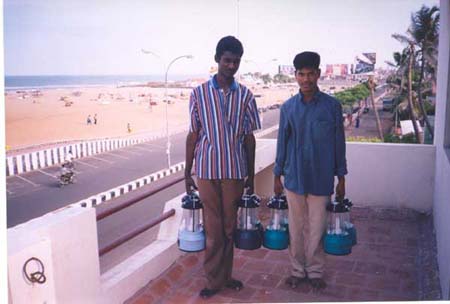
In the event, a niece
of the Chennai sponsor took up the supervision of the project,
and while the first two boys didn't stick it out, the next two
came up trumps. "They're much better businessmen than us," says
Jos admiringly. "They went to the vendors on the beach - who,
as slum-dwellers, were part of the same 'family' - and offered
to rent them solar lanterns for the same price as the vendors
previously paid to hire out Petromax lanterns. Then they increased
the price for weekends and holidays, the really busy times. They
began with one lantern, now they're up to 65!"
The vendors pay a deposit,
then rent the lanterns by the night. Originally the boys brought
the lanterns to the vendors in the evening, then picked them up
late at night, but now the vendors collect the lanterns from the
house where they are charged up by solar panels during the day.
AuroRE chooses and provides the technology - the lanterns, chargers
and solar panels - and also provides a loan for part of the cost
of the equipment (well-wishers have donated the rest).
"Everybody's learned
a lot," says Hemant. "The beach environment is very hostile -
all that sand and wind - but after some initial training the boys
now do all the necessary servicing themselves. They're incredible!
Meanwhile market forces are telling us which is the best lantern
- our initial design was rejected by the vendors because it didn't
give enough light, so we had to come up with a bigger one. It
also emerged that the solar lanterns are 'gender-positive': unlike
the Petromax lanterns, our lanterns can easily be lit by ladies,
thus giving them more independence."
AuroRE plans to expand
the scheme in Chennai. They are also considering introducing it
to Pondicherry street vendors. While Hemant can hardly contain
his enthusiasm it takes a lot to make an economist completely
lose his head. "The key component in all this is the battery,"
he points out. "The batteries in the lights are supposed to last
five years but we just don't know how they will perform. If they
give out in one and a half years, we're definitely making a loss.
If they last three years, we're ahead. And if they hold out for
four years we're going to start issuing shares in this enterprise
to all Aurovilians!" As for the future...Hemant takes a deep breath
and launches out while Jos leans forward, trying to look as if
this isn't new to him too. I see three areas which we'll be involved
in. Firstly, product integration using advanced solar technologies:
in other words, we'll identify the best components then put them
together in an optimized system. We're already working on an improved
solar rice cooker, solar lantern and solar home lighting kit.
Secondly we want to focus much more upon providing renewable energy
services, similar to the experiment in Chennai and particularly
in the area of solar thermal applications. In the long run we
may explore community solar cooking applications on the scale
of our Solar Kitchen. Finally we need to consolidate our experience
of project management, which is the activity which runs everything
else that we're doing at present. "Basically, we'd like to see
our role as a catalytic agent, like the hub of a network. In this
way we could remain small but we'd have the freedom to develop
techniques and applications which would then spread through a
network of suppliers, entrepreneurs, NGOs etc. into India as a
whole."
Why stop at India? I'm
about to ask. But my tape has run out...
|