|
January '03
The project of Sadaca
-
by Rolf
Financing apartment
blocks through loans to be repaid from monthly rents is an option
which is being studied by Auroville's Funds and Assets Management
Committee (FAMC)
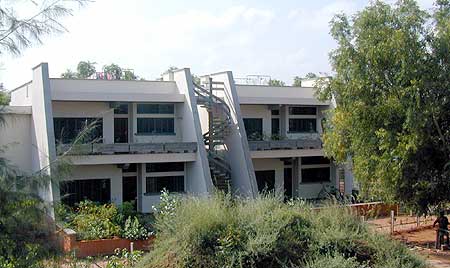
Higher-density buildings are not necessarily an architectural
preference brought upon Auroville by a "capricious"
Master Plan. It might well be a conscious alternative. For sharing
has proven to be beneficial for ecological, economic and social
reasons. Ecologically, sharing results in a more efficient use
of natural resources like land, water and energy. The water consumption
in high-density areas, for example, has proven to be considerable
less than in low-density areas. Collective wastewater treatment
plants can supply all the recycled water which a common garden
would need. Electricity consumption is less as many facilities
such as storerooms and washing machines can be shared.
Economically too, sharing
means saving costs. Large solar hot-water systems are cheaper
than small ones; maintenance expenses of collective infrastructure
are considerable lower; the costs of employees such as gardeners
and watchmen can be shared. Given the present economic situation
of the Central Fund, and the fact that funds available for personal
maintenance are not increasing while there is a constant inflation
in the cost of living, higher density living might become more
and more a necessity.
Last there is the social
aspect of living more closely together. For harmonious living,
one is compelled to take other people's needs into account and
maybe change one's behavior along the way, which may turn out
to be a training in non-egoistic living.
Notwithstanding the
advantages of sharing, apartment buildings are slow to manifest
in Auroville. The basic difficulty of building high-density housing
blocs seems to be financial. The higher the envisaged density
the greater are the complications. The limitations of the present
situation, which allow projects to proceed only by advance cash
from interested persons or from outside donations, considerably
slow down the development of the Residential Zone. It naturally
leads to individually manageable solutions, like building single
houses, as can be observed in the low-density areas. Our experience
with Invocation taught us how difficult it is to find a sufficient
number of people who are willing to advance the money and who
can wait a few years while construction takes place before moving
in. We have experienced that in a project like Arati our own financial
constraints forced us to build only one house divided into two
apartments at a time, for it is easier to pre-finance two than
four or more units.
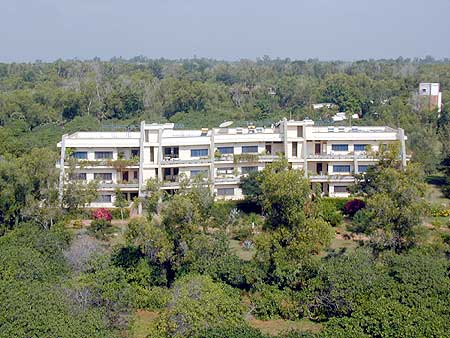
The difficulty of lack
of available housing poses considerable constraints, not only
for Auroville but also for those who want to join. The Newcomers
policy in effect limits the possibilities of joining Auroville
to those who have sufficient funds to make a donation to Auroville
in order to get a place to live; the policy makes it nearly impossible
for people without capital to join Auroville. There is also no
solution offered to newcomers who have not sufficient capital
to build a house, but have only some sort of monthly income. But
this cannot be the last word concerning housing and entry.
It is being argued that
affordable housing is increasingly a matter of fundraising. The
Kailash apartment building is taken as an example, or the Creativity
community which to a large extend depends on outside donations
[see also Auroville Today October 2002]. While fundraising is
doubtless an option to be pursued, the "free" housing
it gives might create psychological or practical "side effects".
Joining Auroville should, we believe, never be an 'easy' commitment
and people who feel the call should be able to stand on their
own feet and therefore to take the responsibility of finding the
means to fully or partially fund their accommodation in Auroville.
Auroville, then, needs
to widen its possibilities and the way it handles housing, without
reducing the individual responsibilities of those who are in need
to find accommodation. One possibility of doing so is by taking
loans from private parties or Auroville units, as well as from
friends of Auroville and supporters of the project. With these
loans apartment buildings can be built, which then can be rented
out against a monthly contribution which is used as loan (and
if applicable, interest) repayment. Alternatively, a unit could
be made available to a new occupant against a donation to Auroville.
The loans should have a one or two year moratorium on loan repayment
and preferably be interest-free, or otherwise given at low-interest
and with deferred interest payment for the first years, as high
interest rates would increase the building costs. The Auroville
unit Sumark has proposed that the Sadaca project near Invocation
be used as an experiment for this approach. Inspired by the Golconde
building of the Sri Aurobindo Ashram, Sadaca will be an apartment
building comprising 9 studios and common facilities in the basement.
The studios would have a carpet area of 37 sq.m. with terraces
surrounding it on two sides. The studios are meant for individuals
who would like to live in Auroville as sadhaks as well as for
long term guests who would like to try and work in Auroville with
an assured domestic base. This proposal is at present being studied
by the Funds and Assets Management Committee, not only on its
financial feasibilities but also in view of the ideals of Auroville.
|