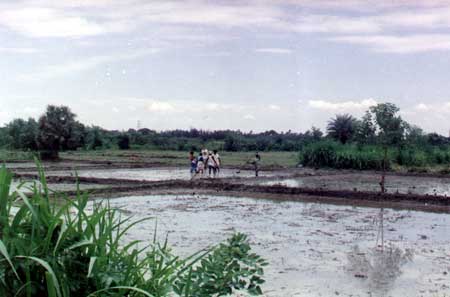
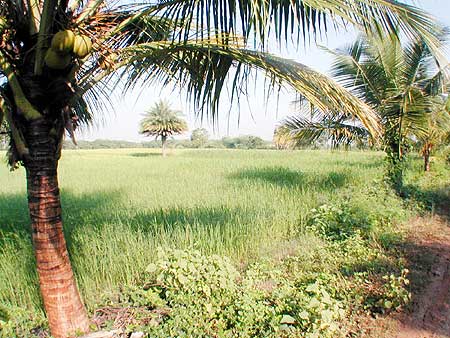
Discipline is a community
situated in the northern greenbelt of Auroville. Like all other
greenbelt communities, it started on bare earth, 27 years ago. Today,
the area is lush. Discipline consists partly of forest, partly of
farmland with a few houses scattered in between.
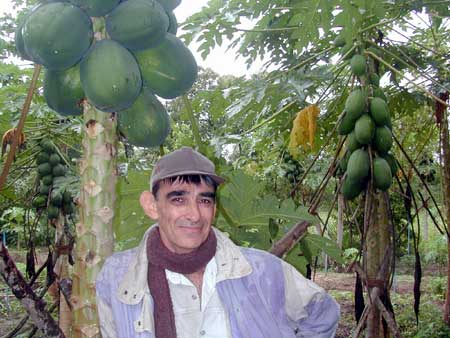
Australian born Jeff is Discipline's farmer. He is responsible for 15
acres of farmland and for a livestock consisting of five cows. "I
joined Auroville in 1982 and started as a teacher. But as things go in
Auroville, at one point there was nobody to take up Discipline farm and
as it needed to be done, I did it. I keep trying to combine it with my
other passions, which are painting and being an actor," he says
cheerfully.
Jeff is also active in
Auroville's Farm Group, which attempts to represent the interests and
needs of Auroville's farms to the community, with increasing success.
"The problem in a nutshell," says Jeff, "is that the
farms' income is insufficient to allow for any substantial investments
in farm development. In fact, many farms run on a shoestring budget, the
income just covers the farms' running expenses. In the best of cases we
break even. Lacking money for investment, the efficiency can't be
improved. It is a vicious cycle, which only can be broken by large
investments from the community or elsewhere. The main part of the farms'
income is generated from product sales. Auroville's Central Fund
contributes towards the personal maintenance of the farmers with a
monthly amount of on average Rs 2,700 per Aurovilian farmer, which is
less than 50% of the true needs. For development work, we depend on
donations from private individuals, from Auroville commercial units or
from outside organizations such as the Dutch Stichting de Zaaier and the
American Foundation for World Education."
Discipline is one of
Auroville's smaller farms. The possibilities to cultivate the land using
a tractor are limited; most of the work is done manually, supervised by
Jeff and by John, a Newcomer from England. The farm employs five men and
three women. The wages paid are slightly above the wages current in the
surrounding villages. Its main products are vegetables - varieties of
beans, cucumbers, pumpkins, squashes, jicama (from Mexico), sweet
potatoes, salads, radishes and yams; a large variety of common fruits
such as chikoo, mango, guava, bullocks heart, papaya, banana and
coconut, and a few uncommon ones such as sour sop, black and white
sapota, and cheese fruit. "I just started to grow passion fruit, a
fruit very rich in vitamin C which is used in fruit juices and for
ice-cream toppings," says Jeff, indicating trellises of neatly
bound passiflora plants. "And I experiment with grafting
techniques, such as grafting tomatoes onto other plants. Other farmers
are engaged in similar experiments to make ends meet. At present, we do
the best we can within our limits. Each farmer uses his or her own
ingenuity to cut costs, experiment with new products and with new
farming methods to increase yields. And we profit from the visit of
individual experts such as Paul, a professional farmer from Holland, who
has farmed in Auroville in the last three years. He helped to develop
farming methods such as the raised-bed farming system, made us aware of
the possibilities of growing additional crops and assisted in many other
ways. The overviews from the Farm Group show that the farms' turnover is
steadily increasing."
Electricity is still a major
expense for Auroville's farms. Though the Tamil Nadu government gives
free electricity to farmers in Tamil Nadu, this doesn't benefit
Auroville's farms. The Auroville Foundation has been classified as
'institutional' and pays the highest rate. However, a change seems to be
in the air, which would classify the Auroville Foundation as an
educational institution and consequently lower the farms' electricity
bills. While most farmers would breathe a sigh of relief, for Discipline
farm it matters little. It is not connected to the local grid and uses a
diesel generator to irrigate the crops. "We tried solar pumps, but
they were not efficient enough. We also installed a drip irrigation
system and a pipe system to distribute cow-urine water to the vegetable
gardens. But the present water situation is insufficient," says
Jeff. "Our existing well needs to be deepened, even a new well may
be required. The 2001 winter monsoon has largely failed, so we may
expect problems unless there are some out-of-season rains."
Paul's visit brought more
than just individual support. It highlighted the fact that in some farms
the level of professionalism can be increased, and that though the total
farm area covers nearly 350 acres, the farms don't yet make most out of
it because they lack the necessary finances. "We also don't have an
overall Auroville farm picture as yet," says Jeff. "The
farmers meet, we coordinate what each of us grows and where to sell it,
but individual initiatives still determine each farm's development. We
do not have a yearly all-Auroville production and development plan.
That's why the idea to attract an agronomist to study the Auroville farm
scene has been around for quite some time now.
Such a professional would
analyze the farms and Auroville's consumption patterns, identify the
problem areas and make medium and long-term action plans. The farms
would commit themselves to this plan, producing what the community
requires, and the community in turn would assist in obtaining the
necessary funds. Prof. Henk Thomas from the Dutch Stichting de Zaaier
was very interested in getting such a plan made. But we have so far
failed to pull it off."
Donor interest in farm
development has not been lacking though. The total donor support over
the last five years amounted to Rs 73 lakhs (US$ 152,000). Apart from
supporting the personal maintenance of the individual farmers, the
Auroville Central Fund provided help in the form of a contingency and an
emergency electricity fund to a total of Rs. 10 lakhs (US$ 21,000).
Auroville's commercial unit Maroma selected two farms, Anapurna and
Siddhartha, and supported them with a total of Rs 28,5 lakhs (US$
60,000). Apart from these internal sources, other donors also helped
substantially: The Dutch Stichting de Zaaier and the American Foundation
for World Education donated Rs. 12 lakhs (US$ 25,000) each in this
period, and Gateway another 9,5 lakhs (US$ 20,000). "And sometimes
there are individuals who help out," says Jeff. "A few months
ago a private individual from Germany helped us by donating Rs 20,000,
just like that."
Donor interest is a
reflection of an increasing awareness in Auroville that it is necessary
to develop the farm scene. This awareness, however, does not translate
into the willingness, let alone the ability, to purchase the Auroville
farms' products at their real costs. Though the Auroville farms are
unable to meet the internal Auroville demand, they cannot sell the
products at the prices required. Says Jeff: "If a subsistence
farmer from the neighbourhood grows 20 or 30 bushes of lady's fingers in
his backyard and sells the produce for Rs 5/kilo, we can't charge Rs 15
or Rs 20 to Auroville's sales outlet Pour Tous. Equally, we have to
compete with products that are grown on a large scale outside Auroville
using fertilizer and pesticides. Only one Auroville farm, Auro-Orchard
managed by Gerard, uses pesticides, and that to a very limited extent.
All the other farms are 'organic'. As we all know, 'organic' implies
lower turnover due to non-use of chemical fertilizers and insecticides.
In Europe, consumers willingly pay two or three times more for
organically grown vegetables and fruits. But in Auroville, we can't
charge what we would need." The main buyers of the farms' products
are the Solar Kitchen, Pour Tous, Vinod's stall in Kottakarai and the
food-processing units KOFPU and Naturallement. The Auroville restaurants
don't buy much from Auroville's farms.
"Over the last years
the situation has improved," concludes Jeff, "but it is far
from enough. If the community seriously wants to manifest The Mother's
ideal of food self-sufficiency, it will have to develop a long-term farm
policy and make even more substantial subsidies available."