|
Jan 2002
The Vedantangal bird sanctuary
- by Kireet (Gerard Jak)
Ninety kilometres northwest
of Auroville one finds an international community of a different type:
The Vedantangal bird sanctuary, a swampy area where over 40,000 birds of
different feathers have literally flocked together. But this is not a
stable community. The main breeding season is from November till March,
the high season is in December and January. After March most birds will
have migrated to cooler wetlands in Northern India, though some of them
will fly as far as Turkey, Iran or Russia.
The best time to see the
birds is shortly after sunrise. So off we set for an early motorbike
ride, bravely defying the cold. The sun had just risen, casting a soft
orange glow on the still misty landscape. Half an hour later the mist
had gone and we enjoyed the fresh green of the paddy fields. Another
hour later we stretched our backs and warmed our hands holding cups of
sweet hot tea from the local tea stall. Then it was bird watching time.
I had visited Vedantangal
before, during a seed-collecting trip outside the season. That was a
silent time and I saw only a few birds. Now an almost deafening noise
produced by thousands of birds greeted us when we mounted the banks that
surround the swamp. There was so much activity going on that it was hard
to decide where to look first. We saw cormorants, egrets, storks,
ibises, herons, spoonbills, pelicans, grebes and many other birds taking
off and landing, nesting in the water-rooted trees, diving for fish or
having a brawl with their neighbour. My expectations were far surpassed.
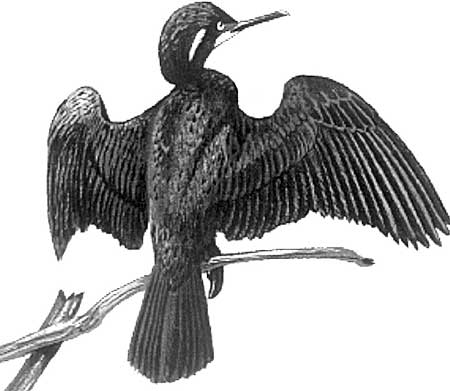
The cormorants are the
busiest birds, flying non-stop and making spectacular dives to catch
fish. As they are good underwater swimmers, it is difficult to predict
where they will pop up next. Once feeding time is over, they perch
upright on a stake near the water, drying their outstretched wings. In
the past people used to tame them for commercial fishing. Happily, this
practice has stopped.
There are also many
varieties of herons around. I see the grey heron, the cattle egret, the
large and the little egret. The cattle egret, as its name suggest, is a
welcome visitor for cows and water buffalos. You see them sitting on
their backs, eating their ticks and the insects that fly up from the
grass when they move around. The little egret is also found in
Auroville, fishing in the ponds and ant-channels around the houses. The
white feathers of this bird, in particular the ornamental dorsal plumes
called 'aigrettes,' were highly fashionable at one time, which nearly
caused the bird's extinction. But the fashion changed, the trade has
become illegal and the bird is no longer endangered.
High above we see storks
drifting easily on thermals. They have not come to breed, but are here
on winter holidays and will eventually return to northern Europe. They
give me the impression of being proud birds, looking down
condescendingly on the swarms below. A pelican swims by, sifting fish
from the water with its large beak, collecting it for the little
nestlings in its expandable pouch. Most interesting are the spoonbills,
truly the punks of the area with their strangely formed beaks and spiky
head feathers. They wade through the swamp continuously, moving their
beaks non-stop in the muddy waters, raking up the bottom mud with the
tip of the lower mandible, catching small tadpoles, frogs, molluscs,
insects and vegetable matter.
That this bird sanctuary
still exists has a lot to do with the beneficial effect it has on the
surrounding farmlands. Thousands of birds produce a lot of guano, and
the water from the swamp is channeled to the paddy fields. This water
not only contains a natural fertilizer, but it also dispends with the
need to use chemical pesticides. The farmers, who enjoy a rich paddy
yield at comparatively low costs, convinced the authorities to declare
Vedantangal the protected nature reserve area it is today. Bird lovers
cannot thank Mother Nature enough for having created this eco-system
where man and bird can live together in harmony.
|