|
May 2003
Auroville employees have their say
- from an interview by Carel
The report on the
socio-economic survey of 3,762 Auroville employees made in the
year 2000 is reaching completion. There are some surprises...
From February to July
2000, a team of postgraduates in social science from Pondicherry
University surveyed all of Auroville's employees, meaning those
working for Auroville's units as well as those working for individual
Aurovilians. The objective of the survey was to obtain a socio-economic
profile of the employees in Auroville and to learn about the dynamics
between Auroville and the villages that surround it. The questions
asked delved deeply into the personal lives of the workers: they
dealt with their income, their education, their food, their expectations
for their children in terms of education and career, their domestic
water supply and waste treatment, whether they own a house or
land, whether they own a car, a tractor or a motorbike, what they
are short of, if there are debts, and what they think about Auroville
and their relationship to Auroville. Also data on alcohol consumption,
smoking, and the expenditure on occasions like weddings and festivals
were collected.
The data is not only
useful for present planning, but will also be compared with data
to be collected in the future-there are plans to repeat the survey
every seven years-as a means to gauge the overall impact of Auroville
on the bioregion. The answers of the employees also provide an
insight about the living conditions of their spouses and children
and other relatives living in the household.
The idea for the survey
came from Meenakshi more than eight years ago, but there was no
money to do it then. In 1999 the Dutch Foundation, Stichting de
Zanier, decided to sponsor it. Auroville's Social Research Centre
took charge of the work and invited the co-operation of Professor
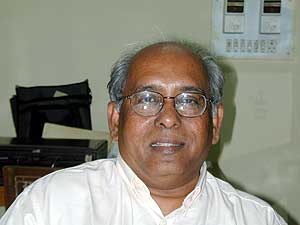
S. Gunasekaran, a specialist in demography, family formation and
research methodology, who had worked, among other positions, as
a consultant for the World Health Organisation before becoming
Head of the Department of Sociology of the Pondicherry University.
Professor Gunasekaran selected and trained a number of social
science postgraduates to do the survey. Then, for about five months,
they went out and interviewed almost every person employed in
Auroville. They were well received. Nearly all Auroville units
and Aurovilians co-operated and the employees themselves were
very open to answering the questions. From a total of 4,179 persons
approached, only 58 refused to participate.
The
next phase was to process the enormous amount of data that resulted
from the survey. This was done by Professor Gunasekaran and two
of his postgraduates. Unfortunately, Professor Gunasekaran was
then involved in a traffic accident which resulted in the death
of his wife and serious injuries to himself, and the publication
of the report has been delayed because of this.
"Our
first job was to find out who, from among the respondents was
truly an Auroville employee. Eventually we came to a number of
3,762 persons employed in the period February - July 2000. The
other interviewees were only incidentally working for Auroville.
From these 3,762 people, 33% said they were employed permanently,
50% replied that they were employed temporary but full-time, 14%
did not know their status, 2% were contract workers and 1% was
working part-time. We found that the average age of those working
in Auroville is young: 29.7 years. When we looked at the wages
paid, we were amazed that they were lower than we had expected.
The average income was Rs 1,545 a month. The total amount spent
by Auroville on wages was about Rs 57.6 lakhs a month and we found
that the 10% of the employees in the highest income bracket took
approximately 23% of the total wages, while the 25% in the lowest
income bracket took only 10%. This points to a lopsided distribution.
We had thought that Auroville employees are well off; they dress
well and are obviously aware of different patterns of consumption.
But the data collected did not support our impression."
Professor
Gunasekaran is quick to point out, however, that the outcome of
this particular part of the survey has to be taken with a pinch
of salt. He explains: "We have not compared the level of
the wages quoted by the employees with the figures of the employers.
The survey is purely based on the replies of the employees. And
you can never expect, when doing a social survey, that all the
answers will be in accordance with the truth, especially when
you ask sensitive questions such as how much one earns, how much
alcohol one consumes and so on. Another important factor to consider
is the nature of the relationship between the interviewee and
the interviewer. In this case, the social status of the interviewee
was lower than that of the post-graduate interviewer, and this
more often than not leads to what we call 'social desirability
responses' which are not truthful but are what the interviewee
thinks the interviewer wants to hear.
A
third factor may have been that the interviews took place during
working hours. There was a 99% response to the survey. Did this
indicate that the employees thought their bosses wanted them to
answer the questions? In the West, a 30% response could be expected.
It was also reported that in some cases the interviewee seemed
a bit afraid to answer the questions, in particular when the employer
was around, and that some respondents were rather secretive about
their feelings regarding their work in Auroville.
'Approximately
28% of the interviewees answered that they were dissatisfied with
their salary. Why should so many employees be dissatisfied with
their salary? "I think," says Professor Gunasekaran,
"that it is a consequence of the fact that those working
for Auroville are confronted daily with the vastly different life
styles of the Aurovilians. They have become aware of the difference
in consumption patterns, which may breed some type of perceptions
that, relative to the Aurovilians, they are not getting adequate
compensation for their work. The same goes for the level of productivity.
A mason in Pondicherry may put more bricks than his colleague
in Auroville, but then the Pondicherry mason will not compare
his working hours with those of the Aurovilians."
The
survey does not show to what extent Auroville influences the lives
of those living in the nearby villages. Says Professor Gunasekaran:
"We could only answer such a question if we could compare
our data with data collected elsewhere where conditions are more
or less similar. But this data is simply not available. This survey
is unique in India as it contains a lot of subjective, so-called
'soft' data - such as 'are you happy with your employer?' - which
is extremely difficult to get. It is rare to have in India so
much information available about so many families. This means
that my report will be written in phases. The first report will
give the bare data; further reports will deal with specific aspects
of the survey. I can also foresee that many PhD. studies could
result from this baseline study. This survey is a veritable gold
mine for future researchers as areas of sociology, economics,
demography, nutrition, to mention but a few, are all touched upon.
The data will be made available to any researcher approved by
a committee appointed by the Auroville Social Research Centre.
My report will be made available in the next few months."
|