|
May 2003
Sound Investment
- by Abha Prakash
Auroville's first music complex about to
open its doors
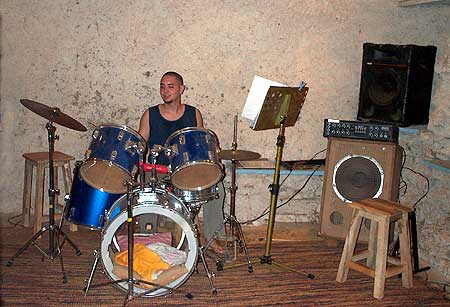
Kalabhumi's old music
studio will soon be defunct. The new music complex which combines
studio facilities with high-tech acoustically engineered performance
space is due to reach completion in July and will replace the
underground generator room which had been functioning as the makeshift
(and noisy) studio for the past several years.
The idea for a new studio
materialized when Franco, an Aurovilian from Italy, as the executive
of Mereville Trust gave twenty lakh rupees (approximately 40,000
euros) in donation for the project. Convinced that "Music
could draw people together in a way more congenial than any usual
meeting or political issue," Franco wanted to offer Aurovilians
an open-air auditorium for the enjoyment of music concerts or
any other artistic performance and, at the same time, give Aurovilian
musicians a decent place to practise and perform. The idea was
welcomed and supported by all, particularly the Cultural Zone
Group and the residents of Kalabhumi, a community dedicated to
the arts, who will participate in the management of the complex
once it starts functioning. Given his dedication to music, a young
Kalabhumi resident, Matthew, has been appointed caretaker of the
studio, with the support of Rolf, another resident musician.
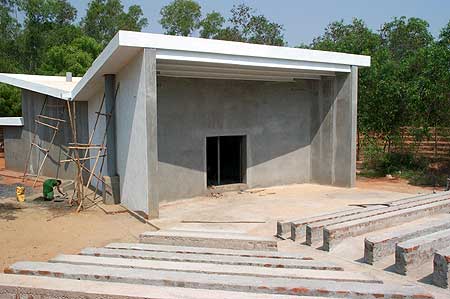
The first sound-proof
building of its kind in Auroville, the Kalabhumi music complex's
spacious interior consists of a music studio for rehearsals, a
dressing room, and an equipment storage room. From a practical
point of view, the complex is innovative in its design and concept.
By merely swinging open the twin doors at the back of the studio,
musicians can enter a partially-covered stage facing an amphitheatre
capable of seating almost 500 people. The transport of music equipment
to performance locations that had been a bothersome and sometimes
dangerous proposition in the past can now be safely avoided. Weatherwise
too, the hall is versatile. During the monsoon, for instance,
the wood-floored indoor space can be used as a small auditorium
with a seating capacity of 150 people. While most activities at
the hall will be music-related, the amphitheatre could also be
used for staging dance performances, theatre, movies, and art
exhibitions. Needless to say, visiting artists and guest musicians
in Auroville would greatly benefit from the range of opportunities
and facilities that the Kalabhumi music complex will offer.
Planned by architect
Paolo Tommasi, and Didier, the sound engineer, the project aims
to enter its second phase if finances allow. This part of the
project will focus on a video-audio library exclusively relating
to music, and a cafeteria that would, among other things, provide
an informal social platform for musicians of all ages and backgrounds.
The aesthetic landscaping of the surrounding area will be carried
out as soon as the first phase of the complex is ready.
But does the quaint
old music studio with its rugged floors and graffiti-strewn walls
really have to go? Matthia, a young drummer, strongly hopes not.
For teenage Aurovilian musicians, the small, sunless studio, despite
its humidity, is like their second home, a place where they hang
out and practise. Furthermore, if the old studio is allowed to
go on, more than one musical band could practice at any given
time. On the other hand, the outward structure of the old studio
badly needs a face-lift, and internally too, it is not wholly
suitable for maintaining the condition of delicate musical instruments.
The final decision regarding the fate of the
old studio lies with the Kalabhumi residents themselves. Possibly
the two studios, a stone's throw from each other, will coexist and
jointly benefit Auroville's diverse music fraternity.
|