|
November 01
Secretary departs
"We will miss you"
- interview by Carel
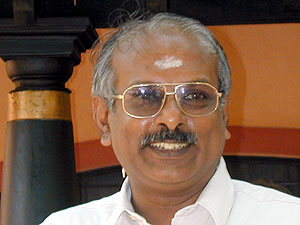
Mr. N. Bala Baskar
I.A.S. has been the Secretary of the Auroville Foundation since October
24th,1996. His original term of office was three years, it has been
extended twice. How was his experience as senior civil servant working
in the Auroville atmosphere?
AVToday: Mr. Bala
Baskar, you are known to have strong views about what's happening in
Auroville and how it could happen better…
Mr. Bala Baskar: Yes,
like every Aurovilian I also have strong views on many things…
AVToday: ...but what
is remarkable is that you have never chosen to impose those views. Why
didn't you do it?
Mr. Bala Baskar: For
two reasons. One is that the Auroville Foundation Act does not envisage
that anything should be imposed either by the Secretary or the Governing
Board. The other is a purely pragmatic reason. If you want to effect a
change in the administrative functioning, it never helps to impose it
all of a sudden, it has to be introduced slowly for the same to be
accepted. I think that I have achieved many things in this fashion
rather than dictating the ways in which something has to be done.
AVToday: Can you give
an example?
Mr. Bala Baskar:
Take the recommendations for the issuing of visas. The Government
had written that visa recommendation should not be issued by the
Auroville community through its Visa Service. The Auroville community
felt very strongly that it should be sending the recommendations
and that it should not be left to the Foundation. It took a long
time to convince them, but when they saw that things were working
out well, they no longer had any reason for objections. This has
resulted in a very smooth cooperation: the visa service sends
me a recommendation letter on the basis of which I return them
my recommendation. It happens that we disagree at times, and in
those cases there is a dialogue and I explain the reasons. It
has worked out beautifully.
Similarly, I have been
working on a system to replace that much objected-to Office Order
# 5. It has become clear to all that some type of document is
necessary to transfer authority from the Foundation to the units
and trusts. We have created a large number of pretty independent
trusts, and some of these trusts have a large number of units.
But there is not much of a connection between the units and the
trustees. The units have been grouped under the trusts for reasons
of administrative expediency, the unit executives function independently
from the trustees and the trustees in fact prefer not to take
responsibility for the units, their ways of functioning or their
losses. But some way of assigning responsibility needs to be found,
so in the Funds and Assets Management Group (FAMC) we are working
to find a solution for the problem, taking into account all perspectives
as well as the legal necessities.
AVToday: Contrary to
your predecessors, you have had a regular interaction with Aurovilians
by your participation in the FAMC. How did you experience those
meetings?
Mr. Bala Baskar: I
see the FAMC meetings as important occasions for interaction with
representatives of many working groups. I think this interaction has
been beneficial for both sides, for us to better understand the
difficulty the community faces, and for them to get instant feedback
from us, including our assessment of possible outside responses to the
problem. We have been able to solve or anticipate many problems across
the table. It has become an essential point for interaction for us as
well as for the Aurovilians.
AVToday: You have
always stressed on the need for the community to get itself organised...
Mr. Bala Baskar: The
community, in fact, has a lot of power. But unless there is some kind of
framework in which this power is exercised, it will remain difficult for
the community to assert its will. Some framework of regulations is
necessary. Someone who wants to have a decision taken should know that
framework. Clarity should be there for each individual. The absence of a
framework will lead to mistrust and to people seeking other ways to
solve their problems such as contacting me as Secretary with the request
that I intervene in a situation. Very often I had to tell people that it
is not my role to take this kind of decision. Other instances are when
representatives of working groups come and ask me to act on their
behalf. My question is always: "How am I to know that their
decision is in accordance with the will of the community expressed in a
resolution of the Residents' Assembly of Auroville?"
So I feel very strongly that
a framework is necessary for Auroville's own good. Some individuals
think that rules imply a limitation of individual freedom. But
individual freedom is completely compatible with a set of rules laid
down for the community, and I have the impression that an increasing
number of Aurovilians already agree with this view. The work done by the
Unity Committee with their so-called 'Divine Anarchy' document
describing such a potential framework shows that there is more
acceptance. I do feel that a Divine nature can certainly sustain
anarchy. But I do not quite see how an anarchic nature can lead one to
the Divine. That is perhaps why Mother put 'Divine' before 'anarchy'.
AVToday: When you
first talked about the need for regulations, you stressed that without
them the Government would never step out of Auroville. Do you consider
the Government stepping out of Auroville as feasible and desirable?
Mr. Bala Baskar: I
think it is feasible, though it won't be very easy. You would have to
give intimation to the government that you are capable of managing
everything on your own, and that point you haven't yet reached.
But I doubt whether it would
be beneficial for Auroville at the present moment. The presence of the
government gives many types of protection and facilitates many things,
which you may not realise. Without the governmental umbrella, the
Auroville Foundation may find it difficult to get exemption from paying
income tax, for example. Instead, Auroville
should look at the present situation as a tool for progress. For
example, Auroville hardly made any use of the goodwill of the members of
the various Governing Boards and International Advisory Councils to
further Auroville's cause. Dr. Swaminathan, the previous Chairman of the
Governing Board, for instance, was ready to find donors for Auroville's
projects and he gave many hints to people in this direction. But except
for the two earth movers which were donated to Water Harvest, in my view
his offers went mostly unattended.
AVToday: You have a
certain double function, being both Secretary of the Auroville
Foundation as well as representative of the Government of India in
Auroville.
Mr. Bala Baskar: Yes,
that double function is there. The Governing Board of the Auroville
Foundation is not really the agency for deciding on visa matters and in
these cases I deal with the immigration officers.
In some cases Aurovilians
themselves came to give me information about somebody considered
undesirable, which information I took into account to decide on the
matter. In some cases I have told the person concerned as well as the
Auroville visa service about my reservations or objections. There was
never any need for secrecy about these things between the Secretary and
the Visa Service.
AVToday: When
you came in 1996, there was the unhappy situation that a few Aurovilians
had received Leave India notices and as of today one person has
not yet returned. You yourself have worked hard to solve these
matters. Do you see any general improvement?
Mr. Bala Baskar: No,
not really. The government has certainly not taken the view that
Aurovilians have a right to any different treatment. India doesn't have
a green card system such as the USA, and the Aurovilians who happen to
be foreign nationals are only residents of India, not its citizens.
If a foreigner is insecure
about the possibility to continue living in Auroville, he or she should
apply for Indian citizenship. Not many Aurovilians have done that. My
office has issued only two recommendation letters so far for someone to
acquire Indian citizenship. There is also a possibility for persons who
are born in India to apply for Indian citizenship. But this implies that
one loses one's nationality, as India doesn't recognise the right to
have a dual nationality.
AVToday: The
community has always refused to create a so-called 'exit-group' which
could expel Aurovilians. Are you in favour of such a group?
Mr. Bala Baskar: How
can I not be in favor? The Auroville Foundation Act describes
specifically that the Residents' Assembly has the power to terminate
persons in the Register of Residents in accordance with regulations made
by the Governing Board. At present you have no such regulations in place
and you depend on the government to evict a person by recalling his or
her residential permit or visa. And how do you evict Indian people? You
need a regulation even if you want to expel a person temporarily.
AVToday: You have
repeatedly told us that in certain circles of the Government of India,
Auroville still has a bad name.
Mr. Bala Baskar: Yes, that is sadly true. It has already changed in many
areas, but negativity about Auroville is still prevalent.. It is a relic
from the past, from the fights with the Sri Aurobindo Society. The
Society has a large network of associations of India, and I do not think
they ever bothered to create a good image of Auroville. Dr. Kireet Joshi
is very aware of this and has been fighting a lone battle against this
for a very long time. Not too many people have come to see for
themselves the reality of Auroville as it has been developing. Many
continue in their negative impression of the past. But some change has
taken place over the years.
AVToday: What would
you advise Auroville does to improve its image?
Mr. Bala Baskar:
Auroville has to do a vast public relation exercise. For example,
Auroville is not very good in hosting important people and does not
create any occasion for those people to come. In India, you just cannot
invite a VIP for a visit and a cup of tea, there must be a formal kind
of occasion: organise a conference and ask them to give a lecture, or
inaugurate something. Auroville seems to find it difficult to do that
kind of thing. And it is not a question of money. Money for these things
can always be found.
AVToday: When you
came in 1996, you mentioned that you had a Saivite [connected to the god
Shiva, eds.] background. Now you have been exposed for five years to an
atmopshere that is based on the teachings of Sri Aurobindo and The
Mother. Has it changed your views?
Mr. Bala Baskar: It
has certainly widened my views. Working in the Auroville atmosphere was
a complete novelty. I doubt very much if I will ever be working in such
an atmosphere again. These five years have changed a lot of things for
my family and myself. When we came, we had just lost our eldest son, and
we went through a period of depression. Gradually we got acclimatized to
Auroville, my younger son went to school in Auroville - though my wife
and I had some initial misgivings about that - and we made friends. It
was a very enriching experience, we came to know many wonderful people.
Though my son has lost a year by going to school in Auroville, the
experience has been very good in general, for all of us. And as is the
case for my kind of people, just when we are nicely settling in, we are
posted again somewhere else. That's a pity.
AVToday: Do you know
what the future is going to bring to you?
Mr. Bala Baskar: No, I still have nine more years to go
before my retirement. I hope I will get a posting with the Government
of India once again. .
AVToday: I think the
community will miss you.
Mr. Bala Baskar: We will miss the community also but we
hope to be visiting often.
|